
Spain Puts €1.019bn Behind An AI Gigafactory With A Private Majority
Spain's AI gigafactory company is 51.01% privately held while €719m enters through SETT and another €300m supports EuroHPC infrastructure outside its cap table.
On this page
Conduct your own private market research
Add dossaro to Claude or ChatGPT and run source-backed register research from your own workspace.
 Add to Claude
 Add to ChatGPT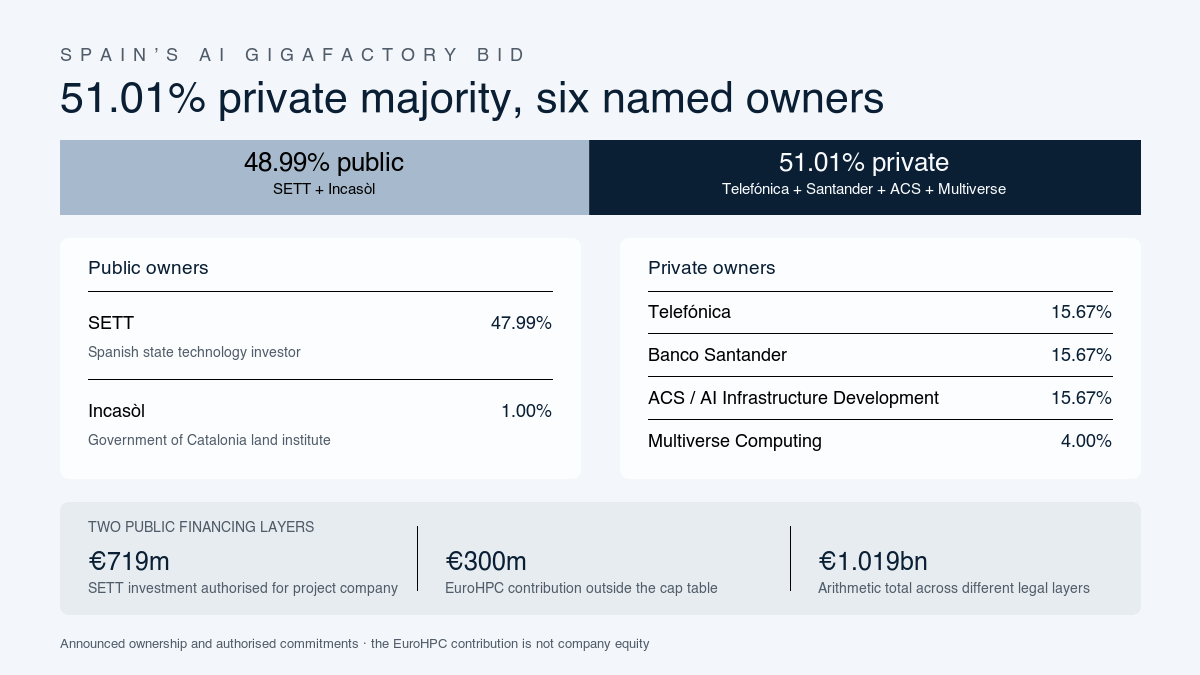
Spain's artificial-intelligence gigafactory company gives private partners a 51.01% majority while public institutions commit money through two separate layers. The Spanish government authorised €719 million through its state technology investor for the project company. It also committed €300 million to Europe's shared high-performance-computing body for artificial-intelligence infrastructure and related initiatives.
The two public commitments sum to €1.019 billion. They are not the same instrument. The first sits at the Spanish consortium or company level. The second goes to the European High Performance Computing Joint Undertaking, known as EuroHPC, outside the company's cap table.
That split is the central economic finding. The ownership chart is almost evenly divided between public and private shareholders, but the visible public de-risking extends beyond the shares held by the state.
Six Owners Split The Company Almost Down The Middle
La Moncloa names all six shareholders. The Spanish Society for Technological Transformation (SETT) holds 47.99%, and Catalonia holds 1% through its land institute Incasòl. Telefónica, ACS and Banco Santander each hold 15.67%. Multiverse Computing holds the remaining 4%.
| Announced shareholder | Role | Ownership |
|---|---|---|
| SETT | Spanish state technology investor | 47.99% |
| Incasòl | Government of Catalonia land institute | 1.00% |
| Telefónica | Telecommunications partner | 15.67% |
| Banco Santander | Banking partner | 15.67% |
| ACS / AI Infrastructure Development | Infrastructure partner | 15.67% |
| Multiverse Computing | Artificial-intelligence technology partner | 4.00% |
| Public shareholders combined | SETT plus Incasòl | 48.99% |
| Private shareholders combined | Four corporate partners | 51.01% |
The private majority is narrow but exact on the announced percentages. Telefónica, Santander and ACS together own 47.01%. Multiverse lifts that block to 51.01%.
The table establishes ownership, not operational control. The company's articles, board composition and shareholder agreement have not been published in the sources used here. A 51.01% economic majority can still sit alongside public vetoes, reserved matters or governance rights. None of those should be inferred without the documents.
The structure nevertheless gives the four private partners company-level exposure to a project that Spain describes as strategic infrastructure. Their positions can provide more than financial upside. Telefónica brings connectivity, ACS infrastructure delivery, Santander finance and Multiverse specialised artificial-intelligence technology. The exact commercial agreements between them and the company remain undisclosed.
€300 Million Sits Outside The Cap Table
Spain's Ministry for Digital Transformation authorised €719 million through SETT on 16 June. The ministry described the operation as an investment in the public-private consortium that would submit Spain's bid.
Spain separately committed €300 million to EuroHPC. The European legal text says the contribution may finance an artificial-intelligence gigafactory or equivalent infrastructure and quantum-technology initiatives in the European Union.
| Public financing layer | Announced amount | Legal destination | What it does not establish |
|---|---|---|---|
| SETT investment | €719m | Spanish project consortium or company | Completed disbursement or price per share |
| EuroHPC contribution | €300m | European High Performance Computing Joint Undertaking | Additional ownership in the Spanish company |
| Arithmetic total | €1.019bn | Two different public layers | Company valuation or quantified loss exposure |
| Wider project ambition | Up to €5bn | Expected investment mobilisation | Closed or committed financing |
The arithmetic total is useful because it shows the public footprint. It must not be mistaken for the company's valuation. Nor does it prove that the entire EuroHPC contribution will flow to this Spanish bid. The European text allows the money to support a gigafactory or equivalent infrastructure and quantum initiatives.
The distinction changes the financing question. A cap table measures who owns the project company. It does not capture every grant, contribution, shared facility or access arrangement that can lower the cost and risk of building the infrastructure.
A Private Majority Can Still Be Publicly De-Risked
The European Commission describes artificial-intelligence gigafactories as private-led infrastructure supported by European and national public funding. Its stated objective is to crowd in private investment while expanding Europe's capacity to train and operate advanced models.
Spain's structure fits that design. Industry and finance partners hold a company-level majority. Public institutions supply almost half of the announced equity ownership and commitments at both the company and European-infrastructure layers.
That allocation can make sense commercially. Computing infrastructure requires sites, energy, connectivity, hardware, financing and customers at a scale that few single companies can assemble. Public capital can absorb strategic-development risk and require broader access. Private partners can contribute execution capability and use the facility commercially.
The unanswered issue is whether the rights match the risk. The public percentages and headline commitments do not disclose what each shareholder contributes, how profits or capacity are allocated, who appoints directors, or which decisions require state consent.
For private-market readers, this is more consequential than a simple public-versus-private label. A partner can own 15.67% while also supplying infrastructure, financing or connectivity under separate contracts. Those commercial relationships can determine where the project's margin pool sits even when the equity percentages are clear.
Multiverse Owns 4% And Supplies The Technology Link
Multiverse Computing is the smallest named private shareholder at 4%, but its position connects the project company to a Spanish artificial-intelligence business that already has substantial state backing.
Dossaro's earlier analysis showed that SETT committed up to €166.2 million across two Multiverse financing rounds and placed its monitoring director on the company's board. Multiverse now appears on both sides of Spain's sovereign-computing strategy: as a recipient of public investment and as a private shareholder and technology partner in the gigafactory bid.
| Multiverse position | Public fact | Commercial relevance |
|---|---|---|
| Project-company shareholder | 4% announced holding | Adds the final four points to the 51.01% private majority |
| Technology partner | Named by the consortium and Moncloa | Connects the facility to model-compression and AI software capability |
| SETT-backed company | Up to €166.2m disclosed across two rounds | Shows repeated state support around the same technology ecosystem |
This does not prove that Multiverse controls procurement or receives preferential access. It shows a deliberate alignment: the state backs Multiverse directly and includes it as an owner in a larger computing-infrastructure project.
The combination can accelerate commercial adoption if Multiverse's software helps customers use expensive computing capacity more efficiently. It can also make the eventual shareholder and supply agreements important for anyone assessing related-party economics and competitive access.
The Bid Still Has To Become A Legal And Financial Close
The Spanish project proposes sites in Móra la Nova, Tarragona, and San Fernando de Henares, Madrid. The European programme is intended to select and support several very large computing facilities. Independent El País coverage reported that the formal selection process opened on 30 July.
| Date | Event | What became visible |
|---|---|---|
| 16 June 2026 | Government authorised €719m through SETT | Direct public investment layer |
| 1 July 2026 | Moncloa published the six-holder split | 51.01% private and 48.99% public ownership |
| 30 July 2026 | European selection process opened | Bid moved into competitive project selection |
| 2027 onward | First European gigafactory construction targeted | Execution and funding milestones become decisive |
An authorised investment is not the same as paid-in cash, and an announced ownership split is not a complete subscription schedule. The next legal documents need to connect the percentages to actual contributions.
The Spanish company-publication workflow should eventually expose the formation entry, articles and later capital events once the project company is indexed. Those records can establish the exact legal identity and nominal capital. They may still need to be paired with the shareholder agreement and SETT investment resolution to explain governance and economic rights.
The Shareholder Agreement Will Decide The Real Balance
The announced structure already answers who sits in the company: SETT, Incasòl, Telefónica, Santander, ACS and Multiverse Computing. It also shows that private partners collectively hold the majority.
The financing record answers a different question. Spain has authorised €719 million at the project layer and committed €300 million at the EuroHPC layer. Public support therefore reaches beyond the state's 48.99% announced ownership.
What comes next will decide whether capital, control and commercial access follow the same split. The formation documents should show the company's legal base. The subscription schedule should price each owner's position. The shareholder agreement should allocate board seats and reserved matters. The EuroHPC agreement should show what part of the €300 million supports this bid and on what terms.
Until those documents arrive, the strongest conclusion is narrower and more useful than a claim about control. Spain's AI gigafactory is designed as a private-majority company whose infrastructure risk is being de-risked through at least two public channels. The ownership list names the beneficiaries of the upside. The next documents must show how closely their contributions match it.
Continue reading
Related Research
Spain Put Its Monitoring Director On Multiverse's Board
Spain committed up to €166.2m to Multiverse Computing across two rounds and placed a SETT monitoring director on its board before the €500m raise.
PaperShell's €40m EU Grant Leaves A €43m Financing Test
PaperShell's signed 2025 annual report links an €83m factory and €40m EU grant to a planned IPO, while private capital must still fund roughly half.
CuspAI's Founders Held 32.61% Before The $450m Series B
CuspAI's founders held 32.61% before its $450m Series B, while UK sovereign capital entered a company whose post-round ownership is not yet public.
QUICKBLOCK's £940k Funding Was Also A Recapitalisation
QUICKBLOCK raised £940,000 after reporting £534,213 of net liabilities. Filings map £638,571 to equity, leaving about £301,429 as implied grants.