
CuspAI's Founders Held 32.61% Before The $450m Series B
CuspAI's founders held 32.61% before its $450m Series B, while UK sovereign capital entered a company whose post-round ownership is not yet public.
On this page
Conduct your own private market research
Add dossaro to Claude or ChatGPT and run source-backed register research from your own workspace.
 Add to Claude
 Add to ChatGPT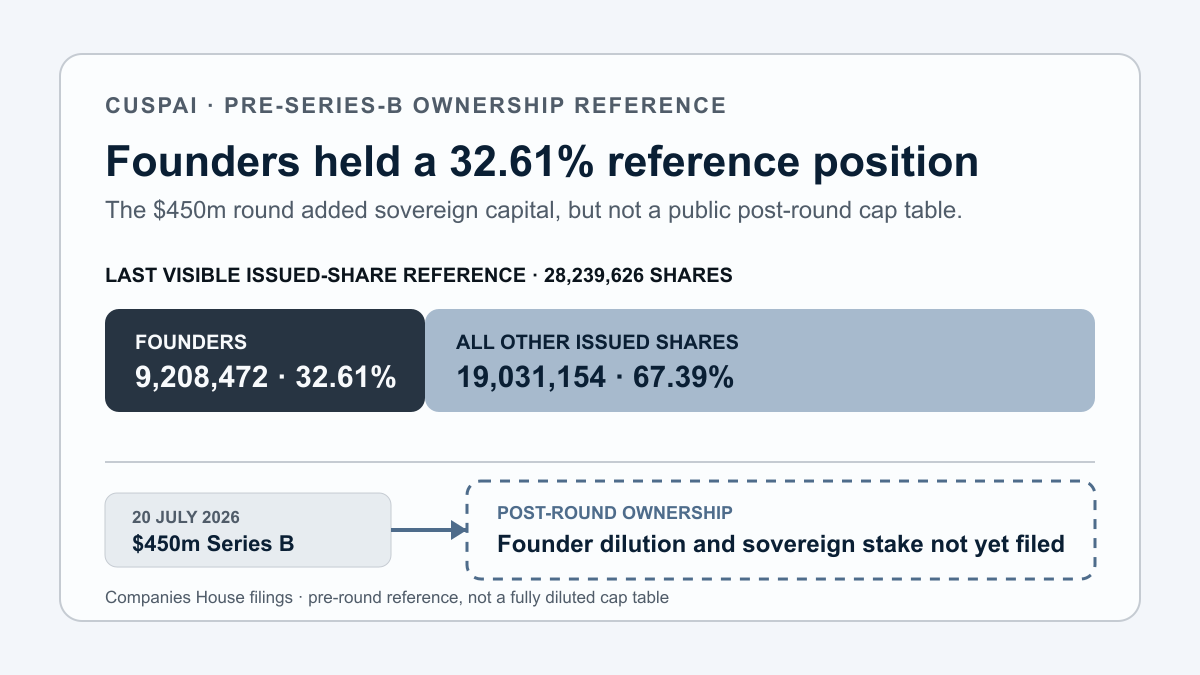
Source record available
CUSP AI LIMITED · 15549537
Open the legal identity and 3 reviewed filings behind this analysis.
CuspAI's two founders held 9,208,472 ordinary shares, equal to a 32.61% reference position in the last visible issued-share state before the company's $450 million Series B. The United Kingdom's Sovereign AI fund then joined a financing that reportedly valued the Cambridge materials-discovery company at $2.6 billion.
The combination is the central economic finding. Public venture capital is entering a company where the founders still had substantial exposure immediately before the round. Yet the public announcement does not say what the state bought, how much it invested or how far the founders diluted.
There is one important timing boundary. The founder holdings come from a confirmation statement made up to 8 March 2026. The 28,239,626-share denominator follows an allotment on 18 March. Using those two filings produces the best visible pre-round reference, but not a synchronized or fully diluted cap table. No reviewed filing yet shows the Series B allocation.
| Last visible pre-round reference | Issued shares | Share of 28,239,626 |
|---|---|---|
| Alyn Chad Edwards | 4,208,472 | 14.90% |
| Max Welling | 5,000,000 | 17.71% |
| Founders combined | 9,208,472 | 32.61% |
| All other issued shares | 19,031,154 | 67.39% |
The table does not claim that Edwards and Welling still own 32.61% today. It establishes the ownership base against which the new sovereign-backed financing should eventually be measured.
The State Joined A $450m Private Financing
Sovereign AI said it invested as part of CuspAI's $450 million Series B. The UK government-backed fund described its mandate as helping British artificial-intelligence companies scale and said CuspAI would use the financing to develop its platform, expand research and bring the technology into industrial applications.
Reuters reported on 20 July that Kleiner Perkins and NEA led the round at a $2.6 billion valuation. Sovereign AI and Bezos Expeditions were among the new investors, alongside Glade Brook Capital Partners, Lux Capital, AMD Ventures and the Netherlands' Invest-NL.
That syndicate gives the round two distinct objectives. Private venture investors are underwriting a large financial outcome. Sovereign investors can also value industrial capability, domestic research and strategic access. Those goals can align, but ownership determines how the upside, influence and downside are divided.
The $450 million headline does not answer that question. Dividing the round by the reported valuation gives 17.31%, but that ratio is not disclosed dilution. It would become an ownership estimate only if the valuation were post-money, the whole round were primary equity at one price and no options, convertibles or secondary shares changed the denominator. The reviewed sources establish none of those conditions.
The Founders' Reference Position Was Still Material
CuspAI was incorporated in March 2024. The March 2026 confirmation statement attributes 4,208,472 ordinary shares to chief executive Alyn Chad Edwards and 5,000,000 to chief technology officer Max Welling. Together, those holdings provide the 9,208,472-share numerator.
Ten days after the confirmation statement's reference date, CuspAI allotted new shares and reported 28,239,626 issued shares. The founders' disclosed ordinary holdings divided by that later total produce the 32.61% reference. It is conservative about what the register can prove and explicit about what it cannot.
| Evidence date | Public filing or event | What it establishes |
|---|---|---|
| 31 March 2025 | First filed accounts | £22.03m cash, £23.29m net assets, £1.11m accumulated loss and 12 average employees |
| 8 March 2026 | Confirmation statement reference date | 9,208,472 ordinary shares attributed to the two founders |
| 18 March 2026 | Share allotment | 28,239,626 issued shares after the allotment |
| 20 July 2026 | Series B reported | $450m round at a reported $2.6bn valuation, including Sovereign AI |
The progression is unusually fast. CuspAI moved from a 12-person average workforce in its first accounts to a financing of global scale little more than a year later. That does not make the 2025 accounts a current operating snapshot. It shows the small base from which investors are funding expansion.
The founder position matters because it preserves direct exposure to the investment thesis. If CuspAI turns artificial intelligence into a repeatable industrial materials-discovery process, a substantial founder holding can produce a very large outcome. It also keeps the founders economically aligned with investors. The unanswered question is how much of that exposure survived the Series B.
A Prior Allotment Already Added £45.66m
The March allotment was itself material. CuspAI issued 2,510,222 Series A3 shares at £18.19 each, implying approximately £45.66 million of cash paid for that class. The filing also shows that the company's capital structure had moved well beyond a simple founder-versus-investor split before the Series B.
| Filed capital evidence | Shares | Price per share | Calculated cash |
|---|---|---|---|
| Series A3 allotment on 18 March 2026 | 2,510,222 | £18.19 | £45.66m |
| Total issued shares after allotment | 28,239,626 | Not uniform | Not a valuation measure |
Nominal and issued-share counts do not translate cleanly into economic ownership when classes carry different rights. CuspAI filed new articles and later variations of class rights in April and May. Preference terms can alter payout order, conversion and voting influence even when two holders own the same number of shares.
This is why the next filing matters more than a simple percentage estimate. A post-Series-B return of allotment would reveal the new class count and consideration. Updated articles would show how the new securities rank. The next confirmation statement could identify major holder positions after the transaction.
Sovereign Capital Adds A Second Return Test
Sovereign AI presents CuspAI as a strategic bet on faster discovery of materials for batteries, semiconductors, carbon capture, manufacturing and pollution removal. The company has also launched an AI Materials Foundry with more than 45 partners, including Nvidia and Meta, according to Reuters.
For the UK, the investment can succeed on more than one axis. A financial return matters, but so can keeping a frontier company headquartered in Cambridge, expanding research capacity and connecting the business to domestic industry. Those benefits do not remove the need to understand the security purchased with public capital.
The same issue appears in Dossaro's analysis of public capital and board influence at Multiverse Computing. A government-backed investor can support a strategic company while the legal terms still determine whether its influence is informational, contractual or economic.
CuspAI's current sources stop before that allocation. Sovereign AI does not disclose its ticket, share class, board rights or ownership percentage. The company does not disclose whether any of the $450 million bought existing shares from founders, employees or earlier investors. There is no basis to describe the financing as a founder cash-out.
That boundary also provides the fair counterposition. Founders retaining a large stake before a growth round is normal and can be desirable. Public venture capital need not dilute them aggressively to pursue a strategic mandate. The state can seek both national capability and financial upside. The missing information is not evidence of a bad bargain; it is the information required to evaluate the bargain.
The Post-Round Filing Will Reveal The Risk Split
Four documents would turn the current reference into a transaction map.
| Next evidence | Decision it would resolve |
|---|---|
| Post-Series-B return of allotment | New share count, class, price and paid consideration |
| Updated articles of association | Preference, conversion, voting and downside rights |
| Next confirmation statement | Founder and major investor positions after the round |
| Sovereign AI allocation disclosure | The state's ticket, ownership and governance exposure |
The first return of allotment is the key watchpoint. It would show whether the $450 million round created a new preferred block and how large that block is relative to the existing 28.24 million shares. It still might not identify every investor, but it would establish the financing's legal scale.
Until that filing arrives, the durable finding is narrower. CuspAI entered its sovereign-backed Series B with founders who represented 32.61% of the last visible pre-round issued-share reference. The state has confirmed that it invested, while its ticket and ownership remain private.
For investors, that leaves a specific question rather than a generic funding story: after $450 million of new capital, how much upside stayed with the founders, how much moved to the new syndicate, and what rights did public money receive in return? Teams reconstructing that answer can use Dossaro's company-register document workflow to preserve the next filings before applying the private-company ownership workflow.
Continue reading
Related Research
Spain Put Its Monitoring Director On Multiverse's Board
Spain committed up to €166.2m to Multiverse Computing across two rounds and placed a SETT monitoring director on its board before the €500m raise.
FINN's €140m Round Shows The Financing Stack Behind A Mobility Unicorn
FINN's 2025 shareholder lists show a 17.2% wider share base, Planet First's 18.8% block and a new Picus vehicle before the €140m Series D round.
Nuclear Turbines Founders Held 57.6% Before £15m Reveal
Nuclear Turbines announced £15m, while its latest register shows founders at 57.6%, IQ Capital at 15.4% and about £6.2m of cash equity filed.
Greyparrot's Series B Shifts A Sub-£120m Sale Shortfall To Founders
Greyparrot's filed terms protect Series B as if a founder-led sale valued the company at £120m, with any shortfall deducted from founder proceeds.