
Greyparrot's Series B Shifts A Sub-£120m Sale Shortfall To Founders
Greyparrot's filed terms protect Series B as if a founder-led sale valued the company at £120m, with any shortfall deducted from founder proceeds.
On this page
Conduct your own private market research
Add dossaro to Claude or ChatGPT and run source-backed register research from your own workspace.
 Add to Claude
 Add to ChatGPT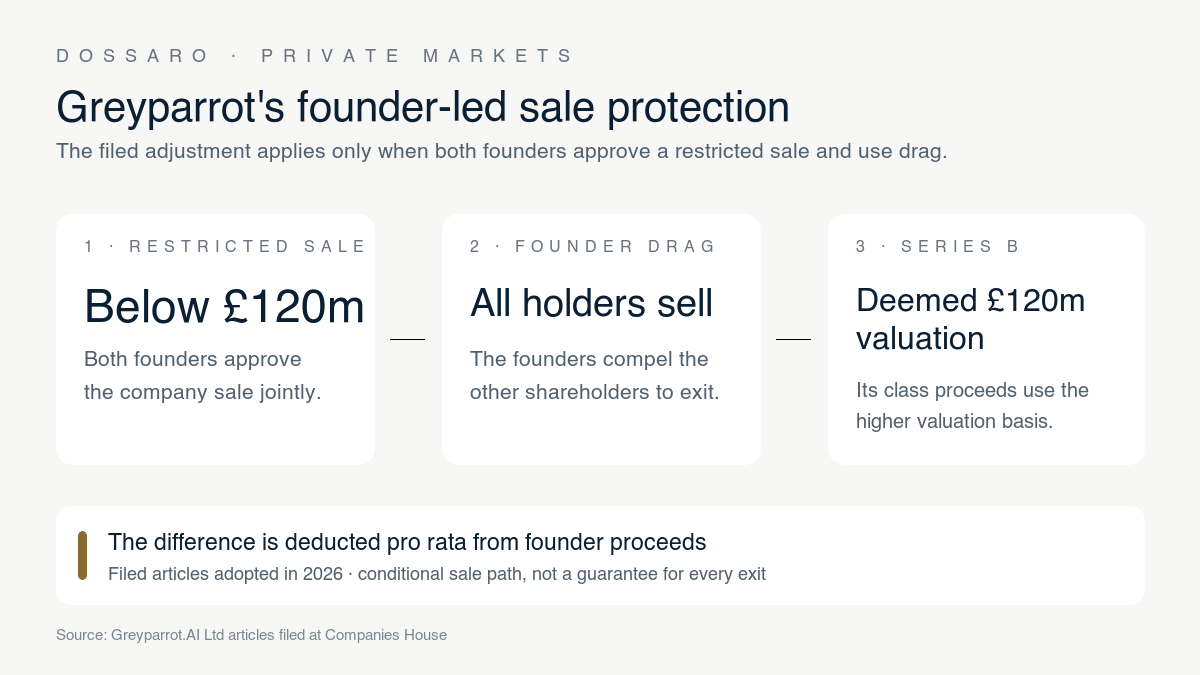
Source record available
GREYPARROT.AI LTD · 11706258
Open the legal identity and 3 reviewed filings behind this analysis.
Greyparrot's Series B terms protect its new share class on one specific downside path. If both founders jointly approve a company sale below £120 million and use their drag right to compel the other shareholders to sell, Series B receives its share of proceeds as if Greyparrot had been valued at £120 million. The difference is deducted pro rata from the founders' proceeds and paid to Series B.
That is the harder commercial term inside the $27 million financing Greyparrot announced on 28 July. The company presented the round as capital to expand its waste-analysis network, dataset and teams across North America and Europe. Independent coverage by BusinessGreen reported the same round as £20 million.
The filed articles answer a different question: who carries downside if the founders choose to force through a sale below the agreed threshold? On that defined path, the answer is the founders, through a reduction in their own proceeds.
| Public financing message | Filed term | Commercial consequence |
|---|---|---|
| $27m Series B for expansion | Sale threshold set at £120m | The financing defines a protected downside scenario |
| Omar Mir publicly described as round lead | Irish company number 787167 defined as Lead Investor | Personal and legal-investor attribution are not the same |
| Growth across North America and Europe | Conditional director right at 20% ownership | Governance power depends on a threshold, not the headline |
| Total funding reported at $60m | £13.835m visible in two new cash allotments | A member register and subscription schedule are still needed |
This is not a £120 million payout guarantee. It is not triggered by every exit, and the company does not promise to pay the shortfall from its own balance sheet. The protection applies when the founders jointly approve a sale below £120 million and invoke a legal mechanism that obliges all shareholders to sell.
A Founder-Led Sale Below £120 Million Changes The Waterfall
Greyparrot's articles filed at Companies House distinguish between two sale paths.
A board-approved sale at a company valuation of at least £120 million is a "Qualifying Sale." A sale below £120 million that both founders approve is a "Restricted Sale." If the founders use a drag notice on that restricted sale, every shareholder can be required to sell.
The unusual adjustment then applies. Series B proceeds are calculated using a deemed £120 million company valuation. Any difference from what Series B would have received at the actual lower valuation is taken pro rata from the proceeds otherwise payable to the founders.
| Sale path | Required approval | Filed treatment |
|---|---|---|
| No sale | None | No sale proceeds or founder adjustment |
| Sale at £120m or more | Board approval | Qualifying Sale under the standard filed waterfall |
| Sale below £120m without the founder drag condition | Depends on transaction terms | The specific founder shortfall clause is not established as triggered |
| Sale below £120m with joint founder approval and drag | Both founders acting jointly | Series B is calculated as if the valuation were £120m; the difference comes from founder proceeds |
The economic point is narrower than saying founders guarantee the investment. Their exposure is limited by the proceeds available to them in that transaction, and the clause is tied to their use of the drag right. It still changes bargaining power. Founders considering a lower-value sale must account for a transfer from their own payout to the Series B holders they compel to exit.
The Protection Sits Above A Conventional Preference
The founder-drag adjustment is additional to the ordinary Series B preference. In the filed distribution order, Series B ranks ahead of the other equity classes and receives the greater of its applicable issue price or its pro rata share as if the equity classes ranked together.
That makes the downside architecture two-layered. Series B first has its class preference. On the defined founder-led sale below £120 million, its proceeds are then adjusted to the deemed valuation through founder proceeds.
The capital filings also show that the 2026 restructuring was not one simple cash issue.
| Series B class | Visible 2026 treatment | Filed amount or price | Safe reading |
|---|---|---|---|
| Series B1 | 311,640 shares | £33.6927 issue price in the articles | Exact count match supports reclassification from the prior Series A state, not a new cash conclusion |
| Series B2 | 142,301 new shares | £26.95 per share | £3,835,011.95 of visible cash consideration |
| Series B3 | 395,734 new shares | £25.27 per share | £10,000,198.18 of visible cash consideration |
| B2 and B3 combined | 538,035 new shares | £13,835,210.13 of visible cash consideration |
The earlier confirmation statement showed 572,573 Series A shares. The new articles show 311,640 Series B1 and 260,933 Series A shares, which add back to exactly 572,573. That supports the reading that part of the existing Series A class was redesignated as B1. It does not support treating all B1 shares as fresh money.
The two new cash allotments total £13.835 million. They cannot be cleanly subtracted from the $27 million announcement because the currencies, closing scope and instruments differ. A later member register or subscription schedule could show another closing, a different instrument or an allocation not visible in those two allotments.
This is the same underwriting distinction that matters in Moa Technology's Series C preference: the announced financing amount describes the round, while filed classes and rights determine who owns what and who is paid first.
The Irish Lead Investor Gets The Chair Only At 20%
The public release describes technology investor Omar Mir as leading the round. Companies House also records Omar Iqtidar Mir joining Greyparrot's board on 17 March 2026.
The articles do not name Mir personally as the Lead Investor. They define the Lead Investor by Irish company number 787167. Ireland's Companies Registration Office records that number as OM Elite Assets Investments Limited.
That legal investor and its permitted transferees gain the right to appoint and remove one Investor Director only while they hold at least 20% of Greyparrot's equity shares. If appointed, the Investor Director becomes board chair and can request seats on board committees and subsidiary boards.
| Governance position | Trigger | Right |
|---|---|---|
| Lead Investor group | At least 20% of equity shares | Appoint and remove one Investor Director |
| Investor Director in office | Appointment remains effective | Acts as board chair |
| Investor Director request | While in office | Join board committees and subsidiary boards |
| Founders and permitted transferees | More than 10% of ordinary shares and both founders remain employees | Appoint up to two founder directors |
| Initial board meeting | Filed quorum rule | At least one founder director must be present, subject to exceptions and the adjournment process |
The current public record does not establish that OM Elite and its permitted-transferee group holds 20%. The right is therefore real but conditional. Mir's directorship does not by itself prove that the threshold has been met or that he was appointed under this specific clause.
Founder protections remain substantial. Qualifying founders can appoint up to two directors, and the initial quorum rule requires founder representation. Greyparrot's structure is better described as hybrid governance than an investor takeover.
The Round Was Legally In Motion Before Its Public Launch
The new articles and the B2 and B3 allotments relate to 17 March 2026. The public announcement arrived more than four months later, on 28 July. That timing does not imply delay or concealment. Private rounds often close legally before communications, and later announcements can follow operational or syndicate milestones.
It does mean the public financing story arrived after the core rights had already been fixed. Investors, founders and advisers assessing the round should start with the March legal state, not assume every term began in July.
Greyparrot's operating case provides the benign explanation for accepting those terms. The company says its analyser units operate across more than 20 countries and that the new capital will expand its network and data platform. Its company history records earlier funding, a strategic partnership with recycling-equipment group Bollegraaf and more than 250 analyser units in active deployment.
A growth investor can reasonably seek downside protection when financing international hardware and data expansion. The protection may never be triggered. Its importance is that the documents assign the cost in advance if a founder-led sale below the threshold does happen.
The Next Member Register Will Decide Where Power Sits
The current filings establish the economic mechanism, the visible B2 and B3 cash and the conditional governance rights. They do not allocate the Series B classes among named investors or prove that the legal Lead Investor currently owns 20%.
Three documents now matter most:
| Next document | Decision-relevant answer |
|---|---|
| Post-round member register or confirmation statement | Which holders own B1, B2 and B3, and whether any group reaches 20% |
| Subscription schedule | How the $27m headline maps to the visible sterling allotments and other instruments |
| Shareholders' agreement or reserved-matters schedule | Which strategic decisions require investor consent beyond the filed director right |
The UK Companies House research workflow is useful here because the dates and document types answer different questions. Allotments show issued cash shares. Articles show rights. A member register shows who actually holds the resulting positions.
Greyparrot's public financing story is about scaling a waste-intelligence platform. Its filed financing story is about who carries the downside and when governance rights activate. On the specified founder-led sale path, Series B is protected at a £120 million valuation basis and founders fund the difference from their own proceeds. The next ownership filing will show which investor can actually use the power attached to that bargain.
Continue reading
Related Research
Moa Technology's £22.2m Round Put £44.4m First In Line
Moa Technology's £22.2m Series C created 46.4% of its issued shares and a roughly £44.4m first claim after accounts warned the round was essential.
Lightning Reach's Sale Replaced Founder Control And Flattened Its Share Stack
UK filings show Lightning Reach's founder lost control on 1 July as a buyer took at least 75% of rights and converted 256,163 shares into one ordinary class.
Risk Ledger's £24m Round Put Axiom Ahead Of Its Founder
UK filings show Axiom became Risk Ledger's largest individual shareholder as £18.5m of cash allotments trailed the announced £24m Series B headline.
Nuclear Turbines Founders Held 57.6% Before £15m Reveal
Nuclear Turbines announced £15m, while its latest register shows founders at 57.6%, IQ Capital at 15.4% and about £6.2m of cash equity filed.