
Risk Ledger's £24m Round Put Axiom Ahead Of Its Founder
UK filings show Axiom became Risk Ledger's largest individual shareholder as £18.5m of cash allotments trailed the announced £24m Series B headline.
On this page
Conduct your own private market research
Add dossaro to Claude or ChatGPT and run source-backed register research from your own workspace.
 Add to Claude
 Add to ChatGPT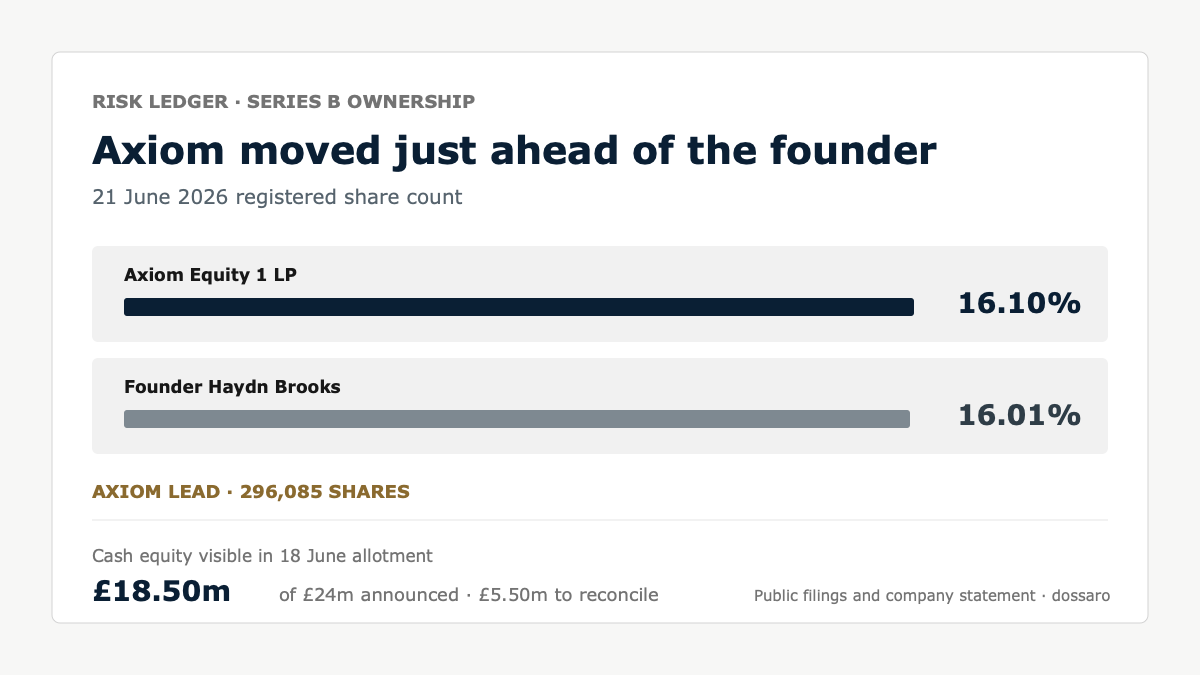
Axiom Equity became Risk Ledger's largest individual shareholder by a margin of 296,085 shares in the cybersecurity company's £24 million Series B. The 21 June 2026 shareholder list puts Axiom Equity 1 LP at 16.10% of all issued shares and founder Haydn Brooks at 16.01%.
The difference is only nine basis points, but the financing also gave Axiom direct governance access. Edward Muirhead Fraser, an Axiom founder, joined Risk Ledger's board on 18 June, the same effective date as the round's visible share allotment.
That allotment records £18.50 million of new cash equity, £5.50 million below the £24 million announced by Risk Ledger. The public filings establish a substantial ownership and balance-sheet reset. They do not identify the instrument or closing behind the remaining part of the headline.
This is the kind of dated distinction the Companies House research workflow is designed to preserve: official profile, control and filing evidence remains separate from the agent's interpretation of a financing announcement.
| Holder | Registered shares on 21 June 2026 | Share of issued count | Position |
|---|---|---|---|
| Axiom Equity 1 LP | 54,220,535 B1 | 16.10% | Largest individual holder |
| Haydn Brooks | 53,895,190 ordinary plus 29,260 A1 | 16.01% | Founder, 296,085 shares behind Axiom |
The crossover does not give Axiom a majority. It changes the centre of gravity instead: the lead investor now has the largest single block of fully voting shares and a representative on the board, while the founder remains almost exactly level.
£18.50 Million Is Visible As New Cash Equity
The 18 June return of allotment breaks the registered cash issue into two prices. Risk Ledger issued 60,439,428 B-class shares at £0.25646 each and another 14,481,748 B-class shares at £0.20716 each. Three A1 shares were also issued at the higher price.
| Cash allotment | Shares | Price per share | Calculated cash |
|---|---|---|---|
| First B1 and B2 issue | 60,439,428 | £0.25646 | £15,500,295.70 |
| Second B1 and B2 issue | 14,481,748 | £0.20716 | £3,000,038.92 |
| A1 issue | 3 | £0.25646 | £0.77 |
| Visible cash equity | 74,921,179 | £18,500,335.39 | |
| Series B announcement | £24,000,000.00 | ||
| Difference to reconcile | £5,499,664.61 |
The £18.50 million is not an estimate of total company funding. It is the cash consideration attached to the shares in that filing. Risk Ledger and independent coverage describe the round as £24 million, led by Axiom with Mercia Ventures returning after the Series A.
Several ordinary transaction mechanics could account for the difference. A later closing, another instrument, an undrawn commitment or a gross-versus-net presentation could all produce a gap between an announcement and one visible allotment. A secondary purchase is another possible structure in the abstract, but the filings inspected for this analysis do not document one.
That distinction is the same one that shaped Dossaro's analysis of TidalSense's funding and preferred-share waterfall: an announced total and a filed cash issue answer different questions. The announcement describes the financing package. The allotment shows how much new equity became visible at the company on a specific date.
The New Issue Reset The Ownership Denominator
Risk Ledger issued 74,921,179 new shares, equal to 22.25% of the post-allotment issued count. Existing holders did not necessarily lose the same percentage of economic value because the classes differ, but the issue made every unchanged holding a smaller percentage of the enlarged share base.
Axiom received most of the largest new class. Its 54.22 million B1 shares represent about 72.4% of all newly issued shares by count. The remaining new B1 and B2 shares sit with returning and other investors across the shareholder list, but the public filings do not provide an investor-by-investor cash schedule.
| Financing effect | Filed position | Commercial consequence |
|---|---|---|
| New shares issued | 74,921,179 | 22.25% of post-allotment issued shares |
| Axiom's B1 block | 54,220,535 | Largest individual registered holding |
| B1 rights | Full voting, dividend and distribution rights; redeemable | Axiom's block carries ordinary voting force plus class-specific economics |
| Axiom board access | Edward Fraser appointed 18 June | Direct participation in governance |
The B1 rights make the ownership comparison meaningful for voting scale. They also prevent a simple conclusion that every share has identical economics. B1 shares are redeemable, while Risk Ledger's capital includes ordinary, A1, A2, B1 and B2 shares. The confirmation statement is therefore a strong registered ownership snapshot, not a fully diluted valuation table.
Nor does 16.10% establish unilateral control. Reserved matters, investor consent thresholds, board composition and any voting arrangements determine how influence works in practice. Those terms are not visible in the public filing index.
The Round Followed A Balance-Sheet Reversal
The latest accounts give the financing a harder commercial context. At 30 June 2025, Risk Ledger reported £2.28 million of cash, £4.60 million of current liabilities and £920,948 of net liabilities. One year earlier, net assets had been positive at £2.81 million.
| Risk Ledger balance-sheet measure | 30 June 2025 | Prior year | Direction |
|---|---|---|---|
| Cash at bank and in hand | £2.28m | £3.85m | Down £1.57m |
| Current liabilities | £4.60m | £2.92m | Up £1.68m |
| Net assets / liabilities | £0.92m net liabilities | £2.81m net assets | £3.73m deterioration |
Those accounts predate the Series B by almost a year. They do not describe Risk Ledger's post-round liquidity, and net liabilities are not a statement that the company could not meet its obligations. They do show why new shareholder funding mattered.
The accounts' going-concern assessment relied on post-year-end shareholder funding and forecast revenue growth. The Series B then brought a much larger capital package into public view. For existing holders, the trade is clear: substantial dilution and new investor influence in exchange for capital to fund product development and expansion.
Axiom Backed A US And Artificial-Intelligence Push
Risk Ledger says it will use the round to deepen its UK customer network, develop artificial-intelligence tools for supply-chain security and expand in the United States. The company says more than 16,000 organisations sit on its network.
TechMarketView's independent report adds a useful commercial qualification: the 16,000 figure includes customers and suppliers completing assessments, while the paying-customer count is not disclosed. It also notes that Risk Ledger will enter a US market with established competitors including SecurityScorecard and UpGuard.
Axiom's Jonathan Organ described the network as difficult to replicate and said the investment was the final deal from the firm's first fund. SecurityWeek independently confirmed the £24 million amount, Axiom lead and Mercia participation on 17 July.
The expansion case therefore rests on two linked bets. Risk Ledger must turn network participation into durable revenue, and Axiom must help the company convert a strong UK position into a competitive US business. The new ownership block and board seat put the lead investor close to both decisions.
The Next Filings Must Reconcile Money And Influence
The current public record answers who gained the largest single block, how many shares were issued for cash and what condition preceded the financing. The next documents need to explain how the rest of the headline was structured and which decisions require Axiom's consent.
| Next document | Decision-relevant answer |
|---|---|
| Later return of allotment | Whether more of the £24m arrived as cash equity |
| Investment or subscription agreement | Instrument mix, investor allocations and closing mechanics |
| Governance schedule or shareholder agreement | Reserved matters, consent thresholds and board rights |
| Next confirmation statement | Updated registered ownership after any later closing |
| Next annual accounts | Post-round cash use, liabilities and revenue progress |
Risk Ledger's announcement presents the Series B as fuel for network growth, artificial intelligence and US expansion. The filings add the ownership consequence: Axiom moved 296,085 shares ahead of the founder, took the largest individual block and placed its own founder on the board.
That is not control by arithmetic alone. It is enough to change the question for existing and incoming investors. The next underwriting work is no longer whether Axiom backed Risk Ledger, but how the £5.50 million difference was financed and which strategic decisions now sit inside the lead investor's consent package.
Continue reading
Related Research
TidalSense's £14.2m Financing Put 71% First In Line
TidalSense's visible £10.31m equity put 70.9% of issued shares in the class paid first, while £3.89m of the £14.2m headline remains unmapped.
Nuclear Turbines Founders Held 57.6% Before £15m Reveal
Nuclear Turbines announced £15m, while its latest register shows founders at 57.6%, IQ Capital at 15.4% and about £6.2m of cash equity filed.
Humanoid's $152m Round Recapitalises A Business With £50.5m Of Founder Loans
Humanoid raised $152m after ending 2025 with £43.5m of net liabilities and £50.5m in founder loans, while its founder appeared to retain 53% of ordinary shares.
FINN's €140m Round Shows The Financing Stack Behind A Mobility Unicorn
FINN's 2025 shareholder lists show a 17.2% wider share base, Planet First's 18.8% block and a new Picus vehicle before the €140m Series D round.