
Nuclear Turbines Founders Held 57.6% Before £15m Reveal
Nuclear Turbines announced £15m, while its latest register shows founders at 57.6%, IQ Capital at 15.4% and about £6.2m of cash equity filed.
On this page
Conduct your own private market research
Add dossaro to Claude or ChatGPT and run source-backed register research from your own workspace.
 Add to Claude
 Add to ChatGPT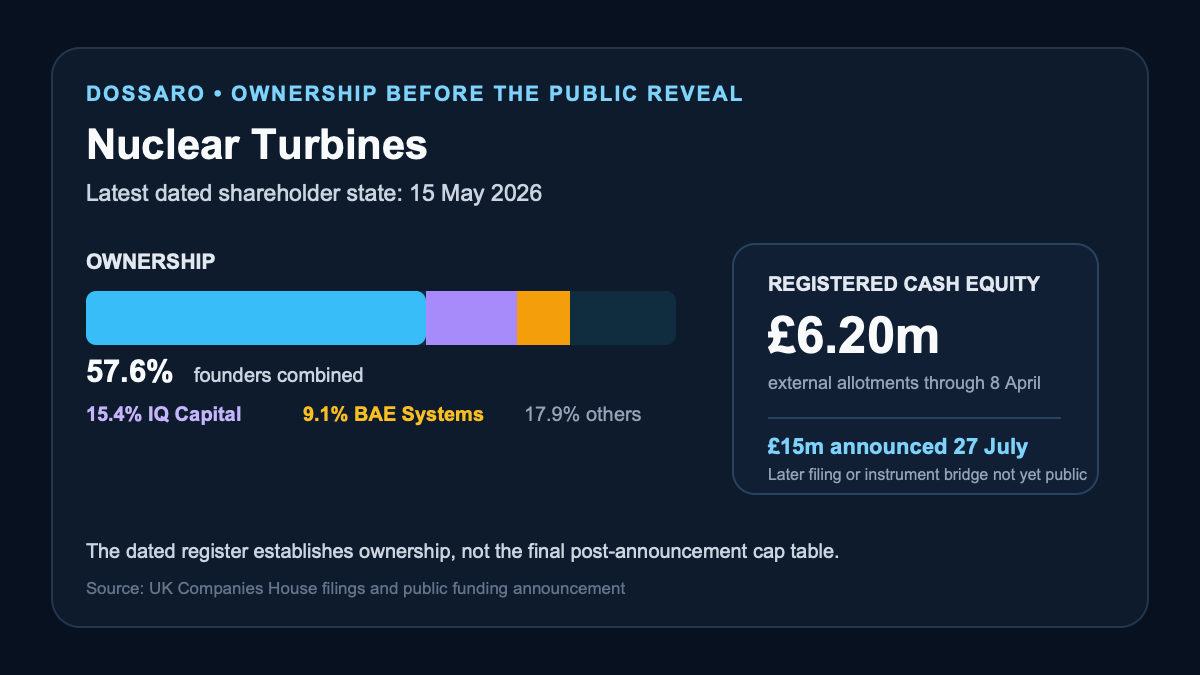
Source record available
NUCLEAR TURBINE LTD · 14871861
Open the legal identity and 3 reviewed filings behind this analysis.
Nuclear Turbines' two founders still held 57.61% of the company at its latest dated shareholder state, while IQ Capital had become the largest institutional holder at 15.40%.
That snapshot was made up to 15 May 2026, before the company emerged from stealth on 27 July with a £15 million foundational round. It is not a final post-announcement cap table. It does show the structure beneath the launch: founder majority ownership, a concentrated IQ Capital block, a continuing BAE Systems stake and several smaller venture positions.
Registered external cash allotments through 8 April total approximately £6.20 million. That number is a dated filing total, not a ceiling on the round. The difference between it and the £15 million announcement may sit in later allotments, a later closing, committed tranches, grants, another instrument or a broader funding definition.
For private-market readers, the central finding is therefore not that the public number is wrong. It is that the latest register identifies who held the company before the reveal and which investor had gained the strongest institutional position.
The Founders Held A 57.6% Majority At The Latest Dated State
The confirmation statement in Nuclear Turbines' Companies House filing history, made up to 15 May, records 1,735,708 shares. Jeremy Owston held 600,000 and Timothy Abram held 400,000. Together, the founders owned 1,000,000 shares, or 57.61% of the issued base.
For repeated UK research, the Companies House agent workflow keeps the resolved company number, filing dates, document references and source limitations attached instead of treating one shareholder statement as a timeless cap table.
IQ Capital funds held 267,272 shares, equal to 15.40%. BAE Systems (Holdings) Ltd held 157,230 shares, or 9.06%. The rest was divided among Empirical Ventures, Rhapsody Venture Partners, Empirical and SFC enterprise-investment vehicles, and Zero Carbon Capital.
| Holder or holder group | Shares | Latest dated position |
|---|---|---|
| Jeremy Owston | 600,000 | 34.57% |
| Timothy Abram | 400,000 | 23.05% |
| IQ Capital funds | 267,272 | 15.40% |
| BAE Systems (Holdings) Ltd | 157,230 | 9.06% |
| Empirical Ventures structure | 100,629 | 5.80% |
| Rhapsody Venture Partners | 97,222 | 5.60% |
| Empirical and SFC investment vehicles | 64,793 | 3.73% |
| Zero Carbon Capital | 48,562 | 2.80% |
The takeaway is that institutional capital had not displaced the founders at the latest dated state. Owston and Abram retained an aggregate majority, while no single outside investor approached their combined position.
That does not guarantee continued founder control after every component of the announced round. A later issue can change both the denominator and the voting balance. The first post-announcement shareholder filing is therefore commercially important, not a routine administrative update.
IQ Capital Took Most Of The Spring Share Block
The ownership percentages also reveal concentration within the spring financing. Between 30 March and 8 April, Nuclear Turbines allotted 477,849 shares. IQ Capital received 267,272 of them.
That gave IQ 55.93% of the spring block and made it the largest institutional shareholder in the May statement.
| Spring financing measure | Shares | Share of spring block |
|---|---|---|
| IQ Capital funds | 267,272 | 55.93% |
| Other spring investors | 210,577 | 44.07% |
| Total spring allotments | 477,849 | 100% |
The commercial meaning is stronger than the percentage alone. IQ Capital Directors Nominees Ltd and Jason Whaley were appointed to the board effective 30 March. IQ therefore combined the largest new share allocation with formal governance presence.
That is still not equivalent to control. The founders remained the majority owners at the latest dated state, and the other external positions were fragmented. IQ's role is better described as the institutional power centre of the spring financing than as a takeover.
The distinction resembles the broader financing-stack question in Dossaro's analysis of FINN's equity and debt package: a funding headline identifies capital providers, but the register shows where ownership and influence actually sit.
£6.2 Million Of Cash Allotments Were Registered Before The Launch
The cash trail began before the spring round. BAE Systems received 157,230 shares on 9 December 2025 for £1,249,999.88.
The spring allotments comprised 413,056 shares at £10.29 and 64,793 shares at £10.80. Together they represent £4,950,110.64 of registered cash consideration.
Adding the BAE allotment produces approximately £6,200,110.52 of visible external cash allotments through 8 April. An earlier Empirical Ventures allotment was recorded for nominal cash consideration, so it does not materially change that total.
| Registered financing stage | Cash consideration | What it establishes |
|---|---|---|
| BAE Systems allotment, December 2025 | £1,249,999.88 | Material spin-out shareholder position |
| Spring allotments, March to April 2026 | £4,950,110.64 | Main visible institutional financing block |
| Total visible through 8 April | approximately £6.20m | Dated registered cash equity |
| Public announcement, 27 July 2026 | £15.00m | Broader foundational-round headline |
The two amounts answer different questions. The £6.20 million is what the inspected allotments register by 8 April. The £15 million is what the company and contemporary coverage describe as the foundational financing on 27 July.
Calling the difference "missing" would overstate the evidence. The latest ownership snapshot predates the announcement by more than two months, and UK filings can follow legal or commercial closings. The public package can also include committed tranches or instruments that do not map one-for-one to the inspected share issues.
The useful conclusion is narrower: the register currently explains a substantial portion of the financing and the ownership it bought, while the final bridge to £15 million remains to be filed or otherwise disclosed.
BAE Systems Retained Economics And Information Access
Nuclear Turbines was spun out through BAE Systems' Launchpad initiative. The register shows that BAE did not merely supply a corporate origin story. Its holding company owned 9.06% at the May date after investing approximately £1.25 million in December.
Articles adopted on 30 March also provide BAE Systems with an observer right. That gives the former parent a channel for information and participation without turning the 9.06% stake into board or shareholder control.
The same articles create S1 and S2 investor classes, investor-majority consent provisions and priority mechanics for a return of capital or exit. These rights matter in a downside or sale scenario because economic protection can differ from headline ownership.
The public shareholder statement labels the positions as ordinary holdings, however. It does not safely map named investors to a specific S1 or S2 class. The existence of preferred-class mechanics is established; their holder-by-holder allocation is not.
| Party | Latest dated economic position | Additional evidenced role |
|---|---|---|
| Founders combined | 57.61% | Majority ownership at 15 May |
| IQ Capital funds | 15.40% | Largest institutional block and board presence |
| BAE Systems | 9.06% | Observer right |
| Other external investors | 17.93% | Fragmented across four groups |
This structure spreads institutional influence rather than concentrating it in one buyer. The founders retained the largest economic bloc, IQ gained board-level influence, and BAE preserved both upside and information access.
The Capital Is Funding A Long Technical And Regulatory Path
World Nuclear News reported that the £15 million will be used to validate the reactor design, build large-scale test rigs, expand the team and prepare to manufacture the first fuel elements. The Next Web independently identified IQ Capital as lead investor and Rhapsody, Zero Carbon and Empirical as participants.
Nuclear Turbines says its design directly heats compressed air and uses mature gas-turbine technology for power conversion. It presents the system as smaller and cheaper than conventional nuclear infrastructure and suitable for data centres and industrial sites.
Those performance and cost claims remain company projections. The reactor is still under development, and the financing is paying for validation rather than scaling a demonstrated commercial fleet.
That makes the cap table economically relevant. Advanced nuclear development can require repeated rounds before regulatory approval and commercial deployment. The founders' current majority may be diluted by later capital needs, while investor rights can become more important if technical milestones take longer or cost more than planned.
The fair counterposition is that £15 million can be entirely consistent with the dated register. A financing announced in July can contain cash or commitments not visible in an April allotment file or a May shareholder statement. Nothing in the public record establishes that the announcement is false.
The Next Filing Will Show Whether Founder Control Changed
Nuclear Turbines entered public view with an unusually legible pre-launch ownership structure. The founders held 57.61%, IQ Capital had assembled the largest institutional block at 15.40%, and BAE Systems retained 9.06% plus an observer right.
The register also accounts for approximately £6.20 million of external cash allotments through early April. It does not yet account for the complete legal and financial composition of the later £15 million headline.
The next decision-changing document is a post-announcement allotment or confirmation statement. It should show whether the round added more shares, whether founder ownership remained above 50% and how the final investor classes were allocated.
Until then, the strongest conclusion is dated but consequential: before Nuclear Turbines revealed its £15 million financing, the founders still owned the majority and IQ Capital had already secured the most influential external position.
Continue reading
Related Research
FINN's €140m Round Shows The Financing Stack Behind A Mobility Unicorn
FINN's 2025 shareholder lists show a 17.2% wider share base, Planet First's 18.8% block and a new Picus vehicle before the €140m Series D round.
Humanoid's $152m Round Recapitalises A Business With £50.5m Of Founder Loans
Humanoid raised $152m after ending 2025 with £43.5m of net liabilities and £50.5m in founder loans, while its founder appeared to retain 53% of ordinary shares.
QUICKBLOCK's £940k Funding Was Also A Recapitalisation
QUICKBLOCK raised £940,000 after reporting £534,213 of net liabilities. Filings map £638,571 to equity, leaving about £301,429 as implied grants.
Street Group's Founders Held 92.8% Before Hg's £200m Deal
Street Group's founders held 92.8% before Hg's deal valued the company above £200m, mapping to more than £185m of paper value at 12.5 times 2025 revenue.