
QUICKBLOCK's £940k Funding Was Also A Recapitalisation
QUICKBLOCK raised £940,000 after reporting £534,213 of net liabilities. Filings map £638,571 to equity, leaving about £301,429 as implied grants.
On this page
Conduct your own private market research
Add dossaro to Claude or ChatGPT and run source-backed register research from your own workspace.
 Add to Claude
 Add to ChatGPT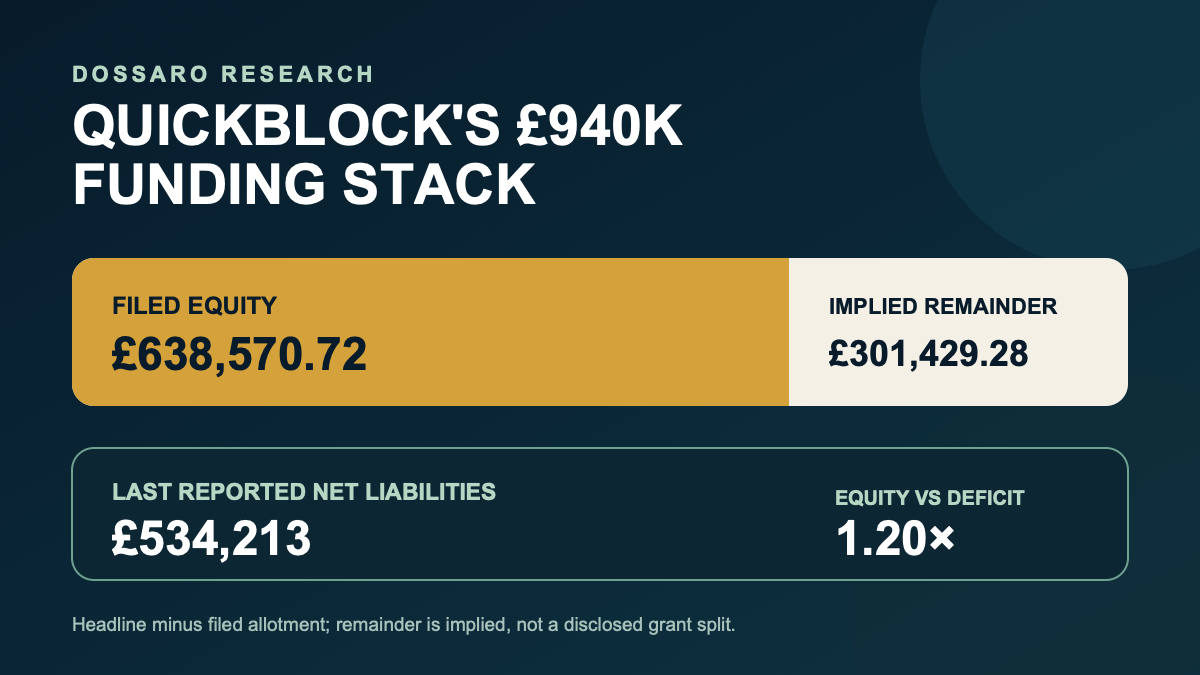
QUICKBLOCK put £638,570.72 of new equity into a company that last reported £534,213 of net liabilities.
The Scottish modular-infrastructure supplier announced £940,000 of equity and innovation grants on 23 July 2026. A Companies House allotment dated one month earlier records 275,246 new Ordinary shares at £2.32 each. That filing maps 67.9% of the public headline to equity.
The remaining £301,429.28, or 32.1%, is the implied non-equity component. The announcement says Scottish Enterprise and Innovate UK provided grant funding for research and development, but it does not publish the exact split between grants and equity.
That distinction changes how private-market readers should interpret the round. QUICKBLOCK is financing expansion into European defence and humanitarian markets, but the equity is also entering behind accumulated losses and creditor claims. The visible equity alone was about 1.20 times the company's last reported net-liability deficit.
The £940,000 Headline Contains Two Different Forms Of Capital
Scottish Enterprise's announcement describes a completed £940,000 package comprising new equity and innovation grants. It names Equity Gap, the University of Strathclyde and Scottish Enterprise as the equity investors, with additional grant funding from Scottish Enterprise and Innovate UK.
The June allotment provides the hard bridge from that mixed headline to the visible share capital.
| Funding component | Amount | Share of £940,000 | Evidence status |
|---|---|---|---|
| New Ordinary-share consideration | £638,570.72 | 67.9% | Filed allotment |
| Implied non-equity remainder | £301,429.28 | 32.1% | Headline minus filed equity |
| Total announced funding | £940,000 | 100% | Public announcement |
The table does not turn the remainder into a disclosed grant award. It shows the arithmetic produced by matching the filed equity issue to the announced mixed package. A later grant notice could change the classification if another instrument sits inside the headline.
The distinction matters because equity and grants carry different economic burdens. Equity dilutes existing shareholders but does not require repayment on a fixed schedule. Grants can fund defined research activity without adding shareholder dilution, although payment milestones and eligible-cost rules can constrain how the money is used.
For QUICKBLOCK, the package therefore spreads the financing burden. Shareholders fund the company through new shares. Public grant providers absorb part of the research risk attached to rapid-deployment shelter products.
The Last Accounts Show A £534,213 Capital Deficit
QUICKBLOCK's Companies House filing history includes accounts made up to 31 May 2025. They report £534,213 of net liabilities.
The Companies House evidence workflow is useful here because it resolves the Scottish company number before combining accounts, allotments and the charge register. Those source surfaces answer different questions and should not be flattened into one financing total.
The composition shows why the new equity is more than an ordinary growth cheque.
| Balance-sheet measure at 31 May 2025 | Reported amount | Financing meaning |
|---|---|---|
| Called-up share capital | £2,100 | Nominal equity base |
| Share premium | £1.565m | Capital previously paid above nominal value |
| Accumulated profit-and-loss deficit | £2.101m | Losses absorbed the visible equity base |
| Net liabilities | £534,213 | Liabilities exceeded reported assets |
| Other loans | £539,593 | Included Innovate UK Loans |
The accumulated deficit had worsened by approximately £813,000 in one year. The accounts also referred to continuing shareholder support and included Innovate UK Loans within other borrowing. A fixed and floating charge connected to that lending remained visible in the company record.
The 2025 balance sheet is not a current solvency statement. It predates the June 2026 allotment by more than a year, and it cannot capture trading, cash use, new obligations or grants received after the reporting date.
It still establishes the capital starting point. On the filed figures, the £638,570.72 equity issue was £104,357.72 larger than the last reported net-liability deficit. That creates capacity to repair the balance sheet, but it does not prove that QUICKBLOCK now has positive net assets.
This is the same analytical distinction visible in Dossaro's examination of PaperShell's EU-backed factory financing: public support can reduce the private capital requirement without eliminating the company's balance-sheet and execution risk.
New Investors Bought 11.6% Of The Enlarged Share Base
The June transaction created 275,246 Ordinary shares at £2.32 each. QUICKBLOCK had 2,099,603 shares before the issue and 2,374,849 afterwards.
| Share measure | Result |
|---|---|
| Shares before the allotment | 2,099,603 |
| New Ordinary shares | 275,246 |
| Shares after the allotment | 2,374,849 |
| New shares as a post-allotment position | 11.59% |
| Filed price per share | £2.32 |
| Total share consideration | £638,570.72 |
The issue sold 11.59% of the enlarged share base as a group. The latest reviewed shareholder list predates the transaction, so the filing does not divide those new shares among Equity Gap, the University of Strathclyde and Scottish Enterprise.
That missing allocation prevents any investor-by-investor ownership claim. It does not weaken the aggregate result: existing holders accepted meaningful dilution to bring in capital that exceeded the last reported net-liability hole.
The £2.32 issue price can be used to reconstruct the cash consideration because the filing states both the number of shares and the price. It should not be used as a full valuation without knowing whether every existing share carries the same economic rights and whether options or other instruments sit outside the visible count.
Scottish Enterprise Was Already Taking Equity Risk
Scottish Enterprise was not a new name in QUICKBLOCK's capital structure. Before the June allotment, the public agency directly held 216,659 of 2,099,603 shares, equal to 10.32%.
A separate Scottish Investment Equity Fund holding represented 3.66% of the pre-allotment shares. The two lines are reported separately and cannot be consolidated without evidence that they should be treated as one legal or beneficial position.
| Public-risk layer | Documented position | Boundary |
|---|---|---|
| Scottish Enterprise direct equity | 216,659 shares, 10.32% before the new issue | Post-round allocation not yet public |
| Separately reported SIEF holding | 3.66% before the new issue | Kept separate from Scottish Enterprise |
| Scottish Enterprise grant role | Named in the £940,000 announcement | Exact grant amount not disclosed |
| Innovate UK support | Grant provider and earlier secured lender | Current grant and loan economics not combined |
The relevant finding is the layering. Scottish Enterprise appears as an existing shareholder, a participant in the new equity syndicate and a grant provider. Innovate UK appears as a grant provider after earlier lending support recorded in the accounts.
Public capital is therefore sharing risk through more than one instrument. Equity participates in upside and absorbs losses. Grants support specified development work. Secured lending sits ahead of equity as a creditor claim.
That structure can be commercially rational for dual-use manufacturing. Products for defence, security and humanitarian response require testing, production capacity and customer validation before revenue can support the full cost base. The public sector can act as funder, lender and customer while private investors finance the company around those programmes.
Expansion Is The Use Case, Recapitalisation Is The Starting Point
QUICKBLOCK says the funding will expand commercial operations in Germany, Poland and Eastern Europe, strengthen production capacity and grow the team. The company describes its product as a flat-pack system made from recycled polypropylene that can be assembled into training environments, protective structures and humanitarian shelters.
The announcement also says QUICKBLOCK has delivered contracts to the UK Ministry of Defence, the German Bundeswehr and the Indian Army. These are company and investor statements about commercial progress, not revenue disclosures.
The expansion case is strengthened by a visible customer set and by European defence demand. It is constrained by the financial starting point. A company whose last accounts showed net liabilities and an £813,000 deterioration in its accumulated deficit needs the new capital to do two jobs: rebuild financial capacity and fund the next stage of production and sales.
The financing mix separates those jobs imperfectly. Grants are tied to research and development activity. Equity is more flexible, but part of its economic effect is to absorb the deficit created by earlier losses. Investors evaluating the round should therefore measure progress against both operating milestones and the post-round balance sheet.
The Next Filings Will Show Whether The Repair Holds
The next confirmation statement should allocate the 275,246 new shares among the participating investors. Grant notices could identify how the implied £301,429.28 remainder is divided between Scottish Enterprise and Innovate UK, or show whether another non-equity component belongs in the bridge.
The next accounts matter more. They should reveal whether the £638,570.72 equity issue moved QUICKBLOCK into positive net assets, how much secured borrowing remained and whether defence expansion converted into revenue without recreating the deficit.
The £940,000 announcement is a credible growth event. The filings make its capital function more precise. At least £638,570.72 arrived as equity behind a balance sheet that last showed £534,213 of net liabilities.
That makes QUICKBLOCK's round both expansion funding and recapitalisation. The investment test is whether the repaired capital base can carry production, research and European sales far enough for operating performance to replace repeated external support.
Continue reading
Related Research
PaperShell's €40m EU Grant Leaves A €43m Financing Test
PaperShell's signed 2025 annual report links an €83m factory and €40m EU grant to a planned IPO, while private capital must still fund roughly half.
Humanoid's $152m Round Recapitalises A Business With £50.5m Of Founder Loans
Humanoid raised $152m after ending 2025 with £43.5m of net liabilities and £50.5m in founder loans, while its founder appeared to retain 53% of ordinary shares.
Moa Technology's £22.2m Round Put £44.4m First In Line
Moa Technology's £22.2m Series C created 46.4% of its issued shares and a roughly £44.4m first claim after accounts warned the round was essential.
TidalSense's £14.2m Financing Put 71% First In Line
TidalSense's visible £10.31m equity put 70.9% of issued shares in the class paid first, while £3.89m of the £14.2m headline remains unmapped.