
Spain Put Its Monitoring Director On Multiverse's Board
Spain committed up to €166.2m to Multiverse Computing across two rounds and placed a SETT monitoring director on its board before the €500m raise.
On this page
Conduct your own private market research
Add dossaro to Claude or ChatGPT and run source-backed register research from your own workspace.
 Add to Claude
 Add to ChatGPT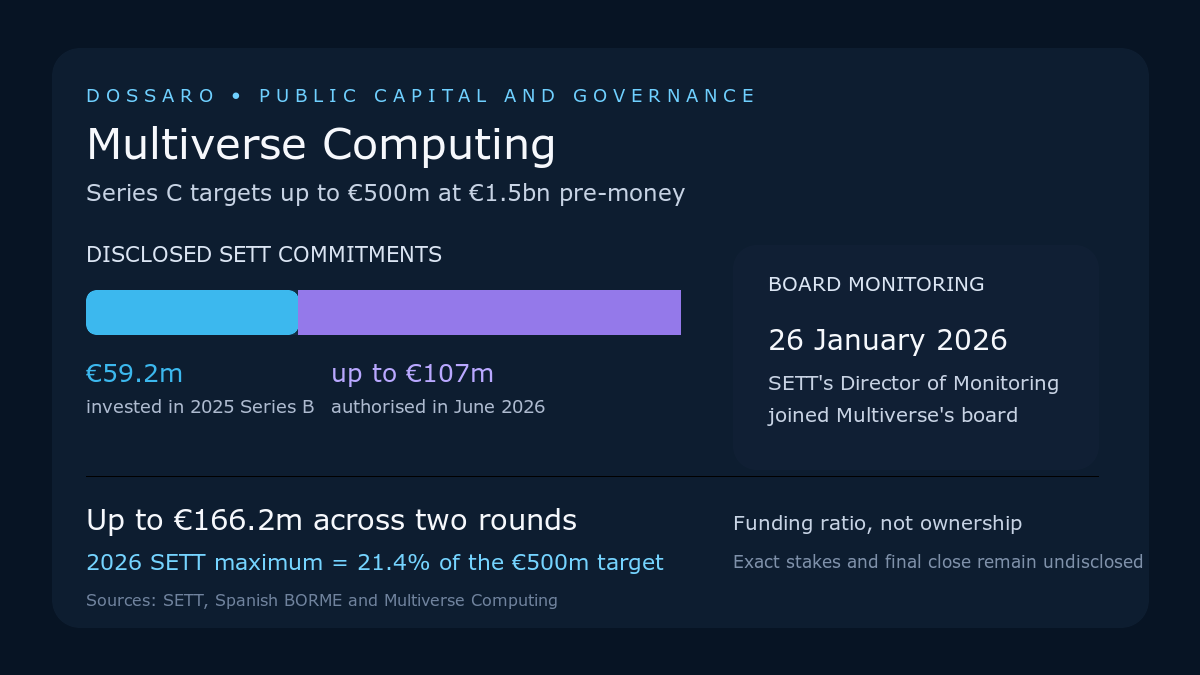
Spain has become more than a passive financial backer of Multiverse Computing.
Its state technology investor SETT invested €59.2 million in the company's 2025 Series B. Francisco Javier López Somoza, identified in a SETT public document as its Director of Monitoring, joined Multiverse's board in January 2026. The government then authorised SETT to invest up to another €107 million in the current financing.
That takes disclosed SETT commitments across the two rounds to as much as €166.2 million. Multiverse announced on 27 July that its Series C targets up to €500 million at a €1.5 billion pre-money valuation and may remain open to selected strategic investors.
The sequence changes the commercial reading of the round. Public capital is helping finance a fivefold valuation step-up while the state has obtained board-level visibility into the company. The records do not establish that Spain controls Multiverse, has a veto or owns a specific percentage.
Spain Has Committed Up To €166.2 Million Across Two Rounds
SETT says it invested €59.2 million in Multiverse in June 2025. One year later, the Spanish government authorised a further investment of up to €107 million through the same state vehicle.
| SETT financing measure | Amount | Status |
|---|---|---|
| 2025 Series B investment | €59.2m | SETT describes it as an investment made |
| 2026 Series C authorisation | Up to €107m | Government-authorised maximum |
| Disclosed cumulative SETT amount | Up to €166.2m | Sum across the two rounds |
| New SETT maximum as share of €500m target | Up to 21.4% | Funding ratio, not ownership |
The 21.4% figure is simply €107 million divided by the €500 million round target. It does not describe SETT's shareholding. The price per security, total securities issued and the rights attached to the state investment have not been published in the sources reviewed.
The public share of the round is also larger than the SETT component alone. Multiverse names the European Innovation Council Fund and the Basque government's Hazten Scale-Up Fund among the investors with commitments to date. Their tickets are not disclosed, so the combined public amount cannot be calculated responsibly.
For private-market readers, this is the central risk-transfer point. A material part of the company's scale-up financing comes from public institutions that can accept strategic and industrial-policy objectives alongside financial returns. Founders and existing investors benefit from a larger capital pool and a higher reference valuation. Taxpayers share exposure if commercial results do not support that valuation.
The State Board Seat Came Before The New Commitment
The governance sequence is more revealing than the funding total on its own.
The official business-register notice records López Somoza's appointment as a Multiverse director effective 26 January 2026. A SETT document identifies him as the organisation's Director of Monitoring. The board appointment came almost five months before the government authorised the new €107 million maximum.
For repeated company research, the Spanish BORME workflow keeps that appointment notice, company match and publication date together without turning it into an ownership conclusion.
| Date | Public or registered event | Decision-relevant meaning |
|---|---|---|
| June 2025 | SETT invested €59.2m in the Series B | State became a repeat capital provider |
| 26 January 2026 | SETT's Director of Monitoring joined the board | Public investor gained inside governance visibility |
| 30 April 2026 | Nominal capital increased by €13,286 | Registered capital base expanded before the announcement |
| 23 June 2026 | Government authorised up to €107m more | State doubled down after obtaining a board position |
| 27 July 2026 | Series C announced at up to €500m | €1.5bn pre-money valuation entered the public record |
The important word is visibility. A director receives information and participates in board decisions under the company's governance rules. That is economically different from a grant or an arm's-length loan.
It is not equivalent to control. The board contains other investor and company representatives, and the public sources do not disclose special SETT consent rights. The evidence supports a monitoring position inside the company, not a state takeover.
The Capital Register Shows Scale, Not Ownership
Multiverse's Spanish register history provides two useful capital markers. In 2025, nominal subscribed capital increased by €13,274 to €61,304. On 30 April 2026, the company registered another €13,286 increase, taking nominal capital to €74,590.
| Registered capital state | Nominal amount | Change |
|---|---|---|
| Before the 2025 increase | €48,030 | Starting point derived from the filing |
| After the 2025 increase | €61,304 | Up €13,274 |
| After the April 2026 increase | €74,590 | Up €13,286, or 21.67% |
The April increase is substantial relative to the prior nominal base, but it cannot be translated directly into cash raised or investor ownership. Spanish private-company financings can issue securities above nominal value, and different securities can carry different economic or voting rights.
That boundary matters because a tempting calculation would treat the 21.67% nominal-capital increase as dilution. The register notice does not support that conclusion. A current shareholder register and the deed behind the capital increase are needed to show who subscribed, what they paid and how the ownership denominator changed.
The same discipline applies to the public commitments. Up to €166.2 million of disclosed SETT backing is not evidence that the state owns 166.2 divided by the company's valuation. Investment timing, security price, pre-money and post-money definitions, and earlier holdings all affect the actual percentage.
The Valuation Is Being Validated By Mixed Capital
Multiverse's announcement names Forgepoint Capital International, BNP Paribas Solar Impulse Venture Fund and Bullhound Capital as co-leads. It also lists corporate, financial, sovereign and public investors across Europe, North America and the Middle East.
| Capital group | Named participants | What is public |
|---|---|---|
| Private round leads | Forgepoint Capital International, BNP Paribas Solar Impulse Venture Fund, Bullhound Capital | Co-lead role |
| Corporate and financial investors | Santander Alternative Investments, Tikehau Capital, HP, Orange Ventures, Scania Invest, NAventures, Zouk Capital | Participation or commitments |
| Sovereign and public investors | SETT, EIC Fund, Hazten Scale-Up Fund, Qatar Development Bank | Participation or commitments |
| Undisclosed economics | All groups | Individual allocations and ownership percentages |
This is not a state-only valuation. A broad private syndicate is putting its name and capital behind the company. The sharper conclusion is that the €1.5 billion pre-money price is not being validated solely by new private capital either.
SETT is a repeat investor, and its maximum current commitment is material relative to the round target. Other public funds add further support. That mix can lower financing risk for the company while giving governments strategic exposure to efficient artificial intelligence infrastructure.
The structure resembles the layered public-risk position in Dossaro's analysis of QUICKBLOCK's equity, grants and earlier public lending. The instruments differ, but the analytical question is the same: which risks remain with private equity, and which are being absorbed or shared by public capital?
The Money Is Meant To Finance A Global Scale-Up
Multiverse says the Series C will expand its library of compressed artificial intelligence models, fund research and development, support sovereign artificial intelligence infrastructure and extend its presence in Asia, the Middle East, Canada and the United States.
The company says its CompactifAI technology can reduce model size by 80% to 95% with immaterial accuracy loss. It also reports more than tenfold growth in annualised revenue since its Series B and 96-fold year-on-year sales growth in the first quarter of 2026.
Those are company-reported performance claims. The public sources reviewed do not provide audited revenue, margins, cash burn or customer concentration for the current period. They therefore explain the investment case but do not independently prove that the €1.5 billion valuation is supported by durable earnings.
This is where the public-private structure becomes commercially important. Efficient artificial intelligence is being framed as both a software market and a sovereignty objective. SETT can justify the investment through employment, domestic capability and strategic infrastructure as well as financial return. A private investor must still decide whether the security price compensates for product, competition and execution risk.
Stewardship Is The Fair Counterposition
Putting a monitoring director on the board can be prudent governance. SETT is responsible for public funds and has a legitimate reason to monitor a large, repeat investment closely. Board representation can improve information flow and accountability without giving the state operational control.
The company also attracted multiple private and strategic investors. Their participation is evidence that the round is not relying on one public cheque. The announced financing may be commercially rational even if public institutions make up a meaningful part of it.
The unresolved issue is not whether public capital should participate. It is whether readers can distinguish the announced target from the final legal close and understand how ownership, governance and downside are divided once the round is complete.
The Final Close Will Test The Public-Private Balance
Multiverse has disclosed an unusually large financing target, but the round may remain open to additional strategic investors. The €500 million headline is therefore a target and announced financing structure, not proof that every euro has already been paid.
The next decision-changing evidence is a final closing statement, a current shareholder register and the deed behind the April capital increase. Together, those records should show SETT's exact ownership, founder dilution, investor allocations and whether the full €107 million maximum was used.
What is already clear is consequential. Spain supplied €59.2 million in 2025, placed SETT's monitoring director on the board in January and authorised up to €107 million more in June. Public capital is not standing outside Multiverse's €1.5 billion valuation story. It is financing the company from inside the governance structure.
Continue reading
Related Research
QUICKBLOCK's £940k Funding Was Also A Recapitalisation
QUICKBLOCK raised £940,000 after reporting £534,213 of net liabilities. Filings map £638,571 to equity, leaving about £301,429 as implied grants.
PaperShell's €40m EU Grant Leaves A €43m Financing Test
PaperShell's signed 2025 annual report links an €83m factory and €40m EU grant to a planned IPO, while private capital must still fund roughly half.
Nuclear Turbines Founders Held 57.6% Before £15m Reveal
Nuclear Turbines announced £15m, while its latest register shows founders at 57.6%, IQ Capital at 15.4% and about £6.2m of cash equity filed.
FINN's €140m Round Shows The Financing Stack Behind A Mobility Unicorn
FINN's 2025 shareholder lists show a 17.2% wider share base, Planet First's 18.8% block and a new Picus vehicle before the €140m Series D round.