
XRlabs Added Seed-2 Preference Rights While Its Founder Kept Statutory Control
XRlabs raised an $8.4m Playground-led seed while filings show 621,130 Seed-2 shares and a founder still above 50% with majority board rights.
On this page
Conduct your own private market research
Add dossaro to Claude or ChatGPT and run source-backed register research from your own workspace.
 Add to Claude
 Add to ChatGPT
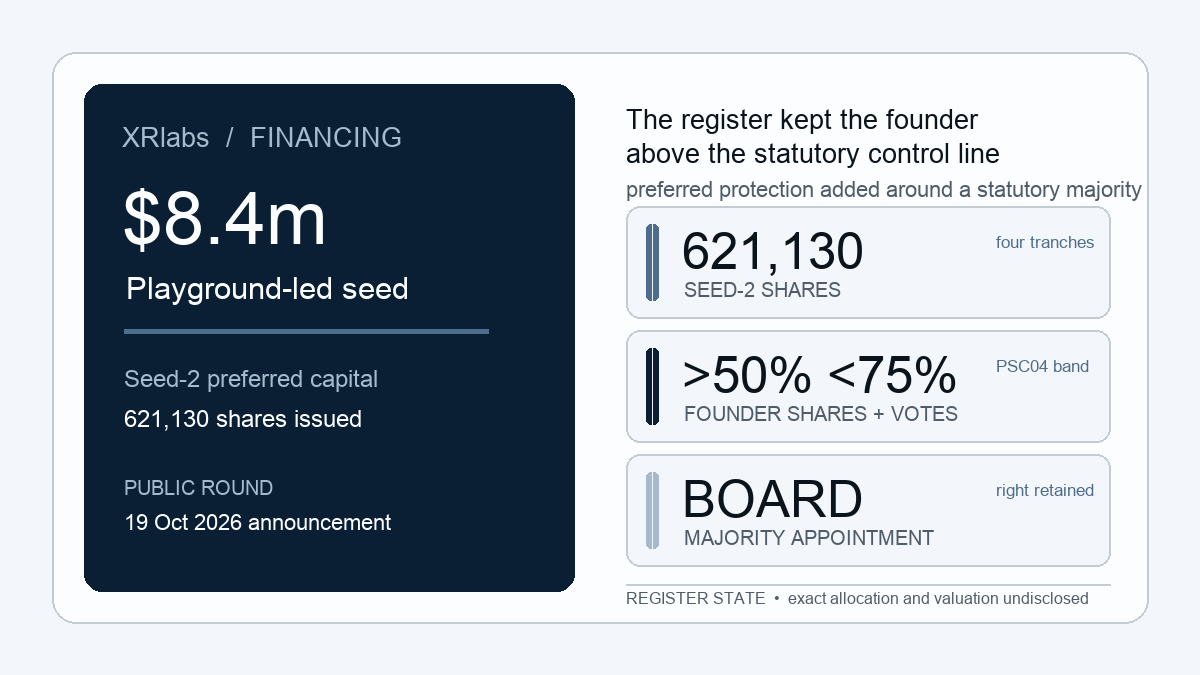
XRlabs raised an $8.4 million seed led by Playground Global, with Eka Ventures participating, but the UK register shows a more specific outcome than the funding announcement: 621,130 Seed-2 shares were issued while founder Dr Ali Rezaei Haddad remained recorded as holding more than 50% but less than 75% of the shares and votes and retaining the right to appoint or remove a majority of the board. The register therefore supports a narrow finding: preferred capital and investor protections were added without a disclosed statutory transfer of control away from the founder.
That does not establish the founder's exact percentage, the identity of every Seed-2 subscriber or the valuation of the round. The filings also do not prove that Playground received the new shares. They do show how a public seed headline translated into a new class of preferred capital, a set of conditional investor rights and a founder control position that was still visible after the financing steps.
The $8.4m announcement is only the entry point
XRlabs, formerly registered as SIMXAR LTD, announced the seed on 19 October 2026. Its announcement names Playground Global as lead investor and Eka Ventures as a participant. It also says former Medtronic chief executive Omar Ishrak became chair and separately describes an allocation from the UK AI Research Resource. The company positions its product as surgical intelligence, but the announcement does not publish a valuation, a post-round cap table or a breakdown of the instruments issued.
Independent coverage confirms the financing headline and the chair appointment. The Cap Table reports the $8.4 million round and Eka's participation, while Venture Capital Tracker repeats the Playground-led financing. Neither source supplies the legal allocation of the new shares.
That gap matters because a headline round can combine new money, different share classes and governance rights. The public sources answer who announced the financing. The Companies House filings answer what the issuer actually added to its capital structure and what control statement was filed after the issue.
The register records a new preferred class
The Companies House filing history shows the relevant sequence for XRLABS LTD.
| Register event | Filed evidence | Commercial reading | Boundary |
|---|---|---|---|
| 3 February 2025 confirmation statement | 1,084,629 ordinary shares and 204,960 Series Seed shares; Dr Haddad listed with 1,000,000 ordinary shares | The last named holder snapshot before the Seed-2 documents | It is not a current post-round cap table |
| 26 August 2026 SH01 | Four cash allotments dated 19 to 24 August, totalling 621,130 Seed-2 shares; total capital 1,910,719 shares | The financing created a distinct preferred class and increased issued capital | Subscriber-by-subscriber allocation is not shown |
| 3 September 2026 resolutions and new Articles | Seed-2 created, earlier Seed redesignated as Seed-1, pre-emption disapplied and authority granted for a SAFE and the Seed-2 issue | The round was implemented alongside a broader rights and financing package | The documents do not tie each tranche to Playground or Eka |
| 3 September 2026 PSC04 | Dr Haddad recorded above 50% but below 75% of shares and votes, with a majority-board appointment right effective 19 August | The statutory control position remained founder-led after the issue | A band is not an exact percentage or a complete governance map |
The SH01 allotment lists four Seed-2 tranches: 443,665, 118,310, 7,005 and 52,150 shares. They add to 621,130. The filing's statement of capital then gives 1,084,629 ordinary shares, 204,960 Seed-1 shares and 621,130 Seed-2 shares, for 1,910,719 shares in total. Seed-2 is therefore 32.51% of issued shares by simple count. That is not an economic ownership percentage because the preferred shares have conversion terms and other rights, and because the founder's current exact share count is not disclosed in this filing.
The filing also sets out Seed-2's economic priority. After any deferred-share payment, each preferred share ranks ahead of ordinary shares on a liquidation or return of capital for the greater of its preference amount or the amount it would receive on conversion into ordinary shares. Seed-2 has full voting and dividend rights. The new Articles contain the broader preference, conversion and anti-dilution framework.
The class was not created in isolation. The written resolutions create Seed-2, redesignate the prior Seed shares as Seed-1 and disapply pre-emption. They also authorise allotments up to £0.854605 of nominal capital, including £0.0074 connected to a SAFE for Oxford Science Enterprises and £0.847205 for the proposed Seed-2 issue and option-pool increase. That wording shows a financing package wider than the $8.4 million announcement, but it does not identify who funded each instrument.
Founder control survived in the statutory record
The decisive filing is the PSC04, which records a change effective 19 August 2026. Dr Haddad is listed as holding, directly or indirectly, more than 50% but less than 75% of the shares and voting rights. The same filing says he can appoint or remove a majority of the board.
This is stronger than the 2025 shareholder list as evidence of the current control position. That earlier confirmation statement records Dr Haddad with 1,000,000 ordinary shares and names Eka Ventures I LP, Eka Ventures II LP and Eric Johnson as holders of the old Series Seed class. It does not show the new Seed-2 holders and cannot be used to calculate a current founder percentage after the August allotment.
The new Articles add investor representation without erasing the PSC statement. For as long as it holds at least 50% of the Seed-2 shares originally purchased by Playground, Playground can appoint one director and up to two board observers. Eric Johnson has a separate director right while he and a permitted transferee hold at least 2% of issued equity, and Eka Ventures has a board-observer right while it and a permitted transferee hold at least 5% of issued equity. The Founder can appoint a director while he is a service provider, and in some circumstances after that if he and permitted transferees retain at least 10%.
Those provisions are conditional. The Articles do not prove that Playground subscribed to a particular tranche, that the thresholds are met today or that the founder can act without investor consent. They do show why the phrase “founder-controlled” needs a qualifier: statutory control and negotiated governance rights can coexist.
Protection for investors, control for the founder
For investors, the structure combines downside protection with a route to board influence. Seed-2 ranks ahead of ordinary shares in a downside or exit distribution and carries full votes. The Articles also use Investor Majority Consent in parts of the preference and board framework. This is a familiar venture trade-off: the founder keeps a majority statutory position while the new capital receives rights that can matter at financing, exit or strategic-decision points.
For Dr Haddad, the PSC04 creates a visible control anchor after the round. That can be commercially important for a surgical-intelligence business whose product roadmap, clinical validation and regulatory work may require a long horizon. It does not guarantee operating independence. Investor consent, a Playground director seat if its threshold is met and board-quorum provisions can constrain decisions even when the founder remains above 50% on the register.
The distinction is similar to the one in Reflex Aerospace's planned NVIDIA investment: a named strategic or financial investor does not by itself establish a new legal cap table. XRlabs goes a step further because the post-issue PSC filing supplies a current control band, but it still does not disclose the exact allocation behind the preferred class. In Universal Quantum's Series A, the central issue was a missing post-round ownership state. XRlabs provides more control evidence, but not the final holder-by-holder map.
The next filing should identify the economic winners
The next confirmation statement, shareholder list or a filed capital document should show who received the 621,130 Seed-2 shares, whether Playground's conditional director threshold is met and how the old Seed-1 holders changed. A later filing may also reveal the option-pool increase and the SAFE's conversion path. Until then, it is not supportable to assign Seed-2 shares to Playground or Eka, calculate the founder's exact percentage, or infer a valuation from the $8.4 million announcement.
The strongest supported conclusion is narrower and more useful. XRlabs added a substantial preferred class around an $8.4 million public seed, while the Companies House register still records Dr Haddad above 50% of shares and votes with the right to appoint or remove a majority of the board. Investors bought preference and conditional governance protection. The public evidence does not show that they bought the statutory wheel.
Sources: XRlabs announcement, The Cap Table, Venture Capital Tracker, and Companies House filing history.
Continue reading
Related Research
Reflex Aerospace's Planned NVIDIA Investment Has Not Yet Reset Its Filed Cap Table
Reflex Aerospace announced a planned NVIDIA minority investment, yet its latest filed list still shows Alpine at 47.43% and Ballheimer at 30.75%.
Universal Quantum's $100m Round Entered a Negotiated Preference Stack
Universal Quantum's $100m Series A met existing preference, anti-dilution and participation rights, while post-round ownership remains undisclosed.
Salience Labs’ $125m Series B Was Split Across 23 Allotment Lines
Salience Labs’ $125m Series B spans 23 UK allotment lines worth about £125m, while Oxford Science Enterprises left the PSC record before the issue.
LO:TECH’s $12m Series A Sits on a Founder-Holding Company Reset
LO:TECH’s $12m Series A follows a holding-company reorganization, preferred seed classes and a Companies House control record that went blank.