
Salience Labs’ $125m Series B Was Split Across 23 Allotment Lines
Salience Labs’ $125m Series B spans 23 UK allotment lines worth about £125m, while Oxford Science Enterprises left the PSC record before the issue.
On this page
Conduct your own private market research
Add dossaro to Claude or ChatGPT and run source-backed register research from your own workspace.
 Add to Claude
 Add to ChatGPT
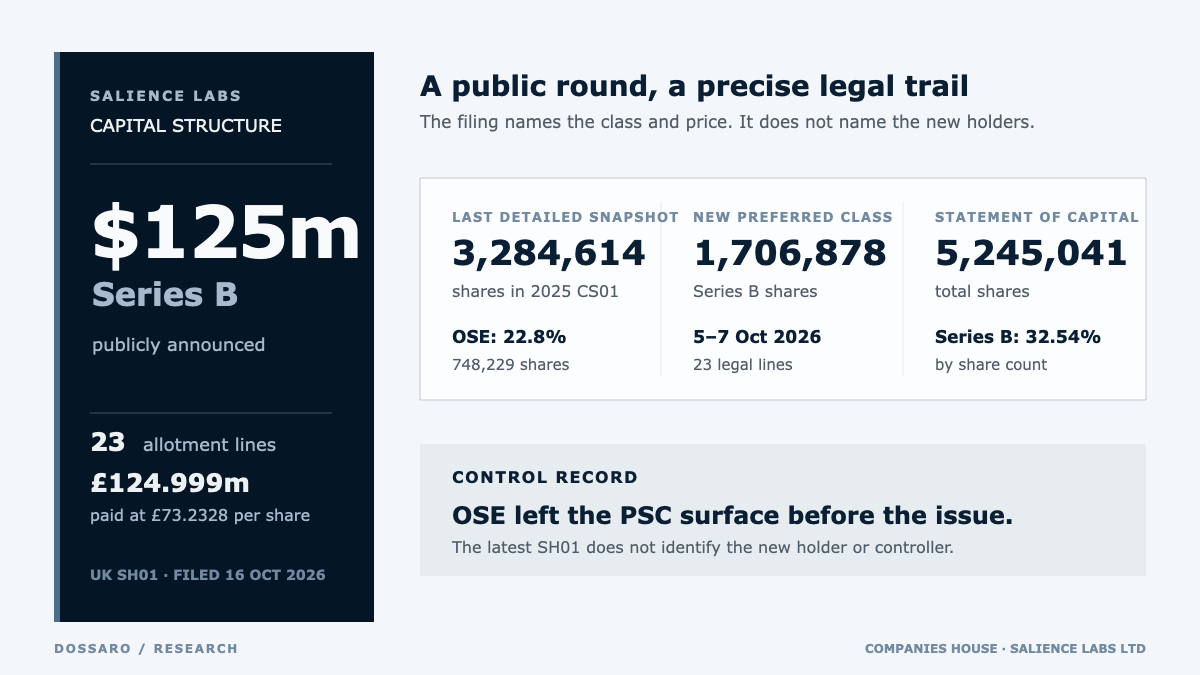
Salience Labs announced an oversubscribed $125 million Series B on 14 October 2026. The UK filing that gives the round its legal shape is more precise than the announcement: one return of allotment lists 23 separate Series B lines, each paid at £73.2328, for a calculated aggregate of £124,999,455.20. The form states that the shares were allotted between 5 and 7 October 2026.
That is not a list of which investor bought which shares. The SH01 does not name the allottees. It is a map of the new class, the price paid and the rights attached to it. At the same time, Oxford Science Enterprises (OSE) had already ceased to appear as a person with significant control (PSC) in the register. The PSC filings do not say whether OSE transferred shares, was diluted, or changed its rights. The new public control holder is therefore not identified by the documents reviewed for this article.
The commercial point is the combination. A financing described publicly as one $125 million round created a substantial preferred class, while the last named PSC relationship had already left the register surface. The evidence supports a change in the capital and disclosure architecture. It does not support assigning the Series B shares to Bullhound Capital, AMD Ventures, Intel Capital or any other named backer.
The filing turns a round headline into 23 legal lines
Salience’s official announcement says Bullhound Capital led the oversubscribed Series B. It names AMD Ventures, Intel Capital, SBI Group, Hudson River Trading and British Business Bank alongside existing investors Applied Ventures, OSE, CIC and Silicon Catalyst. Bullhound Principal Callum Stewart joined the board. Independent coverage from The Cap Table confirms the round and the investor list, but does not disclose a valuation, a share allocation or a price per share.
The Companies House filing history supplies those missing legal details. The 12-page SH01 filed on 16 October 2026 reports 23 separate allotment entries in the Series B class. Each entry shows £73.2328 paid per share and no amount unpaid. The individual entries add to 1,706,878 Series B shares. Multiplying the filed quantity by the filed price produces £124,999,455.1984, which rounds to £124,999,455.20.
The form’s date field says the shares were allotted from 5 October to 7 October 2026. That is a three-day legal allotment window, not a single line that can be read as one investor subscription. A batch of 23 lines can reflect different subscriptions, closing mechanics or administrative sequencing. The filing does not tell us which explanation applies, and the public release does not allocate the lines among the named investors.
| Register state | What the filing shows | Commercial reading | Still unknown |
|---|---|---|---|
| 2025 CS01, filed 26 November 2025 | 3,284,614 shares across 68 shareholder lines; OSE held 748,229, or about 22.8% of that snapshot | A broad pre-Series-B holder base with OSE as the largest identifiable PSC-linked block | Any changes between the CS01 and the Series B allotment |
| Latest SH01, filed 16 October 2026 | 23 Series B lines, 1,706,878 shares, £73.2328 paid per share, £124,999,455.20 calculated in total | A large preferred class was legally issued for roughly the dollar headline’s sterling equivalent | The identity and size of every allottee |
| SH01 statement of capital | 5,245,041 total shares; Series B represents about 32.54% by share count | Series B is a material part of the post-issue capital stack | The ownership, voting and economic split within the class |
The 2025 CS01 and the latest SH01 are dated snapshots, not a simple bridge. Other allotment filings sit between them, and the SH01 statement includes the classes in issue at the filing date. The comparison therefore shows the scale of the new Series B and the prior OSE position without pretending that the 2025 total plus the new Series B alone reconstructs the latest total.
Series B is a preference instrument, not just a share count
The SH01 reproduces the rights for the new class. The Series B preference amount is stated as £54.1743 per share, as adjusted. The rights include anti-dilution language before a qualifying financing, a one-for-one conversion provision and priority in a sale or asset-sale waterfall. The filing also describes voting and distribution mechanics across Series B, Series A, Seed and ordinary shares.
Those provisions matter more than the headline percentage. A 32.54% share-count figure does not by itself state the Series B investors’ downside protection, conversion choice or priority on an exit. Nor does it show whether a named investor received the class directly, through a nominee, or alongside another vehicle. The return of allotment identifies a legal class and its terms, not the negotiated allocation behind the round.
The distinction is familiar in private-company financings. Universal Quantum’s Series A filings show how preference terms can change the economic reading of a headline round, while Microbiotica’s Series C filings separate a new preferred class from assumptions about who owns it. Salience’s documents call for the same discipline: the rights are visible, but the holder ledger is not.
OSE left the PSC surface before the latest issue
The control chronology begins before the Series B return. A PSC07 filed on 23 October 2025 records OSE ceasing to be a PSC with an effective date of 14 July 2025. A PSC08 filed on 11 November 2025 states that, from 14 July 2025, Salience knew or had reasonable cause to believe that there was no registrable person or registrable relevant legal entity to enter in the register.
The filing sequence is a change in what the public register discloses. It is not a finding that Salience had no controller in an economic sense. A PSC entry can disappear because a person’s shares or rights change, because ownership becomes dispersed, because a legal entity sits above the threshold, or because another arrangement changes the registrable position. The filings do not distinguish between those possibilities.
That qualifier matters because the OSE cessation predates the October 2026 SH01. It would be wrong to say the Series B filing proves that OSE sold its stake, or that Bullhound, AMD or Intel replaced OSE as the controller. The documents establish that the old PSC-linked relationship stopped being reportable and that a large new preferred class was later issued. They do not name the new control holder.
The public announcement’s board detail adds governance context without closing that gap. Bullhound’s Callum Stewart joined the board, which shows a negotiated governance outcome around the financing. A board seat is not a shareholder register, and it does not prove that Bullhound received a particular part of the 1,706,878 shares.
What the new capital map changes for stakeholders
For existing shareholders, the key issue is not simply dilution from 1.7 million new shares. The Series B rights can change the order in which value is distributed on a sale and the circumstances in which investors convert into ordinary shares. The missing allottee schedule makes it impossible to say from the filing which existing holders were diluted, which investors gained priority, or whether any strategic participant received special governance rights.
For new investors, the filing confirms that the round was not an ordinary-share issue. The preference amount and anti-dilution provisions create a negotiated downside and conversion package. A lender, commercial partner or employee assessing the company would need the full articles and any shareholder agreement to understand how that package interacts with the older Series A and Seed classes.
For Salience itself, the three-day allotment window and the 23 legal lines show how a single public financing can be implemented through a set of distinct corporate actions. The register now contains the paid price, the class rights and the post-issue capital statement. It still does not contain the financing table that would connect the public investor list to those legal actions.
The next filing should name the economic outcome
The most useful next document is an updated confirmation statement with a complete shareholder list after the Series B issue. It could show whether the named investors appear directly, whether OSE remains a holder under another legal form, and how the 23 allotments are distributed. A new PSC notice would also clarify whether an individual or relevant legal entity crossed a registrable threshold after the financing.
The current evidence supports a narrower conclusion. Salience raised a publicly announced $125 million Series B. Companies House records 23 Series B allotment lines issued between 5 and 7 October 2026, 1,706,878 shares paid at £73.2328 each, and a statement of capital with 5,245,041 shares. The new class carries preference and anti-dilution terms. OSE’s PSC-linked relationship had already ceased to be reportable, and the public filings do not identify the new holder or controller.
That is enough to change the story from a simple investor list into a capital-structure event. It is not enough to assign ownership, infer a sale by OSE, or claim that any named investor controls Salience. The next shareholder and PSC filings will determine whether the new preferred class also produces a new public control record.
Continue reading
Related Research
Universal Quantum's $100m Round Entered a Negotiated Preference Stack
Universal Quantum's $100m Series A met existing preference, anti-dilution and participation rights, while post-round ownership remains undisclosed.
Microbiotica's £36m Series C Added a Senior Preference Layer
Microbiotica's £36m Series C added 16.8m shares, including senior C1 and C2 classes, while the filing leaves subscribers and full cash reconciliation unresolved.
Stryker's CMR Surgical Bet Arrived Before Its Preferred Stack Moved
Stryker announced a $400m preferred investment in CMR Surgical, but the same-day filing recorded only 268 ordinary shares and unchanged preferred ranking.
WhiteLab's $26m Series B Followed a Parent-Debt Share Conversion
WhiteLab's French SAS was still wholly controlled by its Delaware parent after a 28,669-share debt conversion when the $26m Series B was announced.