
Microbiotica's £36m Series C Added a Senior Preference Layer
Microbiotica's £36m Series C added 16.8m shares, including senior C1 and C2 classes, while the filing leaves subscribers and full cash reconciliation unresolved.
On this page
Conduct your own private market research
Add dossaro to Claude or ChatGPT and run source-backed register research from your own workspace.
 Add to Claude
 Add to ChatGPT
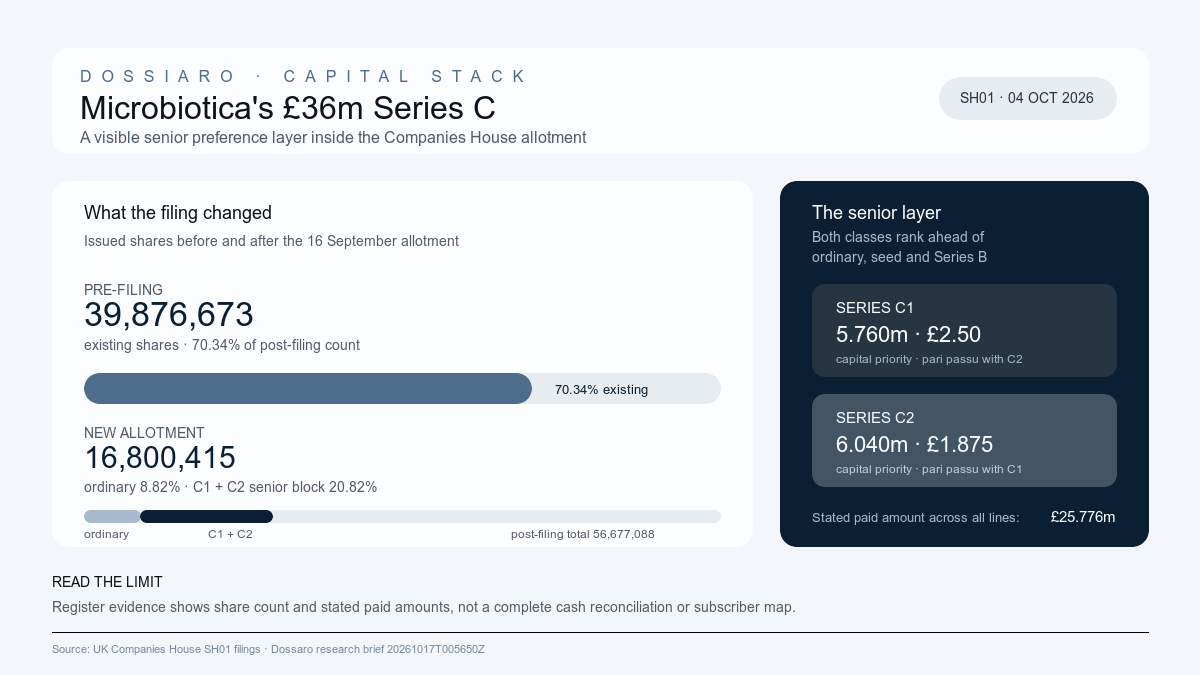
Microbiotica's £36 million Series C did more than add a funding headline. A Companies House filing shows that the financing entered the company through 16,800,415 new shares, including two senior classes whose capital rights rank ahead of the existing ordinary, seed and Series B shares. The filing makes the legal shape of the new money unusually visible, even though it does not identify the subscribers or reconcile the entire public round value.
IP Group and Microbiotica announced the financing on 16 October 2026 as a £36 million, or $48 million, Series C to advance the microbiome company's pipeline into Phase 2 clinical development. The announcement names IP Group, British Business Bank, Tencent, Cambridge Innovation Capital, Flerie and other specialist investors. IP Group's RNS announcement and the company's GlobeNewswire release establish the public event. Independent coverage at Startup.eu confirms the round and syndicate.
The register adds a more useful question: what did the new capital buy in the company's capital structure? The answer is not a reconstructed investor cap table. It is a documented senior preference layer, with a visible share count and stated paid amounts.
The filing records three distinct allotments
Microbiotica's SH01 was filed on 4 October 2026 for shares allotted on 16 September. It records 4,999,996 new ordinary shares, 5,760,000 Series C1 shares and 6,040,419 Series C2 shares. The company's total issued share count rose from 39,876,673 in the prior SH01 to 56,677,088 after the allotment.
The filing gives each line a paid amount. The ordinary shares show £0.01 per share, Series C1 £2.50, and Series C2 £1.875. Multiplying those disclosed amounts by the corresponding share counts produces approximately £25.776 million of stated paid consideration:
| Class | New shares | Amount paid per share | Stated paid amount | Capital position |
|---|---|---|---|---|
| Ordinary | 4,999,996 | £0.01 | £49,999.96 | Full rights, subject to class priorities |
| Series C1 | 5,760,000 | £2.50 | £14,400,000.00 | Senior to ordinary, seed and Series B |
| Series C2 | 6,040,419 | £1.875 | £11,325,785.63 | Senior to ordinary, seed and Series B |
| Total | 16,800,415 | £25,775,785.59 | C1 and C2 rank pari passu |
That arithmetic is a filing calculation, not a claim that the Series C raised only £25.8 million. The public release says £36 million, and IP Group describes the financing as having a second completion. The visible SH01 may therefore capture only part of the announced financing, or a set of allotments whose stated paid amounts do not map one-for-one to the headline consideration. The filing does not identify the subscribers, the exchange rate used for the dollar figure, or any second-completion instrument.
C1 and C2 sit above the old preference stack
The important point is not simply that two new labels appear. The SH01's prescribed particulars describe the economic order of the classes. Series C1 and Series C2 each have a capital distribution right in priority to the ordinary, seed and Series B shares. They rank pari passu with each other, and each is entitled to the greater of the price paid per share or the amount it would receive on an as-converted basis if all shares shared the surplus pro rata.
In plain terms, the new C1 and C2 holders have a first claim tied to their respective paid amounts, while retaining an alternative route to ordinary economics when that would produce more. The two classes share that senior position with one another rather than one sitting above the other. The older Series B shares remain senior to seed and ordinary, but the new C classes now sit ahead of them in the documented capital waterfall.
That is a material risk allocation. If an exit or winding-up produces limited surplus after liabilities, C1 and C2 have a contractual path to recover their preference amounts before the older classes participate. If the company is worth enough for an as-converted distribution to exceed the preference, the same wording preserves upside participation. The filing does not disclose whether any investor is entitled to additional participation beyond that formula, so it cannot support a full waterfall or return model.
The prior filings show how much of the old stack predates the Series C. A March 2022 SH01 recorded 4 million Series B shares at £2.50 per share and a post-filing total of 36,218,724 shares. A December 2025 SH01 recorded a small ordinary allotment and a total of 39,876,673 shares. The October 2026 filing therefore documents a step change in both count and class structure rather than a simple top-up to the ordinary register. The March 2022 filing artifact, the December 2025 filing artifact, and the October 2026 filing artifact provide the dated capital sequence.
The share count shows dilution, not investor returns
The new allotment represents 29.64% of the post-filing share count. The pre-existing 39,876,673 shares represent 70.34%, while the new ordinary tranche represents 8.82% and C1 plus C2 together 20.82%. Those percentages describe issued share counts only. They do not establish voting influence, beneficial ownership, valuation, liquidation proceeds or the economic dilution of any named founder or investor.
That distinction matters because the public financing announcement names institutions but the SH01 does not map them to classes or quantities. It would be unsafe to assign British Business Bank, Tencent, IP Group or any other named participant to C1, C2 or the ordinary tranche without a subscription agreement, shareholder list or later confirmation statement. Nor can the £36 million headline be divided by 16,800,415 shares to infer a single issue price: the filing itself records three paid amounts, and the announcement refers to a second completion.
Microbiotica's current PSC statement also does not solve the ownership question. Companies House records no individual or entity with significant control in the current statement. A PSC filing is a threshold-based control disclosure, not an investor-by-investor cap table. As with the Universal Quantum preference stack and ZuriQ's preferred-share filing, the register can expose the legal rights of a financing without revealing the private allocation behind it.
Why the preference layer changes the commercial reading
The public story is a £36 million biotech financing intended to move a clinical pipeline into Phase 2. The filed story is more specific: part of that money was associated with a new senior capital layer, and the company used two C classes to separate paid amounts while keeping them equal in priority. That structure moves downside risk away from the new capital and toward the classes below it, while preserving a route to participate in an upside distribution.
The result is not evidence that the financing was distressed, nor proof that older holders accepted a particular valuation. It is evidence that the financing was negotiated as a priority stack rather than issued as unqualified ordinary equity. For employees, founders and earlier investors, the headline amount therefore cannot be read in isolation from the order in which value would be distributed.
The register also leaves an important counterposition open. The prescribed particulars may have been agreed as standard venture terms before the October close, and the SH01 may record only the first completion. A later agreement could amend, waive or supersede parts of the stack. The safe conclusion is narrower: the public filing establishes the senior C1/C2 rights and the visible allotment; it does not establish the full financing consideration, subscriber identity or post-money valuation.
The next filing to watch
The next meaningful evidence would be a later SH01 or CS01 that names the issuing classes and carries the post-completion capital, a subscription or financing document that maps subscribers to C1 and C2, or a group-level filing that explains the second completion. A later PSC statement may clarify governance, but it cannot replace the missing financing instrument.
Until that evidence appears, Microbiotica's Series C is best understood as a £36 million public financing with a £25.776 million visible allotment calculation and a newly documented senior preference block. The headline tells us why the company raised. The capital stack tells us who gets paid first.
Continue reading
Related Research
Universal Quantum's $100m Round Entered a Negotiated Preference Stack
Universal Quantum's $100m Series A met existing preference, anti-dilution and participation rights, while post-round ownership remains undisclosed.
ZuriQ's $25.5m Seed Created A 28.6% Preferred Block
ZuriQ's $25.5m seed closed legally in May, creating a 28.6% preferred block and adding a Quantonation-linked director before its July reveal.
Reactive Technologies’ €19m EIB Debt Meets a £25m Preference Stack
Reactive Technologies’ €19m EIB debt is non-dilutive, but filings show £25m of Series D preference rights and an HSBC charge over IP and assets.
OMass’ $310m Series C Added a £40m C-1 Preference Layer
OMass’s $310m Series C included a £1 deferred-share cancellation and a £40m Series C-1 issue with priority rights, exposing a new downside layer.