
ZuriQ's $25.5m Seed Created A 28.6% Preferred Block
ZuriQ's $25.5m seed closed legally in May, creating a 28.6% preferred block and adding a Quantonation-linked director before its July reveal.
On this page
Conduct your own private market research
Add dossaro to Claude or ChatGPT and run source-backed register research from your own workspace.
 Add to Claude
 Add to ChatGPT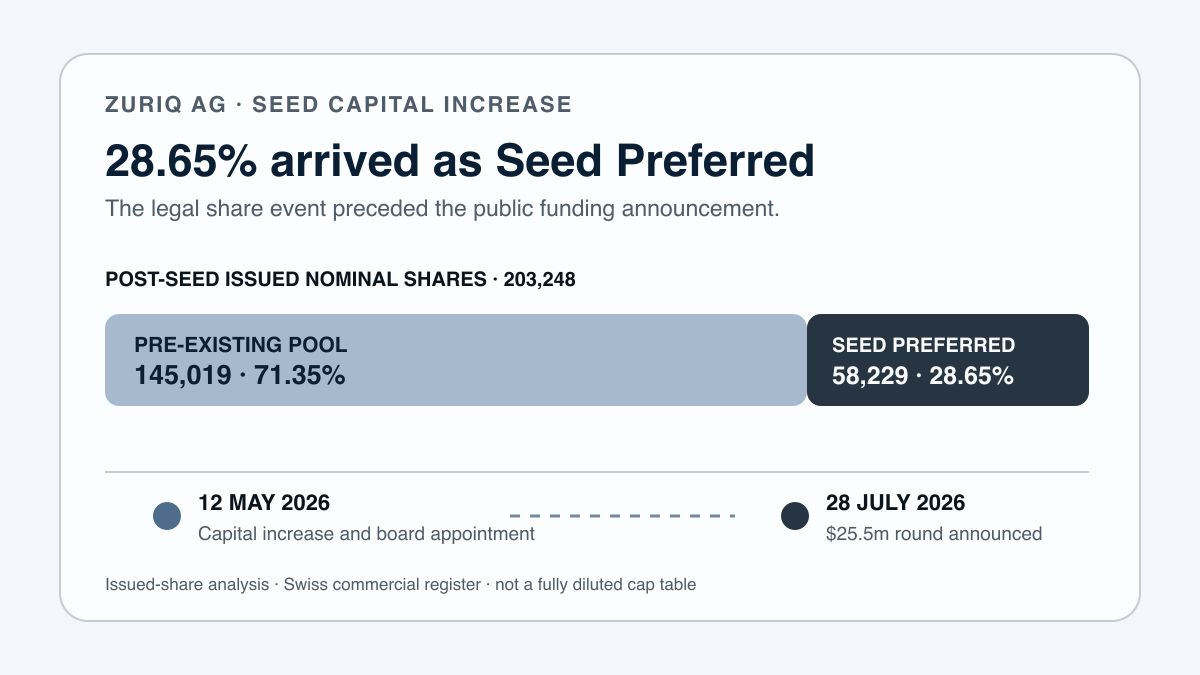
ZuriQ's $25.5 million seed round created a new preferred-share block equal to 28.65% of the Swiss quantum company's issued nominal shares. The legal capital increase happened on 12 May 2026, more than two months before ZuriQ announced the financing on 28 July.
The same May register mutation added Emily Rose Meads to ZuriQ's board with joint-signature authority. Related French register records connect Meads to Quantonation Ventures SC II, supporting a link to the round's lead investor. That makes the seed more than a large cheque: it introduced a distinct preferred layer and visible lead-investor influence at the legal close.
The limit is equally important. Swiss public records show the class, count and board change, but not which investor received each share or the contractual rights beyond the preferred designation. The 28.65% figure describes issued nominal shares, not a fully diluted ownership table.
| Date | Public or legal event | Decision-relevant result |
|---|---|---|
| 19 April 2024 | ZuriQ incorporated | 100,000 ordinary registered shares created |
| 30 September 2024 | Pre-seed capital increase | 45,019 preferred shares added, with liquidation preferences |
| 12 May 2026 | Seed capital increase and board change | 58,229 Seed Preferred Shares added; Emily Rose Meads joined the board |
| 28 July 2026 | $25.5m seed announced | Quantonation named as lead alongside Forward.one, Extantia, Firgun Ventures and previous investors |
The sequence changes how the financing should be read. The July announcement was the public reveal, not the point when the new equity layer first appeared in the register.
The July Announcement Followed A May Legal Close
ZuriQ said it had raised $25.5 million to expand its team, accelerate research and development, fabricate chips and scale the number and quality of its qubits. Quantonation led the round, with Forward.one, Extantia and Firgun Ventures participating alongside all previous investors. Independent coverage from Tech.eu confirmed the amount, date and syndicate.
The Swiss commercial-register publication adds the earlier legal event. On 12 May, ZuriQ increased its nominal capital from CHF145,019 to CHF203,248 by creating 58,229 registered Seed Preferred Shares with a nominal value of CHF1 each. The mutation was published on 20 May.
That roughly ten-week gap resembles the timing issue visible in Ossprey's pre-seed round: a press date can lag the legal share event that actually changes the capital structure. For investors and counterparties, the register date is the better anchor for tracing the economic state.
Seed Preferred Took 28.65% Of Issued Nominal Shares
ZuriQ began in April 2024 with 100,000 ordinary shares. Its September 2024 capital increase added 45,019 preferred shares. The May seed then added 58,229 Seed Preferred Shares.
| Capital layer | Shares before May 2026 | Shares created in May | Post-seed shares | Post-seed share |
|---|---|---|---|---|
| Ordinary and pre-seed preferred pool | 145,019 | 0 | 145,019 | 71.35% |
| Seed Preferred | 0 | 58,229 | 58,229 | 28.65% |
| Total issued nominal shares | 145,019 | 58,229 | 203,248 | 100.00% |
The pre-existing pool therefore retained 71.35% of issued nominal shares. ZuriQ's founders and earlier backers sit somewhere inside that pool, but the public Swiss record does not allocate their individual positions. Public coverage also says previous investors participated in the seed, so it would be unsafe to treat 71.35% as a static incumbent group untouched by the financing.
Preference matters even without the subscription agreement. ZuriQ's 2024 preferred shares were published with liquidation preferences, and the 2026 class is expressly called Seed Preferred. Preferred capital can change how proceeds are ranked in a downside or exit scenario. The public record does not reveal the multiple, participation mechanics, conversion terms or veto rights, so it supports a ranking observation, not a payout calculation.
For private-market readers, that is the central economic shift. Nearly three-tenths of the visible issued-share base arrived in a purpose-built seed class rather than as indistinguishable ordinary equity.
CHF71.9m Post-Money Is A Scenario, Not A Disclosed Valuation
The company announced $25.5 million, also reported as CHF20.6 million. If that entire Swiss-franc amount maps uniformly and one-for-one to the 58,229 new Seed Preferred Shares, the arithmetic implies a price of CHF353.78 per share.
| Uniform-pricing scenario | Calculation | Implied result |
|---|---|---|
| Price per new Seed Preferred Share | CHF20.6m / 58,229 | CHF353.78 |
| Pre-money value | 145,019 × CHF353.78 | CHF51.3m |
| Post-money value | 203,248 × CHF353.78 | CHF71.9m |
The useful takeaway is a bounded valuation reference, not a claim that ZuriQ disclosed a CHF71.9 million post-money valuation. The announced cash could include tranches, instruments or secondary components that do not correspond one-for-one to the nominal issuance. Different investors could also have subscribed on different terms.
This is why nominal-share arithmetic should be separated from price evidence. The share count establishes the size of the new class. The CHF71.9 million figure becomes credible only if a subscription agreement or investor disclosure confirms uniform pricing and the amount attached to those shares.
Quantonation's Influence Became Visible At The Close
Quantonation was the named lead in July. In May, Emily Rose Meads joined ZuriQ's board with joint-signature authority. Related French register records identify Emily Meads as a partner in Quantonation Ventures SC II, supporting the connection between the new director and the lead investor.
That link should not be overstated. A board seat provides information access and governance influence; it does not establish unilateral control. Joint-signature authority also requires another authorised signatory. The Swiss publication does not disclose reserved matters, voting agreements or investor vetoes.
Still, the timing is commercially meaningful. The board appointment appeared in the same mutation as the Seed Preferred issuance. Quantonation's role was therefore visible in governance at the legal close, not merely in the later press release.
For diligence teams, this is the difference between an investor list and a transaction map. The list names the syndicate. The combination of capital class, date and board mutation shows how the lead investor's participation reached into the company's formal structure.
The Missing Share Ledger Decides Who Defended Ownership
All previous investors participated, according to ZuriQ. That leaves a decisive allocation question: how much of the 58,229-share block went to Quantonation and the other new investors, and how much went to incumbents maintaining their positions?
| Next evidence | What it would resolve |
|---|---|
| Subscription agreement | Price per share, tranches, rights and any non-cash components |
| Updated share ledger | Allocation of the 58,229 Seed Preferred Shares by holder |
| Post-round investor disclosure | Whether incumbents defended or increased ownership |
| Further articles or governance filing | Reserved matters, conversion rights and board protections |
The share ledger is the most important next document because the current public record stops at the class total. It cannot establish founder dilution, Quantonation's percentage or any investor's exact economic exposure.
The transaction already has a clear shape. ZuriQ legally closed its seed in May, created a preferred block equal to 28.65% of issued nominal shares and added a Quantonation-linked director before announcing the round in July. The unresolved investment question is no longer whether the capital structure changed. It is who received the new preferred block, at what price, and with which rights.
For teams reconstructing ownership from fragmented public records, Dossaro's private-company ownership workflow provides the relevant register-first method. In ZuriQ's case, the next material update will come from an allocation document, not another funding headline.
Continue reading
Related Research
Ossprey's Pre-Seed Closed Seven Months Before Announcement
Ossprey's $2.65m pre-seed announcement followed a December share issue that gave investors 25.4% and preference rights while founders retained 68.5%.
Nuclear Turbines Founders Held 57.6% Before £15m Reveal
Nuclear Turbines announced £15m, while its latest register shows founders at 57.6%, IQ Capital at 15.4% and about £6.2m of cash equity filed.
Risk Ledger's £24m Round Put Axiom Ahead Of Its Founder
UK filings show Axiom became Risk Ledger's largest individual shareholder as £18.5m of cash allotments trailed the announced £24m Series B headline.
Spain Put Its Monitoring Director On Multiverse's Board
Spain committed up to €166.2m to Multiverse Computing across two rounds and placed a SETT monitoring director on its board before the €500m raise.