
OMass’ $310m Series C Added a £40m C-1 Preference Layer
OMass’s $310m Series C included a £1 deferred-share cancellation and a £40m Series C-1 issue with priority rights, exposing a new downside layer.
On this page
Conduct your own private market research
Add dossaro to Claude or ChatGPT and run source-backed register research from your own workspace.
 Add to Claude
 Add to ChatGPT
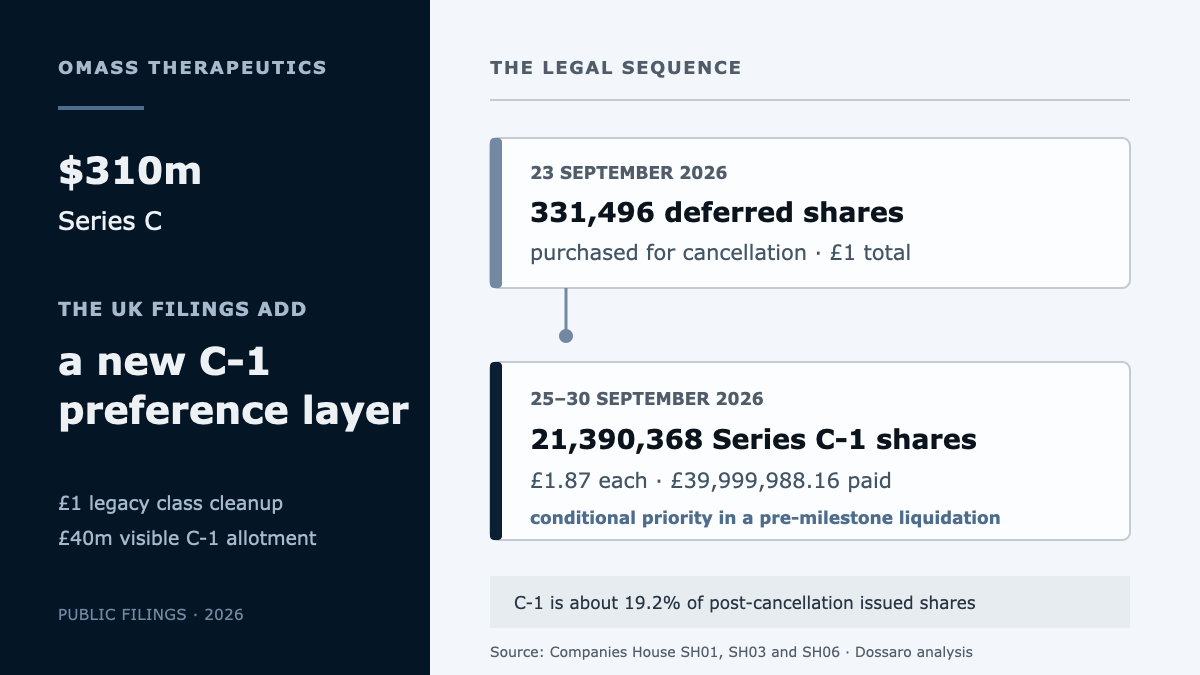
OMass’ $310 million Series C was not one undifferentiated equity event in the UK. The filings show a two-step reset: 331,496 deferred shares were bought for cancellation for £1, then 21,390,368 Series C-1 preferred shares were allotted at £1.87 each. The visible UK cash leg was £39,999,988.16.
That legal sequence matters because the new C-1 class carries a stated priority payment in a liquidation before milestone completion if the preferred subscription price is not fully paid out. The company’s public announcement describes a $310 million (£230 million) financing across a broad investor syndicate. The UK forms expose one preferred layer inside that wider event, but they do not identify its holders or map the rest of the financing.
A £1 cancellation came before the new preference class
OMass announced the oversubscribed Series C on 15 October 2026. The company said Bain Capital Life Sciences, Forbion and Novo Holdings co-led the round, with participation from Janus Henderson Investors, SV Health Investors, Jefferson Life Sciences and existing backers including Syncona, Oxford Science Enterprises, GV, Northpond Ventures, Sanofi Ventures, British Business Bank and the University of Oxford. Proceeds were earmarked for OMS1620, its MC2 receptor antagonist, and early clinical data for an SLC15A4 inhibitor.
The Companies House sequence adds a different kind of information. A purchase-of-own-shares return dated 2 October records 331,496 deferred shares delivered for cancellation on 23 September for an aggregate £1. The SH06 filed on 14 October confirms the cancellation and leaves 111,205,484 shares in issue.
The old deferred class was not an ordinary founder or investor block. Its published rights gave the entire class a £1 priority in a capital distribution, with no voting or dividend rights. Removing it for £1 therefore looks like a legal-class cleanup immediately before the new financing layer appeared. It does not establish who held the shares, what any holder received beyond the stated aggregate amount, or why the company chose that sequence.
| Legal step | Filing record | What it changes in the reading |
|---|---|---|
| 23 September 2026 | 331,496 deferred shares purchased for cancellation for £1 | A legacy class with a whole-class £1 capital priority is removed |
| 25–30 September 2026 | 21,390,368 Series C-1 shares allotted at £1.87 | A new preferred class enters the issued capital |
| 2 October 2026 statement | 111,536,980 shares before the cancellation is reflected | The public round has a dated UK equity leg, not just an announcement date |
The UK form records about £40m, not the whole headline
The Series C-1 SH01 reports 21,390,368 shares at £1.87 paid per share. Multiplying those fields gives £39,999,988.16. The statement of capital lists 111,536,980 shares before the deferred class is removed, including 31,923,076 Series A shares, 49,999,995 Series B shares and the new C-1 block.
After the cancellation, the C-1 shares represent roughly 19.2% of the nominal issued-share count. That percentage is a useful measure of the new class’s place in the legal capital structure. It is not a fully diluted ownership percentage, a voting-control calculation or a valuation. Share premium, options, conversion rights and any other class terms can change the economic result.
The gap between £40 million in this UK allotment and the public £230 million sterling description should also be handled carefully. It is not evidence that the financing was short, unpaid or misstated. A cross-border private round can use multiple entities, instruments or closings. The forms simply show that the UK company’s visible Series C-1 issue is one leg of the event, not a complete map of it.
The dates make the distinction harder to dismiss as a reporting artifact. The shares were allotted between 25 and 30 September, the SH01 was filed on 2 October, and the cancellation forms were filed on 14 October, the same day the public round was announced in the United Kingdom time zone. The legal actions therefore sit close to the financing announcement, even though the filing dates and announcement date are not the same event. That chronology supports a financing-structure reading without proving that every tranche closed simultaneously.
It also shows why a share count is not a substitute for a cap table. The return states the class, number and price, but not the subscriber names or any share premium. Existing Series A and Series B holders may have participated, converted instruments or been diluted under terms that the SH01 does not publish. The C-1 block is measurable; the distribution of economic exposure is not.
C-1 changes the downside conversation
The C-1 particulars give each share one vote and pari passu dividend rights. For capital distributions, C-1 sits with the preferred classes ahead of ordinary and incentive shares. They also include a special priority payment if liquidation occurs before milestone completion and the aggregate subscription price of the preferred shares is not fully paid out.
That is a specific downside protection, not a generic label. It means the economics of the round cannot be understood from the $310 million amount alone. In a weak outcome before the stated milestone, the C-1 terms could affect how available proceeds are allocated among preferred and ordinary layers. The filing does not disclose the size of the priority payment, the subscription agreement, the holders or the complete waterfall, so the article cannot calculate any investor recovery.
The distinction is similar to the one in Microbiotica’s Series C preference stack, where a new class changes the order of claims without revealing a full investor-by-investor payout. OMass supplies the same diligence lesson in a larger biotech round: class rights are economic facts even when the shareholder list is not public.
The financing is a clinical runway, not a disclosed valuation
OMass and Fierce Biotech describe a company moving from a lean Phase 1 development team toward Phase 2 work. OMS1620 is being advanced for congenital adrenal hyperplasia and ACTH-dependent Cushing’s syndrome. The company also plans early clinical data for an SLC15A4 inhibitor aimed at lupus and related diseases.
That use of proceeds explains why the syndicate could support a large round. It does not turn the £1.87 allotment price into a company valuation. The UK return records a nominal capital and paid amount for one class. It does not say what share premium was agreed, whether all investors subscribed in that class, or how the company’s earlier preference layers were priced.
The board changes named in the announcement add governance context. Bain’s Evan Greif and Forbion’s Audrey Cacaly joined the board, while Novo’s Max Klement and SV Health Investors’ Ali Jazayeri became board observers. Those appointments show investor participation in governance, but they do not prove that any one investor controls OMass or received the C-1 shares.
What the next filing needs to answer
The register now supports a sharper account of the round. OMass removed a legacy deferred class for £1, created a C-1 class with conditional priority rights and recorded about £40 million paid for that class. The public financing remains a $310 million event with a broader perimeter and a clinical-development purpose.
The unresolved business question is who subscribed to C-1 and where the rest of the round sits. A post-round confirmation statement, another allotment return, amended articles or a shareholder disclosure could connect the new class to named investors and reveal whether other instruments or entities supplied the balance. Until that bridge appears, the defensible conclusion is that OMass’ headline round came with a new preference layer and a cleaned-up legacy class, not that the UK filing represents the whole deal.
Continue reading
Related Research
Microbiotica's £36m Series C Added a Senior Preference Layer
Microbiotica's £36m Series C added 16.8m shares, including senior C1 and C2 classes, while the filing leaves subscribers and full cash reconciliation unresolved.
Salience Labs’ $125m Series B Was Split Across 23 Allotment Lines
Salience Labs’ $125m Series B spans 23 UK allotment lines worth about £125m, while Oxford Science Enterprises left the PSC record before the issue.
Universal Quantum's $100m Round Entered a Negotiated Preference Stack
Universal Quantum's $100m Series A met existing preference, anti-dilution and participation rights, while post-round ownership remains undisclosed.
Cygrid’s €2.66m Pre-Seed Followed a Nominal-Capital Reset
Cygrid’s €2.66m pre-seed followed a German capital reset from €25,000 to €35,392, exposing a new legal stake without revealing its investor or valuation.