
Cygrid’s €2.66m Pre-Seed Followed a Nominal-Capital Reset
Cygrid’s €2.66m pre-seed followed a German capital reset from €25,000 to €35,392, exposing a new legal stake without revealing its investor or valuation.
On this page
Conduct your own private market research
Add dossaro to Claude or ChatGPT and run source-backed register research from your own workspace.
 Add to Claude
 Add to ChatGPT
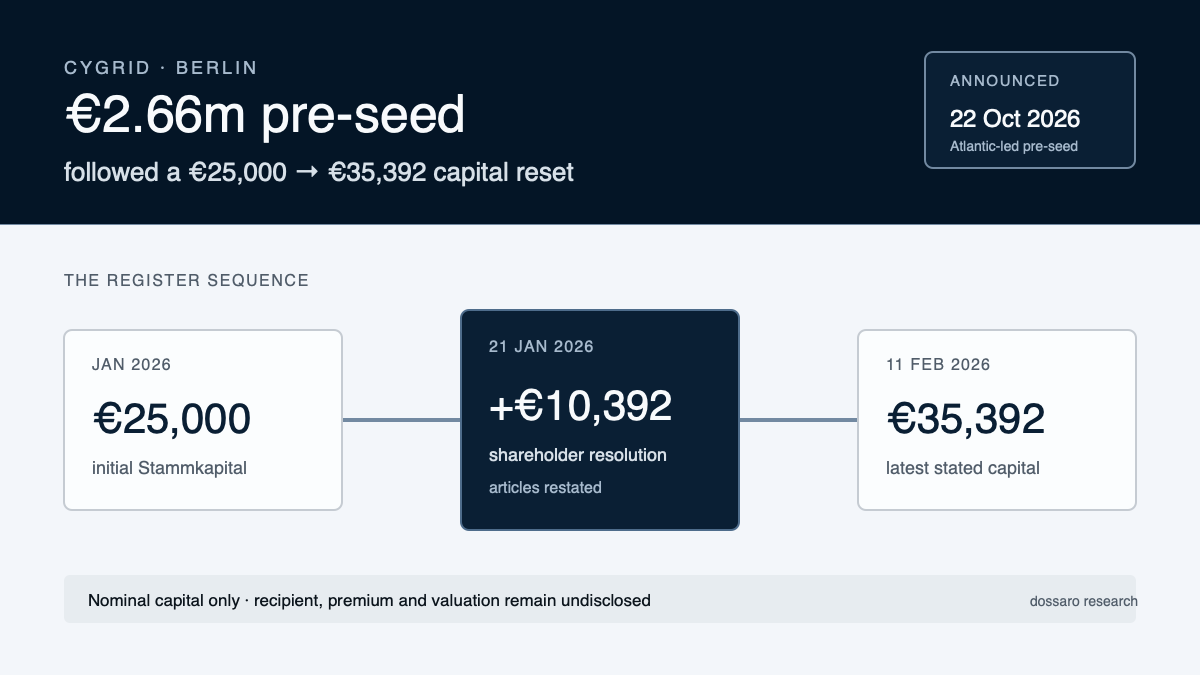
Cygrid’s €2.66 million pre-seed was announced after the Berlin company had already increased its German nominal capital from €25,000 to €35,392. The capital decision was dated 21 January 2026 and entered in the register on 11 February, months before the company emerged from stealth on 22 October.
The increase does not reveal who received the new position, what premium was paid or what valuation the backers accepted. It does establish a legal-capital reset that changes the diligence question around the round. Cygrid’s public story is a financing for identity enforcement across human, machine and artificial-intelligence agents. Its register story is a company that had already rebuilt its stated capital base before naming Atlantic, d11z and its operator angels as investors.
The public round describes a security product, not a cap table
Cygrid’s official announcement says the Berlin startup raised €2.66 million in pre-seed funding led by Atlantic, with participation from d11z and angels associated with bonify/SCHUFA, Zscaler and AmberVale Capital. The company says it had stopped more than 2,000 risky identity actions at more than 20 companies before launch, and that the financing will fund enforcement capabilities, hiring and go-to-market expansion.
The product description is specific. Cygrid maps human, service-account and AI-agent identities into an identity graph, then evaluates and blocks actions before they reach a sensitive system. The company says it is already operating across Google Workspace, Microsoft 365, GitHub, Slack and HubSpot. Startup.eu’s independent coverage, published on 23 October, confirms the round amount, Atlantic’s lead role, the d11z participation and the stated use of funds.
Neither public account describes the securities issued by Cygrid GmbH. They name the financing participants and the product case, but not a nominal-capital increase, subscriber list, issue price or post-money ownership schedule. That is the gap the German register can narrow, without turning it into a complete investor map.
The German register records two capital states
Cygrid GmbH is registered at Amtsgericht Charlottenburg under HRB 282801 B. Its current extract, retrieved on 26 October 2026, states €35,392 of Stammkapital and lists Dmitry Kharchenko and Dekel-Tom Paz as managing directors. The chronological extract records the company’s first entry in January 2026 with €25,000 of capital and the later increase.
The relevant sequence is short:
| Register event | Capital state | What it establishes |
|---|---|---|
| Company contract dated 5 January 2026; first entry 9 January | €25,000 | Initial stated capital of the German GmbH |
| Shareholder resolution dated 21 January; entry 11 February | €35,392 | €10,392 nominal increase and restated articles |
| Current extract retrieved 26 October | €35,392 | Latest accessible legal-capital state after the increase |
The increase is €10,392. Relative to the original €25,000, that is 41.57%. Relative to the post-increase €35,392, the new nominal block is 29.36%. Those percentages describe the legal capital ledger, not the share of the company held by Atlantic, d11z, an angel or either founder.
That distinction is central for a German GmbH. Nominal capital is the registered amount of share capital. The financing economics can also include a premium, and the extract does not state one. It does not say whether the new nominal units were issued to a fund, an operating founder, a strategic participant or an existing holder. It also does not publish the subscription price or the rights attached to each unit in a way that supports an investor percentage.
A capital reset is evidence of a new position, not its price
The strongest finding is therefore chronological rather than allocational. Cygrid had a €25,000 legal-capital base in January. A shareholder resolution then raised it by €10,392 and restated the articles. The company later announced a €2.66 million pre-seed whose backers are visible in public coverage but not in the register extract’s capital line.
For diligence, that changes the first question from “Which investors backed Cygrid?” to “Where did the round’s economics sit?” The register confirms that a new nominal position existed before the announcement. It does not establish that the full €2.66 million was paid into the German entity, that the increase was the financing itself, or that the new capital represented 29.36% of the company’s economic or voting rights.
The most defensible interpretation is that the public financing and the legal-capital increase belong to the same early corporate build-out, but the source set does not prove their one-to-one relationship. A GmbH can use a nominal increase for a priced subscription, while the larger economic amount sits in a premium. It can also prepare its articles and capital before a later close. The evidence supports both possibilities and does not choose between them.
The same boundary applies to the named backers. Atlantic led the public round and d11z participated, but neither fund can be assigned the €10,392 increase from the current extract. The public announcement identifies angels including Andreas Bermig, Boris Gorin and Vlad Tropko, but their legal positions are not stated. The two named managing directors are part of the company’s current register state, not proof that either founder retained a particular percentage after the financing.
Why the timing matters for an AI-security company
Cygrid’s launch narrative is about controlling what an identity can do after it has logged in. Its corporate record presents a parallel governance question: which legal entity received the new capital, and what rights came with it?
That question has commercial weight even when the amount is small by later-stage standards. A pre-seed investor may receive ordinary units, preferred terms, a convertible instrument or a contractual right that is not visible in the nominal-capital figure. Existing holders may have been diluted by the new units, but their economic exposure depends on the premium, the articles and any shareholder agreement. A customer or acquirer evaluating the company therefore needs more than the round headline and more than the €35,392 number.
The pattern is familiar across private-company financing. Epoch Blue’s preferred-share filing shows how a public seed can sit beside multiple legal classes and a board appointment. Adsilico’s Series A filings likewise show why a large announced round and an issued-share count answer different questions. Cygrid is earlier in its life, but the same separation between headline capital and legal position already applies.
The evidence boundary is the useful result
The public and register records support five firm points. Cygrid GmbH is the Berlin legal entity behind the announcement. Its initial January 2026 register state showed €25,000 of Stammkapital. A 21 January shareholder resolution increased that amount by €10,392 to €35,392, and the change was entered on 11 February. Cygrid announced a €2.66 million pre-seed on 22 October, led by Atlantic with d11z and named angels participating. The latest extract still does not identify the recipient, premium or valuation attached to the capital increase.
The records do not support a claim that Atlantic or d11z received a particular number of units, that the €2.66 million was fully paid into Cygrid GmbH, or that the 29.36% post-increase nominal block equals an investor’s ownership or voting stake. They also do not establish the post-round cap table or any liquidation preference.
The next decision-changing document is a filed shareholder list, subscription record or amended articles that names the recipient of the €10,392 increase and states the rights attached to it. A later filing may also show whether the public pre-seed created a new class, used a premium or closed at a parent entity. Until that evidence appears, the defensible conclusion is precise: Cygrid announced €2.66 million after its German company had already reset nominal capital, making the legal position visible while leaving the financing economics open.
Sources
Continue reading
Related Research
Epoch's $4.25m Seed Came With 670,087 Preferred Shares
Epoch's $4.25m seed sits beside 670,087 preferred shares, $6.26m of filed paid-in amounts, a Burnt Island board appointment and a June issue window.
Adsilico’s £10m Series A Made Series A 47.24% of Issued Shares
Adsilico’s £10m Series A created two large Series A allotments, but Companies House leaves the investor-by-investor ownership map unresolved.
OMass’ $310m Series C Added a £40m C-1 Preference Layer
OMass’s $310m Series C included a £1 deferred-share cancellation and a £40m Series C-1 issue with priority rights, exposing a new downside layer.
EVASIVE Robotics’ €2.1m Pre-Seed Created a Nine-Holder Preferred Syndicate
EVASIVE Robotics’ €2.1m pre-seed issued 9,330 Pre-Seed shares to nine named holders, giving the syndicate 27.18% of German nominal capital after closing.