
EVASIVE Robotics’ €2.1m Pre-Seed Created a Nine-Holder Preferred Syndicate
EVASIVE Robotics’ €2.1m pre-seed issued 9,330 Pre-Seed shares to nine named holders, giving the syndicate 27.18% of German nominal capital after closing.
On this page
Conduct your own private market research
Add dossaro to Claude or ChatGPT and run source-backed register research from your own workspace.
 Add to Claude
 Add to ChatGPT
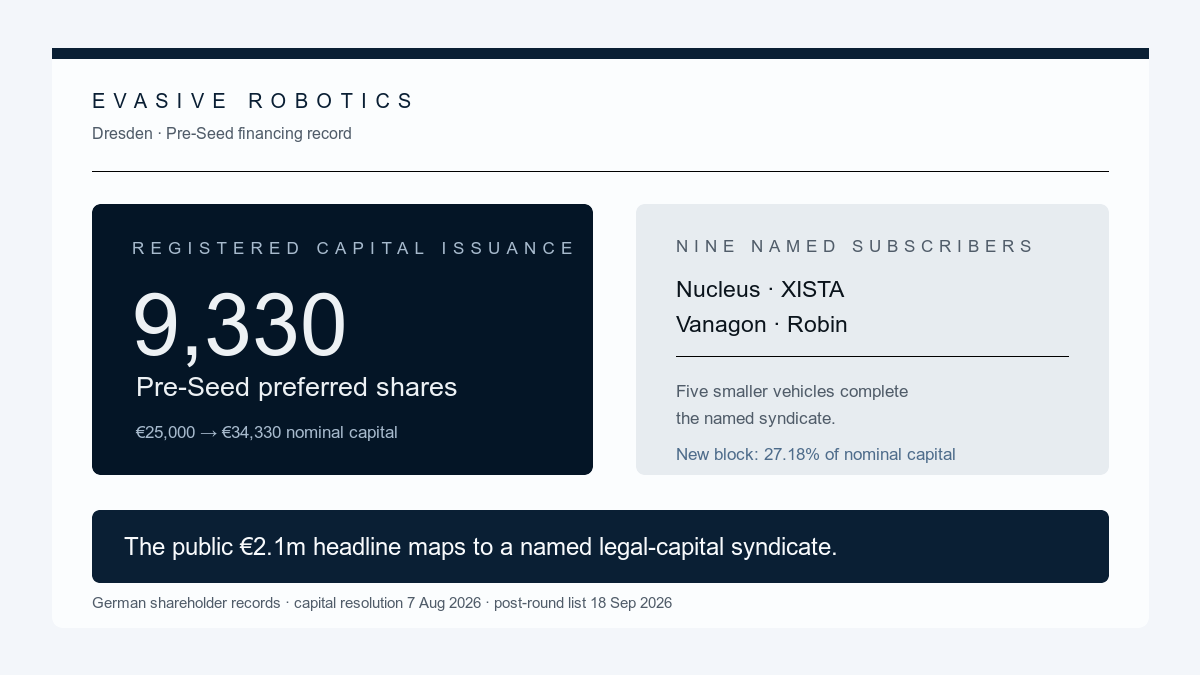
EVASIVE Robotics announced an oversubscribed pre-seed of more than €2.1 million. German shareholder records show the financing did more than add a headline lead investor: it created exactly 9,330 Pre-Seed preferred shares for nine named funds and corporate vehicles. Those new shares represent 27.18% of the company’s €34,330 registered capital after the increase.
The finding is precise, but it is not a valuation. The records do not show the cash paid by each subscriber, any premium over nominal value, liquidation preferences or a complete voting outcome. They do show a legal-capital block that was not visible in the public funding announcement. The original holders moved from 100% of the registered capital to 72.82%, while Nucleus Capital and XISTA each emerged with 8.12% of the nominal share base.
The public round describes a robotics product, not the holder map
EVASIVE’s announcement from XISTA, published on 22 October 2026, says the Dresden company raised more than €2.1 million with XISTA Science Ventures participating. The company was founded in 2024 by Stefan Zetzsch, Frank Peters, David Kuß and Tom Sauer. It develops software that coordinates several robots safely and efficiently in shared industrial workspaces, with the aim of reducing integration work and making factory setups more flexible.
XISTA says the funding will support product development, team growth and additional industrial deployments. Startup.eu’s independent coverage confirms the pre-seed amount, names Nucleus Capital, XISTA, Vanagon and Robin Capital among the investors, and describes the orchestration layer for assembly and palletizing. Dealroom’s profile likewise lists a €2.1 million October round and the four main funds.
Those sources answer the public questions of amount, timing and product. They do not publish the post-round shareholder list, the number of shares issued or the class of those shares. The company’s imprint identifies the exact legal entity as EVASIVE ROBOTICS GmbH, registered with Amtsgericht Dresden under HRB 45899. That identity makes the filing sequence the useful counterpoint to the funding headline.
The register shows an earlier founder transfer
The accessible German shareholder records show €25,000 of registered capital before the pre-seed issuance. The holder map was already changing before the new syndicate appeared.
| Register state | Registered holders and capital | What the record establishes |
|---|---|---|
| 6 November 2024 | Kane Lives Ventures UG 10,700; DKuss Ventures UG 7,150; SZetzsch Ventures UG 7,150; total €25,000 | Three original vehicles held the full registered capital |
| 9 June 2026 | TS Ventures UG acquired 2,500 shares; Kane Lives 38.52%; DKuss Ventures 25.74%; SZetzsch Ventures 25.74% | A 10% position was transferred before the financing |
| 18 September 2026 | €34,330 total capital; four original vehicles 25,000 shares; nine new holders 9,330 shares | The Pre-Seed class was recorded after the capital increase |
The June list records TS Ventures UG with 2,500 shares, or 10% of the €25,000 base. The exact percentages from the register are 38.52% for Kane Lives, 25.74% for DKuss Ventures, 25.74% for SZetzsch Ventures and 10% for TS Ventures. The transfer is important context, but it is separate from the later cash increase. It means the founder vehicles were not a single unchanged block when the pre-seed closed.
Nine subscribers created a 27.18% preferred block
The 7 August 2026 capital-resolution minutes approve an increase of €9,330, from €25,000 to €34,330, against cash. The resolution creates a new Pre-Seed preferred class and names the subscribers. A companion subscriber list and the 18 September shareholder list carry the same allocation forward.
| Subscriber | New Pre-Seed shares | Share of post-round nominal capital |
|---|---|---|
| Nucleus Capital Fund II | 2,789 | 8.124% |
| xista science ventures II EUVECA | 2,789 | 8.124% |
| Vanagon Ventures Fund I | 2,145 | 6.248% |
| Robin Fund II | 858 | 2.499% |
| Uncanny Capital | 43 | 0.125% |
| GER4TECH | 214 | 0.623% |
| Commsolid | 214 | 0.623% |
| Zanger Beteiligungsgesellschaft | 64 | 0.186% |
| KIEMIS Holding | 214 | 0.623% |
| New syndicate total | 9,330 | 27.18% |
The arithmetic is straightforward: 9,330 new shares divided by 34,330 total shares equals 27.18%. The four earlier vehicles retain 25,000 shares, or 72.82%. Their post-round nominal positions are approximately 28.05% for Kane Lives Ventures, 18.75% for DKuss Ventures, 18.75% for SZetzsch Ventures and 7.28% for TS Ventures.
The capital resolution says the shares were payable within ten bank days. The later shareholder list records the nine subscribers. Together, the documents establish an issuance and a resulting registered-capital map, rather than a transfer from one investor to another.
Nominal capital is not the €2.1m price tag
The contrast between €9,330 of nominal capital and more than €2.1 million of announced funding is the central diligence point. A German GmbH can issue shares at nominal value and receive additional money as a premium. It can also pair an equity issue with instruments or contractual rights that are not stated in the shareholder list. The available records do not say which structure accounts for the difference here.
That boundary matters for how the dilution should be read. The 27.18% figure is a share of registered capital. It is not a claim that the new investors paid 27.18% of the company’s value, that their cash was divided in proportion to the share counts, or that any one fund has a particular economic return. The documents also do not state liquidation preferences, veto rights, conversion terms or a shareholders’ agreement.
The preferred label still carries useful information. It shows that the financing was not recorded as a single undifferentiated ordinary-share issue. The exact rights remain in the company’s constitutional documents, and the available evidence supports no stronger conclusion about control than the share counts themselves.
The original holders remain a large block, but not the old one
The pre-seed left the original vehicles with a clear majority of registered capital, yet it also changed the composition of the company’s capital table. Before the increase, three vehicles held the full €25,000 base. After the June transfer and the August issuance, four original vehicles together hold 72.82%, while nine new subscribers hold 27.18% in the Pre-Seed class.
That is a meaningful financing architecture even without a valuation. Nucleus and XISTA are each large enough to be visible as individual holders. Vanagon adds a 6.25% nominal position, and Robin holds 2.50%. The five smaller holders together account for about 2.18%. The syndicate therefore combines two anchor funds, two material participants and a long tail of smaller vehicles.
The pattern is different from a round where a single lead fund takes a new block and the rest of the syndicate is hidden behind a nominee. It is also different from a founder secondary: the August resolution records new cash shares, and the total registered capital increases. Cygrid’s earlier pre-seed filing sequence illustrates why a nominal-capital movement can show that a new legal position exists without revealing the premium or investor allocation. Epoch Blue’s preferred-share records show how a class label can matter for governance without proving a control transfer.
What the filing sequence changes for investors and founders
For investors, the records make the syndicate legible. The round was not only an announcement backed by a lead fund. It was a named set of subscribers that received a new preferred class and a defined portion of registered capital. That is enough to identify who should appear in later amendments, shareholder lists or governance documents.
For the original holders, the immediate effect is dilution from 100% to 72.82% of nominal capital, layered on top of the earlier TS Ventures transfer. Whether that dilution is economically favourable depends on the premium, the preference stack and the company’s future value. The records do not show the founders’ voting threshold or whether any reserved matters require investor consent.
For EVASIVE, the structure fits a company moving from a founder-funded base into industrial deployment. Multi-robot coordination has a commercial consequence only if the software can be integrated into real production lines. The funding announcement says deployments and team growth are next. The legal records show which capital providers now have a documented position while leaving the operating milestones to be proven.
The strongest conclusion is therefore narrow: EVASIVE’s oversubscribed pre-seed created 9,330 Pre-Seed preferred shares for nine named holders, giving the new syndicate 27.18% of the German company’s registered capital. It did not disclose the valuation, each investor’s cash contribution or the rights attached to the class. The next decision-changing documents are the amended articles and any subscription or shareholders’ agreement that set out those economics.
Sources
Continue reading
Related Research
Cygrid’s €2.66m Pre-Seed Followed a Nominal-Capital Reset
Cygrid’s €2.66m pre-seed followed a German capital reset from €25,000 to €35,392, exposing a new legal stake without revealing its investor or valuation.
Epoch's $4.25m Seed Came With 670,087 Preferred Shares
Epoch's $4.25m seed sits beside 670,087 preferred shares, $6.26m of filed paid-in amounts, a Burnt Island board appointment and a June issue window.
Adsilico’s £10m Series A Made Series A 47.24% of Issued Shares
Adsilico’s £10m Series A created two large Series A allotments, but Companies House leaves the investor-by-investor ownership map unresolved.
Tendos’ €12m Seed and Insight’s Separate 40% Stake
Tendos announced a €12m Insight-led seed, while German shareholder lists show a separate 8,221-share transfer that lifted Insight to about 40%.