
Epoch's $4.25m Seed Came With 670,087 Preferred Shares
Epoch's $4.25m seed sits beside 670,087 preferred shares, $6.26m of filed paid-in amounts, a Burnt Island board appointment and a June issue window.
On this page
Conduct your own private market research
Add dossaro to Claude or ChatGPT and run source-backed register research from your own workspace.
 Add to Claude
 Add to ChatGPT
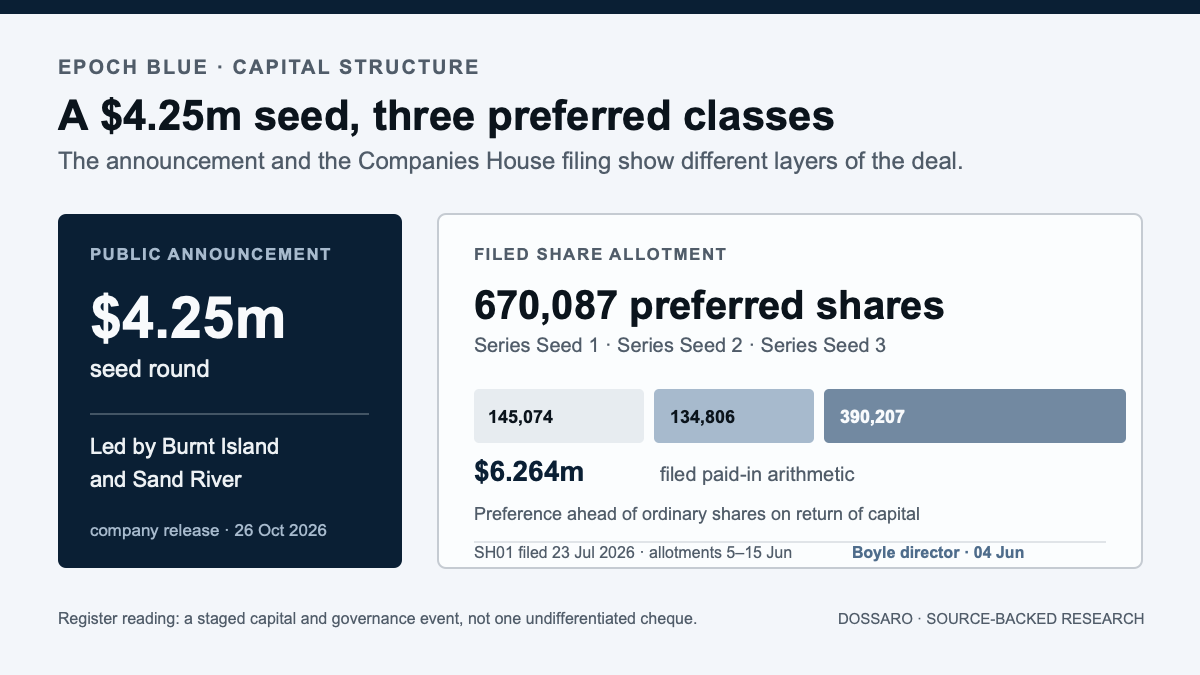
Epoch Blue's public $4.25 million seed announcement describes a financing for a supply-chain compliance business. The UK filing sequence shows a more structured event: between 5 and 15 June 2026, Epoch Blue Ltd allotted 670,087 shares across three Series Seed classes, with the filed paid-in amounts adding to about $6.264 million. The same record gives each class a preference ahead of ordinary shares on a return of capital.
That does not mean the company received $6.264 million on one day, or that the public round figure is wrong. It means the commercial event cannot be read as one undifferentiated cheque. The company's announcement says the seed closed at $4.25 million and was led by Burnt Island Ventures and Sand River. The Companies House filing records the legal share classes, the allotment window and the rights that sit behind the capital. A separate filing records Burnt Island Ventures partner Christine Boyle as a director from 4 June, before the announcement.
For investors, the useful finding is the combination. The public story is a $4.25 million seed and a new EUDR compliance product. The filed story is a three-class preferred stack, a 40.12% increase in the simple issued-share count, and a board appointment that preceded the public release. The documents do not identify which investor received each class, disclose a post-money valuation or prove the final voting or liquidation outcome.
The announcement and the register answer different questions
Epoch says its software helps companies prepare for the European Union Deforestation Regulation. In its 26 October announcement, the company said it had closed a $4.25 million seed led by Burnt Island Ventures and Sand River, with Christine Boyle and Greg Robson named as the relevant fund partners. It also said the platform had screened more than 12,000 suppliers over six months and could reach more than 30,000 enterprises through partners.
Independent coverage by The Cap Table confirms the round framing and reports that two existing institutional backers increased their positions. That account does not disclose a valuation or investor-by-investor allocation either.
The public sources therefore establish the fundraising narrative, but not the legal mechanics. Those mechanics appear in the Companies House filing history for EPOCH BLUE LTD, company number 14833307. The SH01 return was filed on 23 July and covers allotments dated from 5 to 15 June. The form is denominated in dollars for the allotment rows, while the statement of capital reports nominal values in pounds.
The result is a source-backed distinction between the announced financing amount and the filed paid-in amounts. They are related evidence, not interchangeable figures.
Three Series Seed classes changed the capital stack
The SH01 lists 145,074 Series Seed 1 shares, 134,806 Series Seed 2 shares and 390,207 Series Seed 3 shares. Together they total 670,087 new shares. Before the allotment, the filing shows 1,000,000 ordinary shares. After it, the statement of capital shows 1,670,087 shares in issue.
| Filed class | New shares | Amount paid per share | Filed paid-in amount | Rights stated in SH01 |
|---|---|---|---|---|
| Series Seed 1 | 145,074 | $5.79 | $839,978.46 | Voting, dividends and preference ahead of ordinary |
| Series Seed 2 | 134,806 | $8.71 | $1,174,160.26 | Voting, dividends and preference ahead of ordinary |
| Series Seed 3 | 390,207 | $10.8917 | $4,250,017.58 | Voting, dividends and preference ahead of ordinary |
| Total | 670,087 | Varies by class | $6,264,156.30 | Three preferred classes |
The calculation is 145,074 × $5.79 + 134,806 × $8.71 + 390,207 × $10.8917 = $6,264,156.30. The filing says no amount was unpaid. It also states that the preferred classes have voting and dividend rights and no redemption right. On a return of capital, each class has a preferential right, pari passu with the other Series Seed shares and ahead of ordinary shares, to receive its preference amount or, if greater, its proportion of the amount available on an as-converted basis.
The share-count change is equally concrete. The 670,087 new shares are 40.12% of the 1,670,087 shares shown after the allotment. That is a simple issued-share calculation, not a fully diluted ownership percentage. The filing does not show who subscribed for each tranche, whether options or convertibles sit outside the issued count, or how the classes divide economic value in every exit scenario.
This kind of separation matters in private-company analysis. A primary issue changes the company's capital base, while the class terms determine how different holders rank when cash is distributed. The Rabot Energy Series B filing provides a useful comparison: its financing story also requires the reader to separate the announced round from the legal entities and securities that implement it.
The $4.25 million headline and $6.264 million filing can coexist
The gap between the announcement and the filing is the story's central accounting question. The announcement says $4.25 million. The SH01's arithmetic produces $6.264 million of paid-in amounts across three classes. Neither source, by itself, explains the difference.
Several readings remain open. The SH01 covers an allotment window rather than a single closing date. The classes may represent more than one stage of the financing, an earlier subscription combined with the new seed, or a legal capitalisation sequence that does not map one-for-one to the press release. The public announcement may also use a round figure that excludes a separate issuance or describes only the newly marketed seed tranche.
What the filing does not support is a clean assertion that every dollar in the $6.264 million total was newly paid on the date the form was filed. The form reports amounts paid on each class and says nothing unpaid, but it is a return covering the allotment period. It does not include a bank record, subscription agreement or investor allocation schedule.
The best-supported description is therefore narrow: Epoch's announced $4.25 million seed sits alongside a Companies House allotment whose class-level paid-in arithmetic totals $6.264 million. The two numbers should be investigated together, not collapsed into a single definitive proceeds figure.
A board appointment came before the public release
The governance signal is separate from the capital arithmetic. An AP01 filed on 29 June records Christine Boyle's appointment as a director effective 4 June. The filing identifies her as an American national and names Epoch Blue Ltd as the company. Epoch's announcement later identifies Boyle as a Burnt Island Ventures partner joining the board.
That timing puts an investor-linked board appointment before the 26 October public announcement by more than four months. It does not prove that Boyle controlled the allotment, that Burnt Island received a particular class, or that the board had already approved every commercial detail of the financing. It does show that governance participation was formalised in the public record before the round was announced.
The timing changes the reading of the seed. The round was not only a capital event followed by a marketing release. At least one investor representative was already a director, while the share issue carried three preferred classes with defined priority rights. Governance and capital structure moved together, even though the public sources do not disclose the complete investor map.
The distinction is important for a buyer, lender or later-stage investor. A board seat can shape information flow and strategic oversight, but it is not the same as a majority stake or a disclosed veto. The SH01 confirms voting rights for the preferred shares, yet it does not state the aggregate votes held by any named investor. The AP01 confirms Boyle's appointment, yet it does not disclose her mandate or any reserved-matters agreement.
What the filings do not yet prove
The public record supports four firm findings. Epoch Blue Ltd is the exact UK entity behind the announcement. It filed 670,087 new shares in three Series Seed classes during June. The filed paid-in amounts add to $6.264 million and the classes rank ahead of ordinary shares on a return of capital. Christine Boyle became a director on 4 June, before the announcement was published.
The record does not support an exact post-money valuation, a fully diluted cap table, investor-by-investor ownership, or a claim that Burnt Island and Sand River split the filed amount in any particular way. It also does not establish whether the ordinary shareholders retained a majority of votes after the issue, because the class-by-class voting totals and any shareholder agreements are not in these filings.
That boundary is commercially useful. It tells a prospective investor what is known from the register and what still requires diligence. The preferred classes create a priority claim on exit proceeds, but the amount of that priority depends on the Articles and the preference amount. The board appointment creates a governance fact, but not a complete control map. The amount mismatch creates a reconciliation question, not evidence of an undisclosed transaction.
The next filing will decide the economic reading
The next useful document is a post-round confirmation statement or shareholder filing that names the holders and shows whether another allotment, transfer, option exercise or conversion followed the June issue. A public subscription agreement or updated Articles would help explain the preference amount and any investor-consent rights. Until that evidence appears, the strongest conclusion remains a register-level one.
Epoch Blue's $4.25 million seed was implemented alongside a 670,087-share, three-class preferred allotment with filed paid-in amounts of about $6.264 million. A Burnt Island partner was appointed to the board before the announcement. That combination points to a staged financing and governance package, not a single undifferentiated cheque. It is enough to change how the round should be modelled, while leaving the final investor economics and control outcome open.
Continue reading
Related Research
Rabot Energy's $50m Series B Reweighted Its Investor Coalition
Rabot Energy's public €50m Series B maps to 26,816 new shares in RABOT Charge, diluting Rabe Venture from 21.90% to 16.34% on issued shares.
Hansetherm’s €10m Seed Put Two Near-25% Blocks at the Center of Its Cap Table
Hansetherm’s €10m seed created 65,429 new shares, putting two less-visible blocks near 25% each while G-FUND holds 2.11% before scale-up plans.
Christian Lindner Added 60 Shares to QuoIntelligence's Post-Series A Capital Base
QuoIntelligence's latest shareholder list records Christian Lindner's 60-share transfer from Mercurius, leaving €54,894 capital unchanged after the Series A.
NexGen Cloud's $106m GPU Loan Followed a Founder-Control Reset
NexGen Cloud's $106m GPU loan followed a founder-linked control reset, a new charge over Finnish capacity and a filed €121m promissory-note schedule.