
NexGen Cloud's $106m GPU Loan Followed a Founder-Control Reset
NexGen Cloud's $106m GPU loan followed a founder-linked control reset, a new charge over Finnish capacity and a filed €121m promissory-note schedule.
On this page
Conduct your own private market research
Add dossaro to Claude or ChatGPT and run source-backed register research from your own workspace.
 Add to Claude
 Add to ChatGPT
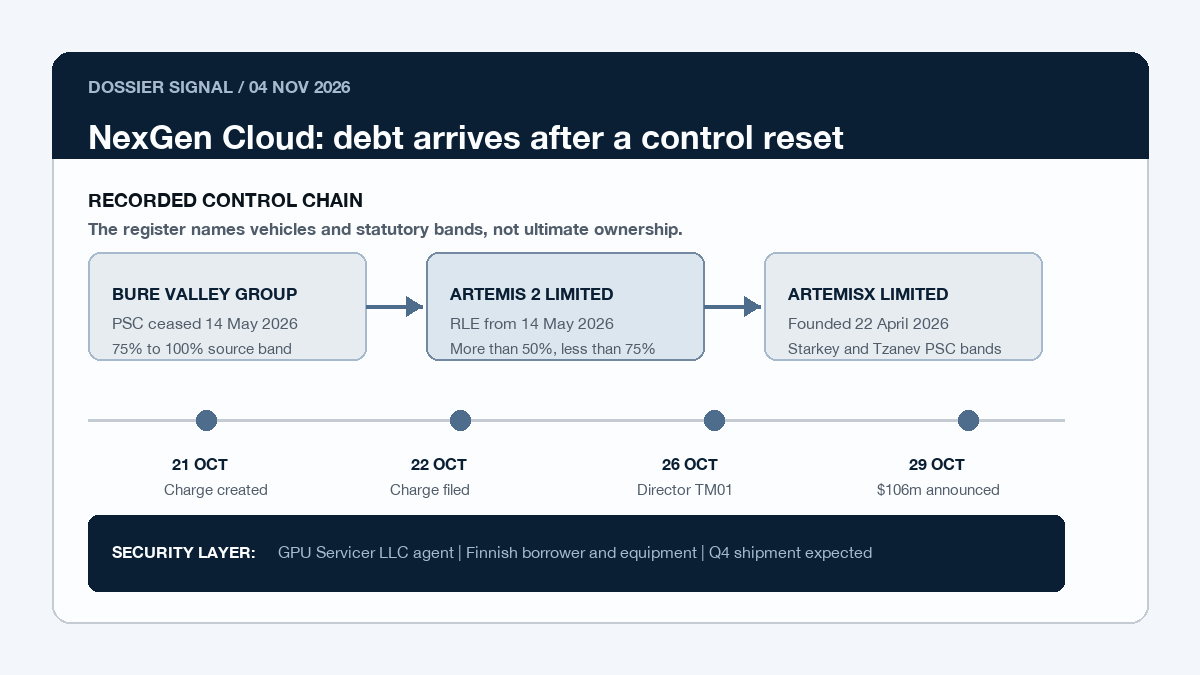
NexGen Cloud's $106 million GPU facility was announced as a capacity expansion, but the public register shows that a control and security reset was already underway. Months before the announcement, Companies House recorded a new Artemis 2 and Artemisx chain in place of the older Bure Valley corporate person with significant control. A charge created on 21 October and filed the next day then put a Finnish borrower, its equipment and its shares inside a security agreement for GPU Servicer LLC. The servers were still expected to ship in the fourth quarter.
That chronology does not prove that the founders caused the loan, that the lenders control NexGen or that the new structure changed ultimate ownership. It does show why the facility should be read as more than a purchase order for Nvidia hardware. The financing sits on a legal structure that allocates control, collateral and execution risk before the new capacity can generate revenue.
The public facility finances capacity that is not operating yet
In its 29 October announcement, USD.AI said it arranged and closed a four-year senior secured term loan for NexGen Cloud. Silver Point Capital and Victory Park Capital joined the lender group. The facility is intended to finance 216 NVIDIA HGX B300 servers, or 1,728 GPUs, at a Tier III data centre in Finland. USD.AI said escrow funding is aligned with shipment and that delivery is expected in the fourth quarter of 2026.
The same release says the Finnish capacity is fully contracted under a take-or-pay agreement with an unnamed AI inference platform, while the loan amortises over the same four-year term. The company had already announced a $34 million USD.AI facility for a B200 deployment in Sweden in June, bringing the two announced facilities to $140 million.
EUVC's independent report makes the timing point explicit: the new capacity was not yet operating. NexGen still had to receive and install the systems, bring the Finnish site online and deliver reliable service over the contract term. The public commercial logic is straightforward. Contracted demand provides a repayment story, while debt lets the company deploy servers without funding the entire purchase from equity.
The risk is equally clear. A take-or-pay contract does not install hardware, guarantee uptime or eliminate customer-payment risk. Until the servers ship and pass the operator's checks, the facility finances a defined deployment rather than a proven stream of Finnish compute revenue.
The control record changed before the debt announcement
The Companies House overview identifies NEXGEN CLOUD LIMITED as an active private company incorporated on 15 April 2020, with registered office at 6th Floor, 99 Gresham Street, London, and SIC 63110 for data processing and hosting. Its control chronology is more informative than the public loan release.
The older corporate PSC, Bure Valley Group Limited, ceased on 14 May 2026. The same effective date appears in the Companies House filings that made Artemis 2 Limited the recorded relevant legal entity. Artemis 2 is reported in the source-native band of more than 50% but less than 75% of NexGen's shares and voting rights. The filing also records that Artemis 2 holds more than 50% but less than 75% of the voting rights, rather than presenting a precise percentage.
Artemis 2 was incorporated on 22 April 2026 with 300 ordinary shares, all subscribed by Artemisx Limited. Its incorporation filing names Christopher William Starkey and Youlian Tzanev as directors. Artemisx was incorporated on the same day. Its initial filing lists Ash Rise Consulting S.L., Antony Wade and YT Property Worldwide S.L. as subscribers, and records Starkey and Tzanev as individual PSCs in the source-native band of more than 25% but not more than 50% each.
The sequence can be stated precisely:
| Recorded event | What the source shows | What it does not establish |
|---|---|---|
| 14 May 2026 | Bure Valley's NexGen PSC row ceased; Artemis 2 became the recorded RLE in the 50% to 75% bands | Why the change occurred or who owns the economic interest behind the chain |
| 22 April 2026 | Artemis 2 was incorporated with all 300 shares subscribed by Artemisx; Starkey and Tzanev were directors | A final NexGen cap table or exact founder percentage |
| 21 to 22 October 2026 | A charge was created and filed for GPU Servicer LLC | The amount drawn, lender allocations or a default |
| 29 October 2026 | USD.AI announced the $106m four-year facility | That the Finnish servers were already installed or producing revenue |
That is a control reset in the statutory record, not a beneficial-ownership conclusion. A PSC band can coexist with shareholder agreements, investor consent rights and indirect interests that are not shown in the filing. It would be overreach to say that the Artemis chain proves Starkey and Tzanev own every economic interest in NexGen, or that the new vehicle was created specifically for the loan.
The charge puts hardware and the Finnish borrower into the risk perimeter
The MR01 filing created on 21 October 2026 names GPU Servicer LLC as the person entitled to the charge. The parsed security agreement identifies NGC FI11 Oy as borrower and pledgor, NexGen Cloud Limited as another pledgor and GPU Servicer LLC as agent for the secured parties. It says the equipment is or will be hosted at a facility operated by GleSYS Finland Oy.
The agreement defines the equipment as servers, GPU cards and supporting networking and infrastructure equipment, identified by make, model, serial number, asset tag and location in a schedule. It also describes a first-priority possessory pledge over that equipment. Another schedule describes a first-priority pledge over 100% of the shares and votes in NGC FI11 Oy, with an event-of-default mechanism under which the agent may use voting rights.
That language shows how the transaction transfers risk. The lenders are not relying only on a promise to repay from a UK cloud company. The security agreement is built around a Finnish borrower, the equipment expected to be installed there and the shares of the borrower. It also contains schedules for bank accounts and receivables. Several of those schedules state that no assets were listed at the date of the agreement, so the article does not claim that every possible collateral category was populated.
The filing contains an unusual scale marker. Schedule 4 prints a promissory-note form with a principal amount of €121 million and an 11% interest rate. Its issue date is blank, and the document contains other placeholders. The schedule therefore cannot be treated as proof that €121 million was drawn, that the $106 million announcement is misstated or that the amount represents the server purchase price. It is better read as evidence of the security package's intended instrument scale, subject to definitive documentation.
The earlier July charge adds context. Its security document concerns shares in NGC TEN AB and was granted to GPU Finance Ltd. The 21 October charge names a different agent, GPU Servicer LLC, and a Finnish borrower with the equipment pledge. The public record therefore shows a sequence of secured financings around Swedish and Finnish deployments, not one undifferentiated $140 million obligation.
A director filing adds timing, not causation
Companies House also records a TM01 termination filed on 26 October. It says Douglas Iain McMurdo's directorship ended on 8 October, three weeks after the Artemis 2 control change and three days before USD.AI's announcement. The timing is notable because it sits inside the same pre-announcement window as the security agreement, but the filing gives no reason.
The safest reading is chronological. The company changed its recorded control path, filed a new security agreement and updated its board record before announcing a larger GPU facility. The documents do not say that the director left because of the financing, that the lenders requested the change or that the event altered day-to-day management. The filing is a watchpoint, not a motive.
The commercial consequence is a risk-and-control stack
The public narrative says NexGen has customer demand and a financing partner capable of converting that demand into European capacity. The filings add three layers to that narrative.
First, the founder-linked Artemis chain is the recorded control path when the new obligation arrives. That can matter to lenders, suppliers and customers because the people recorded in the control chain are associated with the operating decision-makers, while the old corporate PSC has ceased. It still does not reveal every contractual right.
Second, the debt is tied to a deployment that is not yet operating. The take-or-pay contract is the benign credit explanation, but the company remains exposed to delivery, installation, uptime and counterparty performance. The security package gives lenders a defined route to equipment and the Finnish borrower's shares if an event of default occurs. That is not the same as present lender control.
Third, the filed €121 million schedule shows why a headline loan amount should not be turned into a valuation or an ownership percentage. The legal instrument includes a promissory-note form and broad collateral architecture, while the public release gives the commercial amount and use of proceeds. Neither source alone answers who ultimately bears the residual economics.
The pattern resembles other private-market financings where the legal wrapper carries as much information as the announcement. Smile2Impress's EIB debt stack shows why the date and security of a loan can matter more than a growth headline. VoltR's emergency bridge shows a different kind of timing gap, where a later industrial package follows an earlier liquidity need. Epoch Blue's preferred stack is a useful contrast for separating capital protection from recorded board control.
The next records should resolve the remaining gap
The next decision-changing evidence is specific. A post-announcement confirmation statement or PSC filing should show whether the Artemis 2 band changed. A shareholder or allotment filing could identify whether new capital entered NexGen directly or a vehicle. Completed equipment schedules could show which servers were actually pledged after installation. A fuller loan disclosure could clarify the borrowing base, amortisation and lender allocations.
Until those records appear, the strongest supported finding is narrower than a claim about ownership or lender control: NexGen announced a $106 million GPU loan after the statutory control chain had been reset and a first-priority security agreement had been filed around a Finnish deployment that had not yet shipped. The public release explains the growth case. The register shows who is recorded around the obligation and what assets the security document was built to protect.
Sources
Continue reading
Related Research
Impress’s €40m EIB Loan Adds a New Layer to Existing Venture Debt
Impress’s €40m EIB loan sits beside outstanding Trinity charges, while older lender security was satisfied in January, making the debt stack visible.
VoltR's €22m Industrial Push Follows a Documented Capital Repair
VoltR's €22m industrialisation package follows a 2025 capital repair: an emergency €400,002.76 issue, a rejected dissolution vote and a founder SPV.
Epoch's $4.25m Seed Came With 670,087 Preferred Shares
Epoch's $4.25m seed sits beside 670,087 preferred shares, $6.26m of filed paid-in amounts, a Burnt Island board appointment and a June issue window.
i23’s £4.9m Seed Arrived After Its Founder Control Record Changed
i23 raised £4.9m for an AI insurance broker after its founder subscribers ceased to be registrable PSCs, leaving the control chain unresolved.