
VoltR's €22m Industrial Push Follows a Documented Capital Repair
VoltR's €22m industrialisation package follows a 2025 capital repair: an emergency €400,002.76 issue, a rejected dissolution vote and a founder SPV.
On this page
Conduct your own private market research
Add dossaro to Claude or ChatGPT and run source-backed register research from your own workspace.
 Add to Claude
 Add to ChatGPT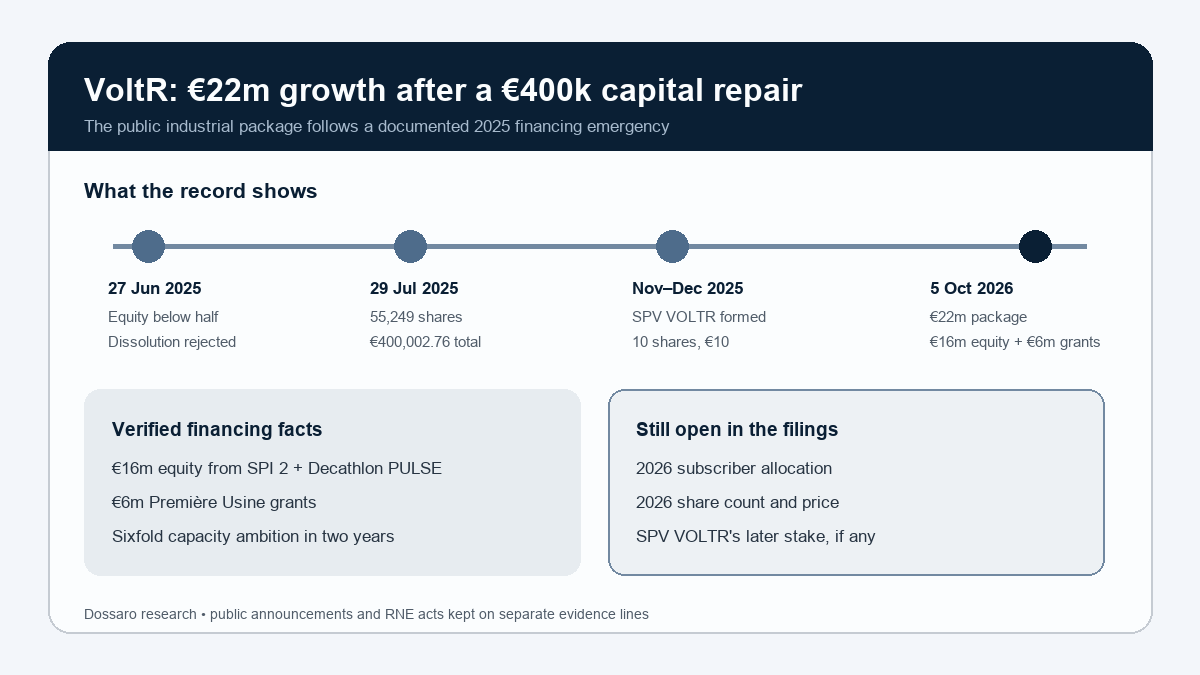
VoltR's €22 million industrialisation package arrived after a documented capital repair, not from an untouched balance sheet. In a 27 June 2025 resolution, the French battery remanufacturer recorded that its equity had fallen below half of its share capital and put dissolution to a vote. The vote failed unanimously. One month later, the company approved an urgent €400,002.76 issue, explicitly citing significant cash difficulties and the need to pay salaries.
The sequence is now material because VoltR announced a much larger package on 5 October 2026. Bpifrance says the financing combines €16 million of equity from its SPI 2 fund and Decathlon PULSE with €6 million of Première Usine grants. The package is intended to double the Verrières-en-Anjou factory and multiply production capacity sixfold within two years. The public announcement is a strong industrial-growth signal. The filings show the financing story began with a narrower question: how to keep the company operating while its capital was impaired.
That does not prove that the 2026 investors rescued the 2025 balance sheet, or that the founder-controlled holding vehicle created later subscribed to either round. It does show a capital-repair phase, a new founder vehicle with a stated VoltR participation purpose, and then a public scale-up package. The distinction between what is documented and what remains open is the useful diligence finding.
The €22m headline combines equity with grants
The Bpifrance release dated 5 October 2026 describes VoltR as a French pioneer in lithium-battery remanufacturing. It splits the €22 million headline into a €16 million equity investment and €6 million of grants. The equity is attributed to the SPI 2 fund, managed by Bpifrance for the French state under France 2030, and to Decathlon PULSE. The grant element comes through Première Usine.
The same release says VoltR has already put more than 20,000 batteries on the market and expects the new financing to double the factory's surface area, multiply production capacity by six in two years and double headcount, including about 40 new jobs. It frames the investment as a move from proof of concept to industrial deployment, with automation, diagnostics, cell reallocation and an ICPE storage site among the uses.
An independent account from Veil Jourde confirms the €22 million financing, its €16 million equity and €6 million grant split, and the industrial expansion rationale. Neither public account identifies the number of shares issued in 2026, the issue price, the allocation between Bpifrance and Decathlon PULSE or any secondary proceeds. A financing headline is therefore not yet a 2026 cap table.
| Public statement | What it establishes | What it does not establish |
|---|---|---|
| €22m secured on 5 October 2026 | A combined equity and grant package for industrialisation | 2026 share count, issue price or investor allocation |
| €16m raised from SPI 2 and Decathlon PULSE | Equity investors named at fund or organisation level | Which legal vehicle subscribed, and in what proportions |
| €6m from Première Usine | Grant support is part of the headline | That the grant is equity or available for shareholder distributions |
That separation matters in a capital model. The €22 million is not a single class of capital with a single claim on VoltR. €16 million is described as equity. €6 million is described as grant funding. Until a current RNE filing or transaction document shows the 2026 issuance, the public figures describe the financing package but not the resulting ownership percentages.
The 2025 filings describe an emergency bridge
VoltR's 27 June 2025 RNE extract says the annual accounts for the year ended 31 December 2024 showed equity below half of the share capital. The shareholders considered a dissolution resolution under Article L. 225-248 of the French Commercial Code. The recorded vote was zero in favour, 1,119,963 against and zero abstentions, so dissolution was rejected unanimously.
The vote did not itself repair the balance sheet. The next parsed acts show how the company raised immediate cash. The 23 July unanimous decisions, implemented by the president on 29 July, authorised 55,249 ordinary shares at €7.24 each, including premium. That produced a total subscription of €400,002.76, of which €5,524.90 was nominal capital and €394,477.86 was issue premium. The documents say the company faced significant current cash difficulties and needed urgent investment, notably to pay salaries.
The issue was fully subscribed and paid in cash. The capital rose from €114,762.50 divided into 1,147,625 shares to €120,287.40 divided into 1,202,874 shares. Existing shareholders' pre-emption rights were removed and the new shares were assigned to a person named in the subscription materials, but the available parsed text does not identify that subscriber by name.
| 2025 capital-repair step | Filing evidence | Economic reading |
|---|---|---|
| 27 Jun | Equity below half of capital; dissolution rejected 0 to 1,119,963 | The company remained a going concern after a solvency warning |
| 23 Jul / 29 Jul | 55,249 shares at €7.24; €400,002.76 total | Emergency cash entered through a targeted issue |
| 29 Jul | €5,524.90 nominal capital and €394,477.86 premium | Most of the bridge was recorded as share premium |
| 29 Jul | Capital moved from €114,762.50 to €120,287.40 | The legal denominator increased by 55,249 shares |
The math is not a technical footnote. The issue price was 72.4 times the €0.10 nominal value. That ratio is the visible consequence of pricing the bridge around the company's financing need rather than simply adding nominal capital. It also means that the new subscriber's economic position cannot be inferred from the nominal capital increase alone.
A founder-only SPV was formed four months later
The second legal thread appears in the register for SPV VOLTR, SIREN 994523181. Its constitutive statutes say that Maxime Bleskine subscribed 10 shares for €10. A CIC Ouest funds certificate dated 21 November 2025 records the same 10 shares and €10 deposit. The statutes state that the company's purpose includes taking direct or indirect participations in VOLTR, SIREN 947745634, or its subsidiaries, and managing the related securities.
That is a concrete link between a later holding vehicle and the operating company. It is not proof that SPV VOLTR bought the 55,249 shares in the July bridge. The capital-repair act does not name the subscriber in the parsed text, and no post-2025 RNE act available for this run maps SPV VOLTR to that issue.
The SPV's €10 starting capital also says little about its eventual financing capacity. A holding company can be incorporated with a nominal amount and later receive assets, new subscriptions or shareholder loans. The useful claim is narrower: a founder-only vehicle was created with a stated VoltR participation object. Its subsequent ownership of VoltR, if any, remains a document question.
This is a familiar distinction in private-company research. Chargepoly's capital-impairment filing shows why a funding headline should be read alongside the balance-sheet event that preceded it. Voodin's grant and investor map illustrates the separate roles that public support and equity can play in one industrial financing story. VoltR adds a control-layer question because its founder's SPV was formed between the emergency issue and the later scale-up announcement.
The 2026 round changes the commercial stakes, not the evidence boundary
The public package gives VoltR the resources to pursue a very different operating scale. Doubling factory space, sixfold capacity and a European expansion plan are measurable commercial ambitions. Bpifrance and Decathlon PULSE are also named partners, not anonymous capital. Those facts support an affirmative conclusion that VoltR has moved from a survival-oriented financing episode to a state-backed and strategic industrialisation programme.
They do not answer the ownership questions that follow from the 2025 filings. The 2026 €16 million equity may have been issued as primary capital, used partly for a secondary transfer, or structured through instruments that will appear in a later filing. The public releases do not disclose a valuation, shareholder percentages, liquidation preferences or whether the €6 million grants are conditional on milestones. They also do not connect the round to SPV VOLTR.
The counter-reading is ordinary and must remain live. The 2025 bridge could have been a planned financing step before a larger industrial round, rather than a rescue in the colloquial sense. A founder-only SPV could be a routine holding structure unrelated to the 2026 investors. The documents prove the timing, purpose and amounts, but not motive or ultimate ownership.
For a financing model, the next documents are therefore clear. The decision-changing watchpoint is a post-2025 RNE capital filing for VOLTR that identifies the 2026 issue, its share count and subscribers. The next SPV VOLTR filings should show whether it acquired shares in the operating company or remained an un-funded vehicle. Those two records would connect the public €16 million equity announcement to the legal cap table.
VoltR's story is already more informative than a simple €22 million funding headline. The company rejected dissolution after a documented capital impairment, raised €400,002.76 to meet urgent cash needs, created a founder-only vehicle with a VoltR participation purpose and then announced a much larger package combining equity and grants. The industrial plan is public. The ownership mechanics of the scale-up round are the next filing still to come.
Continue reading
Related Research
Chargepoly's €23m Round Followed Capital Loss At Its Stations Unit
Chargepoly raised €23 million after its wholly owned stations vehicle fell below half its capital, shifting existing deployment risk to new investors.
VMG Took 50% Of Voodin As Its €48m EU Project Began
German shareholder lists show VMG Green took 50% of Voodin as related VMG companies joined the consortium running a €48.18m EU-backed blade factory.
Spain Puts €1.019bn Behind An AI Gigafactory With A Private Majority
Spain's AI gigafactory company is 51.01% privately held while €719m enters through SETT and another €300m supports EuroHPC infrastructure outside its cap table.
MAASH's €12.15m Package Is a Governed Industrial Restart, Not Just a Startup Round
MAASH's €12.15m package combines €5.85m equity, €4.3m public support and a €2m loan, with new board representation before mycoprotein scale-up.