
MAASH's €12.15m Package Is a Governed Industrial Restart, Not Just a Startup Round
MAASH's €12.15m package combines €5.85m equity, €4.3m public support and a €2m loan, with new board representation before mycoprotein scale-up.
On this page
Conduct your own private market research
Add dossaro to Claude or ChatGPT and run source-backed register research from your own workspace.
 Add to Claude
 Add to ChatGPT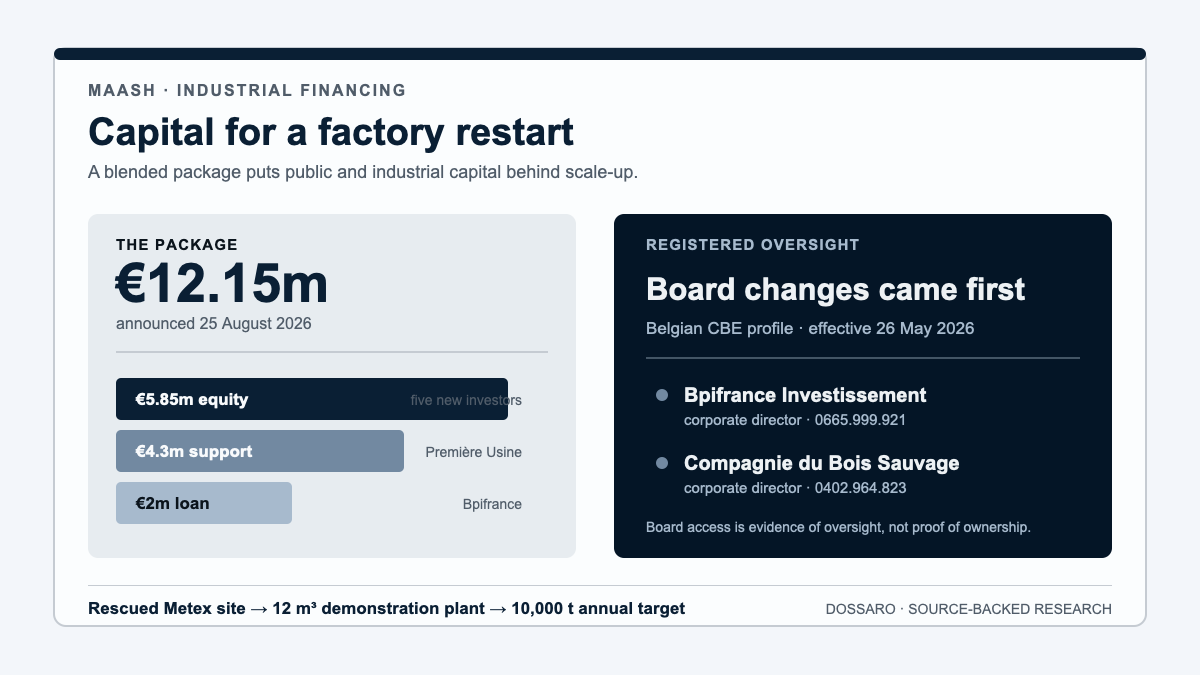
MAASH's €12.15 million financing is better understood as a governed industrial restart than as a conventional startup round. The package combines €5.85 million of equity, €4.3 million of Bpifrance support and a €2 million Bpifrance loan. The Belgian company had already added corporate directors tied to Bpifrance Investissement and Compagnie du Bois Sauvage on 26 May 2026, before announcing the financing. That sequence puts public and industrial capital inside the oversight structure as MAASH reactivates a former Metex site in France.
The distinction matters because the money is tied to a physical production programme, not only to software or laboratory development. MAASH says the package will fund a 12 cubic metre demonstration plant at Carling-Saint-Avold and prepare a later industrial stage targeting 10,000 tonnes of mycoprotein a year. The public sources establish the financing split, the site and the leadership transition. They do not disclose valuation, ownership percentages, debt seniority or any investor's control rights.
The headline amount has three different risk channels
Bpifrance's 26 August release describes a €12.15 million envelope for MAASH's next development phase. It breaks that amount into three components: €5.85 million raised from five new equity investors, €4.3 million awarded through the Première Usine programme backed by France 2030 and a €2 million Prêt d'Amorçage Investissement loan. Vegconomist independently confirms the same split and identifies the demonstration plant and annual production target.
| Component | Amount | Economic role | What the source does not show |
|---|---|---|---|
| New equity | €5.85m | Risk capital from Ambra Capital, InvestPro, Bpifrance Amorçage Industriel, Nordzucker and Tereos | Price per share, valuation or investor percentages |
| Première Usine support | €4.3m | Public backing for the industrial demonstration programme | Grant conditions, draw schedule or security package |
| Bpifrance loan | €2.0m | Debt funding alongside the equity and support | Maturity, ranking, covenants or repayment terms |
| Total package | €12.15m | A blended capital stack for industrialisation | The allocation between Belgian and French entities |
The mix changes who carries execution risk. Equity investors absorb downside in exchange for potential upside. The public support is connected to an industrialisation milestone, while the loan creates a repayment obligation. Treating the entire €12.15 million as interchangeable venture cash would obscure that asymmetry. It is a different risk profile from Certain Energy's single-company battery financing, where the central question was how a project round translated into control rights.
It also explains why this financing belongs in the industrial-project category. A demonstration plant has commissioning, yield, feedstock and customer-qualification risks that do not appear in a headline round. The capital must move a process from technical preparation to repeatable production, then convert that output into contracted demand. The package gives MAASH resources for that path, but it does not guarantee the path will be completed.
A rescued factory is part of the financing thesis
MAASH acquired the former Metex Noovista site and activities at Carling-Saint-Avold through a judicial process in July 2024. The asset gave the company existing fermentation infrastructure and a route to demonstration scale without building an entire facility from zero. Bpifrance says the site is the base for the 12 cubic metre plant. Vegconomist reports the same acquisition history and says MAASH plans to use the site to produce LoCylia, its mycoprotein ingredient.
That asset history changes the capital arithmetic. The company is not financing a greenfield factory, but it is also not buying a finished production line. A rescued site brings equipment, permits, industrial know-how and possible remediation or recommissioning work. The commercial advantage is a shorter route to scale. The financial exposure is that a large portion of the value proposition depends on making an inherited industrial base reliable and cost competitive.
The announced 10,000-tonne annual target is therefore a forward operating objective, not current output. The public record does not disclose present capacity, utilisation, offtake contracts or unit economics. A counterparty can credit MAASH with an identifiable industrial base while still asking how much of the package is needed before commercial production becomes self-funding.
Board appointments came before the funding announcement
The Belgian Crossroads Bank for Enterprises profile for MAASH, enterprise number 0774.786.708, lists the company as an active public limited company in Anderlecht. It records two corporate directors, enterprise numbers 0402.964.823 and 0665.999.921, as appointed from 26 May 2026. Their permanent representatives are Benoît Deckers and Anne-Sophie de La Gorce. The same profile lists founders and managers including Frédéric Van Gansberghe, Gaspard Gilbert, Torsten Geißler, Pierre Lainé, Aslak Lie and Katlijn Linster from that date.
Public company records identify 0665.999.921 as Bpifrance Investissement and 0402.964.823 as Compagnie du Bois Sauvage. The register establishes the appointments and effective date. It does not establish share ownership or a voting agreement. A corporate board seat can reflect ordinary investor protection, strategic participation or an operational partnership without proving control.
The timing is nevertheless commercially relevant. The board expansion predates the 25 August announcement reported by Bpifrance and the 26 August publication carried by Vegconomist. It suggests that governance was being built around the industrial restart as capital was assembled. That is different from announcing a financing first and leaving oversight arrangements entirely undisclosed.
The sequence also clarifies the role of the new investors. Nordzucker and Tereos are not only financial names in the release. Bpifrance says Tereos will provide fermentation substrates and technical support, while the investor group brings industrial expertise and market access. Those relationships can lower procurement and go-to-market friction, but the sources do not quantify any commercial commitment or preferential economics.
Leadership is shifting from build mode to industrial execution
Samah Garringer is due to become MAASH's chief executive in September 2026. Bpifrance describes her more than 25 years of experience across food, ingredients, nutrition and industrial scale-up, including senior roles at DSM, Avril Group and ENOUGH Foods. Gaspard Gilbert, a co-founder and current managing director, is moving into the chief commercial officer role and will temporarily also act as chief financial officer. Frédéric Van Gansberghe remains chair of the board.
The leadership change is part of the financing's economic design. A company preparing a demonstration plant needs a different operating cadence from one proving a fermentation concept. Technical delivery, quality systems, customer qualification and working-capital management become as important as research. Installing an executive with industrial and commercial experience can support that transition, but it is not proof that scale-up targets will be met.
For founders, the disclosed shift is a change in responsibility rather than a documented exit. Gilbert remains involved in commercial partnerships and Van Gansberghe remains chair. The public material does not state whether the founders were diluted, sold shares or changed their voting rights in the round. Any claim about individual proceeds or control would exceed the evidence.
The package creates a shared execution test
MAASH's financing gives several parties a reason to monitor the same milestones. Equity investors need the plant to reach reliable yields and customer acceptance. Bpifrance's support is tied to an industrial programme, and its loan must be repaid. Tereos and Nordzucker bring potential supply and market relationships, while the founders retain operational and governance roles.
That alignment can be valuable, but it also creates dependencies. A demonstration plant can consume capital before it produces saleable volume. Public support may be conditional. Debt service can become a competing call on cash if commissioning takes longer than planned. Industrial partners can add resilience, yet their involvement does not remove the need for independent customers and repeatable margins.
The last public step is therefore not the financing announcement itself. It is the evidence that MAASH converts this blended package into an operating asset with measured performance. The company has a defined site, a disclosed capital stack and an announced leadership plan. It does not yet publish plant output, contracted revenue, valuation or the terms that govern the investor group.
What the next documents should answer
The next decision-changing evidence is specific. A filed capital statement or shareholder document would show how the €5.85 million equity was priced and whether the founders' positions changed. Loan or grant agreements would clarify repayment, security, milestones and conditions. A later operating update should show whether the 12 cubic metre plant entered production, what yields it achieved and how much of the 10,000-tonne target remains a planning assumption.
The Belgian CBE record should also be watched for changes to the corporate directors and permanent representatives. It currently records board appointments from 26 May 2026, but it does not publish beneficial ownership or investor percentages. If the company later files ownership, capital or governance changes, those records could distinguish board access from economic control.
The evidence supports a precise thesis: MAASH has assembled a €12.15 million rescue-and-scale package around an acquired industrial site, with equity, public support, debt and new board representation arriving as it moves toward demonstration production. That makes the transaction a governed industrial restart. It is not evidence that the plant is already commercial, that any investor controls the company or that the package guarantees a successful scale-up.
Sources: Bpifrance's financing release, independent Vegconomist coverage, IN Food's report, Boursorama's report on the Metex asset transfer, and Belgian CBE profile for MAASH.
Continue reading
Related Research
Certain Energy's £10m Series A Ended Ceres' Registered Control of RFC Power
Certain Energy's £10m Series A reset RFC Power's register: Ceres moved below the PSC threshold as British Business Investments entered the ownership record.
Oakley's Graphwise Majority Deal Was a Merged-Group Sale, Not a Vienna Startup Exit
Oakley bought a majority of Graphwise after Ontotext absorbed Vienna's Semantic Web Company, putting the merged group, not one startup, at the deal's centre.
Deutsche Telekom Agreed to Buy Both Halves of Poland's Fiberhost Split
Deutsche Telekom agreed to buy Fiberhost's open-access network and INEA's retail business, reunited after a 2021 split under one Polish holding chain.
VoltR's €22m Industrial Push Follows a Documented Capital Repair
VoltR's €22m industrialisation package follows a 2025 capital repair: an emergency €400,002.76 issue, a rejected dissolution vote and a founder SPV.