
Certain Energy's £10m Series A Ended Ceres' Registered Control of RFC Power
Certain Energy's £10m Series A reset RFC Power's register: Ceres moved below the PSC threshold as British Business Investments entered the ownership record.
On this page
Conduct your own private market research
Add dossaro to Claude or ChatGPT and run source-backed register research from your own workspace.
 Add to Claude
 Add to ChatGPT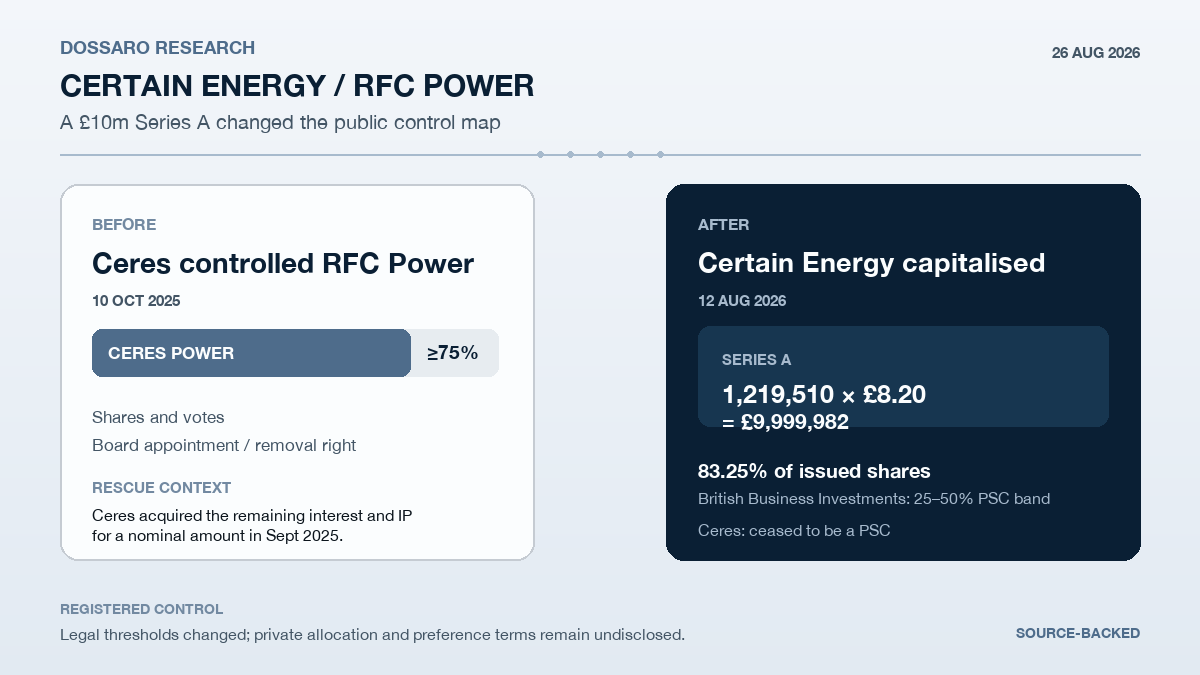
Certain Energy's £10 million Series A did more than finance a grid-battery company. It changed who appeared to control the company in the UK public record.
The round was announced on 26 August 2026, when RFC Power rebranded as Certain Energy. Two weeks earlier, RFC Power had allotted 1,219,510 Series A shares at £8.20 each. The filing arithmetic comes to £9,999,982, and the new class represented about 83.25% of the 1,464,400 shares in issue after the allotment.
That new capital sits alongside a statutory control reset. Ceres Power Limited, which had been recorded as holding at least 75% of RFC Power's shares and votes and the right to appoint or remove its board, ceased to be a person with significant control on 12 August. British Business Investments Limited, the British Business Bank's investment arm, was recorded in a new band of more than 25% and no more than 50% of shares and votes.
The filings do not allocate every Series A share to each investor, and a PSC band is not a complete beneficial-ownership table. But the sequence is commercially clear: a business that Ceres had brought back onto its balance-sheet perimeter was recapitalised with public-investment participation, while Ceres' registered controlling status ended.
A rescue that became a new capital story
RFC Power began as an energy-storage spinout developing manganese flow batteries for long-duration grid use. Ceres Power's own 2025 announcement said it had acquired the remaining RFC Power interest and intellectual property for a nominal amount in September 2025, after RFC Power had faced a possible going-concern risk. Ceres' interim reporting also said its earlier 24.2% RFC Power interest had been impaired to zero.
That history matters because the 2026 financing was not a routine follow-on round. Ceres first consolidated the project after a distressed period. The public announcement then described a £10 million Series A led by British Business Investments, with participation from Centrica, Ceres and Temasek Trust's C3H investment platform. The round was intended to move the technology from development toward commercial grid deployment.
The legal record captures the change at a different level from the press release. A Companies House allotment filing dated 12 August lists the Series A issue. A same-day PSC filing records British Business Investments in the 25 to 50% band, while another filing records Ceres Power's cessation as a PSC. That combination is unusual enough to be the central fact of the deal: the financing altered the control map as well as the funding runway.
The pattern resembles other energy restructurings where the operating business, the rescue capital and the headline financing are not the same legal event. In Freqcon's asset rescue, the operating assets moved into a new vehicle while the former owner remained behind. Certain Energy is different: the company itself stayed the issuer, but the register shows a new public-investment block entering as Ceres' formal control ended.
What the share allotment actually proves
The allotment calculation is straightforward:
| Filed fact | Calculation or interpretation | What it does not prove |
|---|---|---|
| 1,219,510 Series A shares at £8.20 each | £9,999,982 of nominal issue price and share capital consideration | The final cash paid by each named investor |
| 244,890 existing shares plus 1,219,510 new shares | 1,464,400 shares after the issue; Series A is about 83.25% of issued shares | A fully diluted ownership percentage including options or unissued rights |
| Series A has full voting, dividend and distribution rights | The new class participates in ordinary governance and economics unless private terms qualify it | The liquidation preference, conversion mechanics or investor-by-investor allocation |
The 83.25% figure is therefore a statement about issued share count, not a claim that British Business Investments owns 83.25%. The public announcement names several participants, and the statutory PSC filing places British Business Investments in a broad threshold band. Neither source discloses how the new class was divided among British Business Investments, Centrica, Ceres and Temasek Trust's vehicle.
That distinction is material for anyone modelling dilution. A large new class can dominate the issued-share count while contractual preferences, reserved matters or separate instruments determine the economic outcome. The register gives a defensible lower-resolution answer: most shares issued on 12 August were in the Series A class, and at least one public investor crossed the 25% reporting threshold.
Ceres kept a stake, but not the same legal position
The company announcement and Ceres' regulatory disclosure describe Ceres as retaining roughly 37% after the financing. Ceres also contributed £1 million in cash and £1.5 million of engineering work in exchange for equity, and its chief financial officer joined Certain Energy's board. The RNS says Ceres will receive a future revenue share from the technology.
Those terms make Ceres an important continuing participant. They do not contradict the PSC filings. A shareholder can retain a substantial minority position without meeting the more-than-25% threshold once the denominator changes, and board influence can continue through contractual rights or a director seat without the person being a registrable PSC. The cessation filing is therefore best read as a change in statutory control status, not as proof that Ceres exited or surrendered every governance right.
For Ceres, the financing also converts a write-off and nominal acquisition into a visible minority position in a funded operating company. For Certain Energy, the transaction turns a rescued project into a separately capitalised platform with a public-investment arm on the register. For counterparties, the difference between those two readings affects who can block decisions, who can appoint directors and which entity is expected to fund the next commercialisation step.
Why the public-versus-filed gap matters
The headline says £10 million. The filings show how that headline became legal capital, but not the full deal contract. This is the same public-versus-filed gap that often matters more than the press release itself: a financing announcement can describe strategic participation and a post-money figure, while the register records only share classes, counts and statutory thresholds.
Certain Energy's public materials put the post-money value at about £12 million and describe Ceres' retained position as roughly 37%. Those figures are useful context, but they are not a substitute for a filed cap table. The allotment form does not establish the company's valuation, and the PSC range does not identify beneficial ownership beyond the reported legal control threshold.
The strongest defensible conclusion is narrower. On 12 August, RFC Power legally issued a dominant block of Series A shares. On the same date, British Business Investments entered the PSC record and Ceres ceased to be a PSC. The company then announced the financing and rebrand as Certain Energy. The event moved the company from a Ceres-controlled rescue structure toward a multi-investor ownership and funding model, without making the private preference and allocation terms public.
The next document that would close the gap
The next evidence to watch is not another announcement. It is a document that identifies the investor allocations and rights behind the Series A: a shareholder list, subscription agreement, updated articles or a later confirmation statement with a fuller ownership snapshot. A board filing could also show whether Ceres' CFO appointment is accompanied by reserved matters or other rights.
Until those documents appear, the article should not infer exact investor percentages, sale proceeds, a valuation beyond the company-stated approximately £12 million post-money figure, or a beneficial-owner ranking. The public record supports a £10 million legal allotment, an 83.25% issued-share block, a new 25 to 50% PSC band for British Business Investments and the end of Ceres' registered controlling status. It does not yet publish the complete economic waterfall.
Sources: Ceres announcement on the Series A and rebrand, Ceres RNS on the RFC Power spinout, Imperial College coverage, and RFC Power's Companies House record.
Continue reading
Related Research
Freqcon's €1.7m Rescue Left The PE-Backed Company Behind
Amper paid €1.7m for Freqcon's operating assets, moving jobs into a €25,000 vehicle while the former PE-backed company stayed in insolvency.
Polarise Turned A €0.5bn Equity Deal Into A Debt Question
Polarise moved from a proposed SWI majority investment at a €0.5bn valuation to debt financing, shifting the control question to creditor protections.
Oceanloop's €38.5m Headline Is Mostly a 2024 EIB Facility
Oceanloop's €38.5m financing headline is 83% debt tied to a 2024 EIB facility, while €6.5m equity enters a 22-position roll-up with dilution unresolved.
HyImpulse's €50m Series A Turns Rocket Sovereignty Into a Public-Private Risk Bet
HyImpulse's €50m Series A extension pairs public and private capital with a €350m order book, but filings do not yet show who bears the new equity risk.