
HyImpulse's €50m Series A Turns Rocket Sovereignty Into a Public-Private Risk Bet
HyImpulse's €50m Series A extension pairs public and private capital with a €350m order book, but filings do not yet show who bears the new equity risk.
On this page
Conduct your own private market research
Add dossaro to Claude or ChatGPT and run source-backed register research from your own workspace.
 Add to Claude
 Add to ChatGPT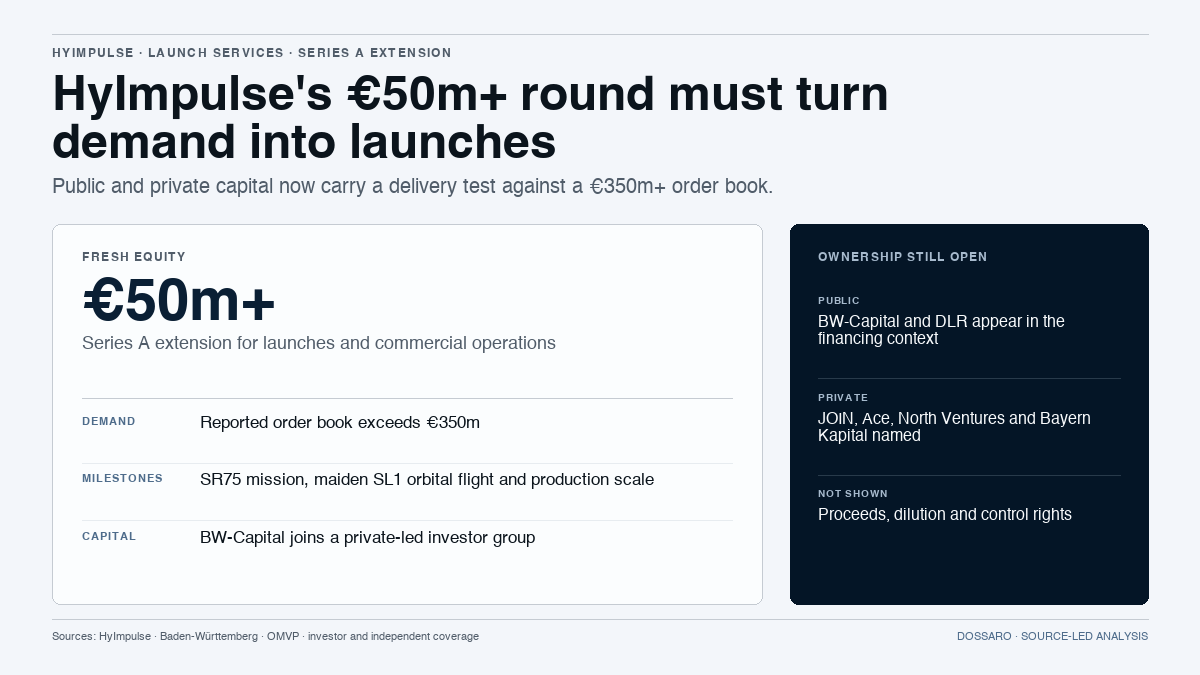
HyImpulse’s more than €50 million Series A extension is best read as a public-private commercialisation bet. The German launch company has paired fresh equity with a reported order book above €350 million, then tied the proceeds to a second SR75 mission, the maiden SL1 orbital flight and a larger production operation. The financing therefore has to do two jobs at once: fund the next technical steps and convince customers that the company can deliver them.
The public sources are clear on the headline. Baden-Württemberg’s investment announcement says BW-Capital is participating in the expanded Series A and that HyImpulse’s order book exceeds €350 million. An investor release from OMVP describes the round as co-led financing above €50 million and says the new capital will support launches and commercial operations. Independent coverage names JOIN Capital and Ace Capital Partners as the co-leads, alongside North Ventures, Bayern Kapital, the German Aerospace Centre (DLR), BW-Capital and returning Campus Founders Ventures.
That is enough to establish a meaningful strategic-capital event. It is not enough to say who now owns what. The reviewed public material does not disclose investor-by-investor proceeds, post-round percentages, dilution or control rights. The important conclusion is not that the financing is unproven. It is that the next risk sits in converting a large demand signal into flight hardware and repeatable operations, while the equity risk remains allocated behind a partially disclosed cap table.
The round is a commercialisation bet, not only a technology cheque
HyImpulse develops launch platforms using hybrid propulsion based on paraffin and liquid oxygen. Its SR75 suborbital vehicle completed an inaugural flight from Koonibba in South Australia in 2024. The company is preparing another SR75 launch from SaxaVord in Scotland and says the new financing will also take its SL1 orbital vehicle toward a maiden flight.
The sequence matters for investors and customers. A first flight can validate a vehicle. A second flight, orbital qualification and production growth test whether the business can turn engineering into a service. The €50m-plus extension is thus financing a chain of milestones rather than a single laboratory project. It is a bet that sovereign European launch capacity can become a dependable commercial capability.
| Signal | What the public sources establish | What they do not establish |
|---|---|---|
| Series A extension | More than €50m of equity financing, co-led by JOIN Capital and Ace Capital Partners | Each investor’s cheque, ownership percentage, dilution or voting rights |
| Public participation | BW-Capital, Bayern Kapital and DLR are named alongside private investors | Public-money size, board rights or control of HyImpulse |
| Commercial demand | A reported order book above €350m | Recognised revenue, cash collected, margin or delivery certainty |
| Launch plan | A second SR75 mission, an SL1 maiden orbital flight and production expansion | Timing certainty, customer concentration or the capital still required |
Public capital is joining a private lead
The participant list is strategically significant even without a cap-table percentage. JOIN Capital and Ace Capital Partners are reported as co-leads, which gives the round a private-market anchor. North Ventures and Campus Founders Ventures add venture continuity, while BW-Capital and Bayern Kapital bring regional public investment vehicles into the financing. DLR links the round to the company’s origin as a spin-off from Germany’s aerospace research ecosystem.
That mix changes the risk narrative. Public capital can support a national or European capability whose payback horizon is longer than a typical software round. Private investors still need a path to commercial returns. Their interests can overlap around launch reliability, production economics and customer conversion, but the sources do not show how those interests are documented in the legal capital structure.
The distinction is familiar in other financing stories. Nscale’s debt stack shows why the headline instrument and the legal layer carrying the risk must be read together. For HyImpulse, the headline is equity and strategic participation. The missing layer is the allocation of that equity among the named participants and any existing holders who retained or surrendered a position.
The order book raises the delivery standard
An order book above €350 million is a powerful commercial signal, but it is not the same as revenue already recognised. It can represent contracted demand, options, milestone-linked commitments or a mixture of customer arrangements. The state announcement and independent reports do not provide a customer-by-customer schedule, delivery margin or cash-conversion timetable.
The financing uses described by OMVP point to the operational work required before that demand can become revenue. HyImpulse must launch a second SR75, progress SL1 toward orbit and expand production and commercial operations. The company is reported to employ more than 100 people. That scale gives it more execution capacity than a prototype-stage venture, but it also creates a recurring cost base before the full order book is delivered.
The commercial consequence is a sharper test for the next reporting cycle. Investors will need evidence of launch cadence, manufacturing throughput, customer acceptance and the funding required between milestones. Customers will need confidence that a supplier can absorb schedule slips without turning every mission into a fresh financing event.
A two-step financing path changes the risk framing
EU-Startups and Vestbee place the new round in a broader financing sequence. They report that an October 2025 package included €15 million of equity and €30 million of additional financing. Those two disclosed components total €45 million, but the €30 million is not described as equity and should not be added to paid-in share capital without further documents.
The same coverage reports that HyImpulse’s total equity and public funding now exceeds €125 million. That is useful context for the scale of the company’s funding journey, yet it combines categories and separate announcements. It is not a substitute for a legal capital table and does not prove that more than €125 million is paid-in equity or that the entire amount remains available for the next launch.
The sequence still explains why this extension matters. Earlier financing helped move the company from a successful SR75 demonstration toward repeat launches. The latest round is tied to orbital ambition and production. As the technical programme advances, the economic question shifts from whether capital can be raised to whether each tranche creates enough delivery evidence to unlock the next one.
The ownership question sits behind the headline
HyImpulse Technologies GmbH is the exact legal entity identified in the Stuttgart register, HRB 764976. The public announcements name the participating institutions, but they do not state their share classes, subscription prices, post-round holdings or board rights. They also do not say whether earlier investors were diluted, sold a position or defended their percentage.
That is not a reason to discount the financing. It is a reason to keep the ownership conclusion precise. The public evidence supports a description of public and private participants sharing exposure to a European launch programme. It does not support a claim that Baden-Württemberg, DLR, JOIN, Ace or any other named institution controls the company.
The same boundary matters when reading the order book. A large demand figure can improve financing terms, but it does not reveal who bears the cost of a delayed launch or a customer that postpones a mission. The equity allocation, issue terms and any preference rights are the documents that would connect strategic intent to economic downside.
What the next filings need to answer
The next useful evidence is a post-round shareholder list and the related subscription or allotment filings. Those documents should show whether the 2026 extension created new classes, how many shares were issued, the issue price, and how existing holders’ voting and economic rights changed. They may also clarify whether the public participants invested directly, through a vehicle or alongside a private lead.
Until that material is available, the strongest finding is also the most disciplined one: HyImpulse has secured more than €50 million for a programme backed by more than €350 million of reported demand, and public and private investors are visibly sharing the commercialisation bet. The exact equity risk allocation, dilution and control remain unresolved. Certain Energy’s public-private control reset and Enpulsion’s aerospace handover offer useful comparisons for why those legal layers can change the economic reading of a financing headline.
Continue reading
Related Research
Nscale's $3bn AI Debt Sits on a New Holding-Company Security Stack
Nscale's $3bn AI-data-centre facilities follow a holding-company roll-up, a $3.695bn premium reset and GLAS charges over parent and Arkon equity.
Certain Energy's £10m Series A Ended Ceres' Registered Control of RFC Power
Certain Energy's £10m Series A reset RFC Power's register: Ceres moved below the PSC threshold as British Business Investments entered the ownership record.
Enpulsion's Lift Me Off Deal Exposes A Funding-Dependent Handover
Enpulsion's Lift Me Off deal coincided with a founder exit, buyer-side appointment and accounts warning that funding and sale completion still mattered.
HyImpulse's €50m Round Lands on a 76.43% Holding Block
HyImpulse's €50m financing meets a register where HylImpulse Holding and Schwarz Holding held 76.43% before the round, leaving post-round control unresolved.