
Nscale's $3bn AI Debt Sits on a New Holding-Company Security Stack
Nscale's $3bn AI-data-centre facilities follow a holding-company roll-up, a $3.695bn premium reset and GLAS charges over parent and Arkon equity.
On this page
Conduct your own private market research
Add dossaro to Claude or ChatGPT and run source-backed register research from your own workspace.
 Add to Claude
 Add to ChatGPT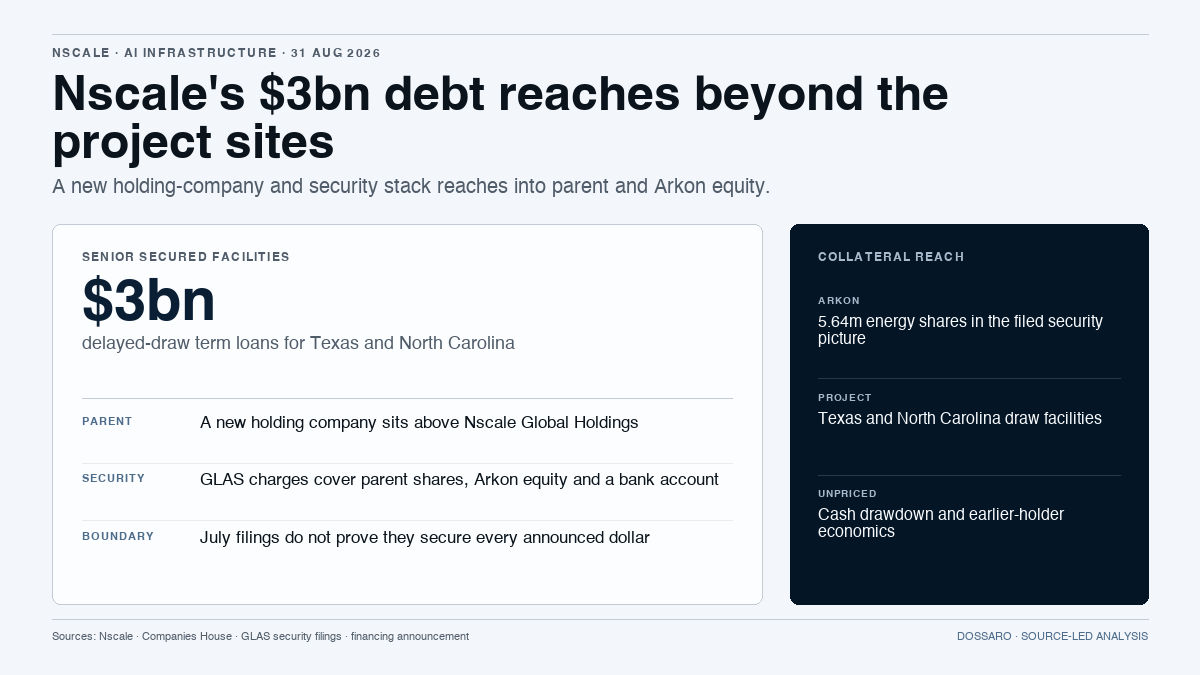
Nscale's approximately $3 billion financing announcement is backed by more than a promise to build AI data centres. In the months before the 31 August 2026 release, the UK group inserted a new holding company above Nscale Global Holdings, moved dozens of earlier registered holders out of the parent shareholder schedule and gave a secured creditor rights over parent shares, Arkon Energy equity and a bank account.
The timing does not prove that the July security filings secure every dollar of the new facilities. It does show where the financing risk sits. Nscale's headline is a pair of senior secured delayed-draw term loans for Texas and North Carolina. The Companies House record shows a legal and collateral stack that reaches above those projects, while the cash drawdown, investor exits and ultimate economics of the earlier holders remain private.
The debt announcement is a project-finance promise
Nscale's 31 August release says the company closed approximately $3 billion of aggregate commitments across two senior secured delayed-draw term loan facilities. The Ward County, Texas facility provides up to $1.85 billion for a campus designed for about 275 megawatts of information-technology load. A second facility provides up to $1.2 billion for a 96-acre, 40-megawatt colocation site in Madison, North Carolina.
The facilities are designed to fund Nvidia GPU systems, networking, storage and liquid-cooling equipment. J.P. Morgan and Goldman Sachs acted as joint lead arrangers and bookrunners. The release says both facilities received investment-grade ratings with stable outlooks, a meaningful signal about how lenders underwrote the projects.
The commitments are not the same as cash already drawn. That distinction matters for a business building power-intensive infrastructure: lenders commit against construction milestones and contracted demand, while the borrower takes the operational risk as equipment is deployed. Reuters reported that Nscale was showing prospective investors about $103 billion of contracted revenue ahead of a possible initial public offering. The report says the contracts average 5.7 years and that the figure is illustrative rather than formal revenue guidance.
The public story is therefore a large, rated project-finance commitment supported by future infrastructure revenue. The register adds a second question: which legal entity controls the equity around those projects, and what can the lender reach if execution or drawdown assumptions fail?
A new holding company changed who appears on the register
Nscale Limited, formerly DSNS Holdings Limited, was incorporated on 22 December 2025. Its 23 April 2026 share-allotment filing shows 50,000 pound-denominated redeemable preference shares and one US-dollar share. Philippe Eric Sachs was recorded as a person with significant control in the 75% to 100% band until May.
On 4 May, Sachs ceased as a registrable controller. The related notices say the company knew of no registrable person or legal entity immediately afterwards. The next day, Nscale Limited became the registrable relevant legal entity for Nscale Global Holdings Limited, with more than 75% of shares and votes and the right to appoint or remove a majority of the board. Joshua Payne also ceased as the parent's person with significant control on 5 May.
The parent shareholder schedule filed on 24 June records the effect. Dozens of earlier registered holders transferred their positions to zero on 4 May. The list includes strategic and institutional names such as NVIDIA Corporation, Nokia Corporation, Dell International, Aker DC Holdings, Blue Owl entities, Redalpine Summit Fund, 8090 Industries, Fidelis New Energy and Deutsche Telekom Venture Investments, alongside other funds, family vehicles and individuals.
That is a decisive register change, but it is not a cash-sale record. A transfer to zero proves that the registered position moved. It does not prove a payout, a loss, a secondary sale or a decision to leave the business. Wordsmith's parent and operator split shows why this distinction matters: the legal layer where investors own shares can sit above the entity holding staff, contracts and operating liabilities.
The parent was recapitalised before the loans were announced
The same filing sequence shows a further change in the parent. Its 28 May 2025 shareholder schedule recorded 2,867,901 ordinary shares, all held by Arkon Energy Pty Ltd. Later service allotments and February and March 2026 issues of Series B and Series C securities took the parent to 10,507,987 shares.
An allotment filing made on 30 June records 276,315 A ordinary shares issued for cash and 278,473 A ordinary shares issued for a non-cash transfer of rights to Nscale shares. The post-allotment total was 11,062,775, an increase of 554,788 shares, or 5.28% of the earlier total. The filing does not identify the allottees in a way that supports an investor-level conclusion.
On the same date, the parent passed a special resolution reducing its share-premium account by $3.695 billion into distributable reserves. This is a capital-account operation. It is not evidence by itself of a dividend, an investor cash-out or insolvency. A large premium balance can be reorganised to make future distributions or other corporate actions possible, but the resolution does not say what management intended to do next.
The combination is more informative than any line alone. Nscale changed the parent-level ownership presentation, issued a new block of shares and moved a very large premium balance into a different reserve category before announcing the new debt facilities. The documents do not establish whether the changes were a conventional internal roll-up, a financing preparation step or a mixture of both.
GLAS can reach the parent and Arkon equity
The clearest commercial consequence appears in two July charges. A charge created on 23 July and filed on 28 July names GLAS Americas LLC as collateral agent and pledges 5,642,755 Arkon Energy Pty Ltd ordinary shares held by Nscale Limited. The pledged certificates cover 2,719,624 shares and 2,923,131 shares.
A second charge gives GLAS fixed and floating security, a negative pledge and fixed security over Nscale Global Holdings shares held by Nscale Limited, two sister-company ordinary shares, a bank account and related rights. Its enforcement provisions give the collateral agent powers to control dividends and voting and to possess or sell charged shares.
The security is wider than a charge over one construction site. It reaches the parent shareholding, a major Arkon equity position and cash-related rights. That makes the lender package economically legible even though the public documents do not state the principal amount secured by either charge.
The timing places the charges alongside the July allotments and ahead of the 31 August announcement. It is reasonable to read them as part of the financing architecture. It would be too strong to say the filings prove that GLAS secures the full $3 billion of Ward County and Madison commitments. The debt may be drawn in stages, and the charge instruments may support a broader group debenture or an earlier facility.
The security stack changes the risk allocation
For Nscale, a holding-company structure can make a large infrastructure programme financeable across several project entities. The Texas and North Carolina borrowers receive committed capital for GPUs and site work, while the wider group provides the equity and cash rights that lenders can monitor or enforce.
For GLAS and the financing group, the collateral package creates an option if the projects underperform. Control over dividends and voting can preserve value before a sale, while possession and sale powers define the lender's route to recovery. The pledged Arkon shares are not a decorative asset: they are a named block of 5.64 million ordinary shares, held through the new parent structure.
For the earlier strategic and venture holders, the register is less informative. Their direct positions disappeared from the parent schedule, but the filings do not show what consideration they received or whether they retained economics through another vehicle. Their exposure may have been consolidated, exchanged or simply moved within the group. A zero balance in the schedule cannot answer that question.
This is the difference between secured growth capital and an unsecured expansion story. Lowell's creditor-equity analysis shows how a financing structure becomes material when creditors can reach an ownership layer rather than only a cash-flow forecast. Nscale's record points in the same direction: the lender has a documented route to assets around the operating projects, not just a claim on hoped-for data-centre revenue.
What the filings prove, and what remains unpriced
The public and filed records support five firm findings. Nscale announced approximately $3 billion of senior secured delayed-draw commitments on 31 August 2026. The facilities are capped at up to $1.85 billion for Ward County and $1.2 billion for Madison. Nscale Limited became the registrable legal entity controlling more than 75% of Nscale Global Holdings' shares and votes in May. The parent issued 554,788 shares in a May allotment and reduced a $3.695 billion share-premium account into distributable reserves. GLAS charges filed in July cover 5,642,755 Arkon shares, parent and sister-company shares, a bank account and related rights.
The record does not establish that former holders were paid out, that the premium reduction funded a distribution, that the July charges secure the whole $3 billion announcement or that the facilities have been drawn. It also does not provide an investor-by-investor cap table, a valuation or a reason for each transfer to zero.
The next decision-changing documents are specific: the principal and security schedule for the 8 May debenture, any facility notice tying the GLAS charges to Ward County or Madison, and a post-roll-up shareholder statement showing where the earlier holders' economics went. Until those documents appear, the strongest defensible reading is that Nscale's AI-data-centre debt sits on a newly consolidated holding-company and collateral stack. The headline is about construction capital, but the risk transfer reaches the parent and its equity around the projects.
Continue reading
Related Research
Wordsmith's $114m Funding Sits Above A £1 UK Subsidiary
Wordsmith AI has announced $114 million of funding above a one-share UK subsidiary, while Ross McNairn's latest register state preserves founder control rights.
Lowell's Recapitalisation Offers Creditors the New Parent as Orlando Takes DACH
Lowell's 2026 reset offers creditors conditional new-parent equity while Orlando buys its DACH platform, linking debt relief to a cross-border carve-out.
SoftBank's $200m Gravis Round Created A 12.63% Series A Class
Gravis's $200m SoftBank round created a Series A class equal to 12.63% of nominal shares and added two board members, not a takeover.
HyImpulse's €50m Round Lands on a 76.43% Holding Block
HyImpulse's €50m financing meets a register where HylImpulse Holding and Schwarz Holding held 76.43% before the round, leaving post-round control unresolved.