
Lowell's Recapitalisation Offers Creditors the New Parent as Orlando Takes DACH
Lowell's 2026 reset offers creditors conditional new-parent equity while Orlando buys its DACH platform, linking debt relief to a cross-border carve-out.
On this page
Conduct your own private market research
Add dossaro to Claude or ChatGPT and run source-backed register research from your own workspace.
 Add to Claude
 Add to ChatGPT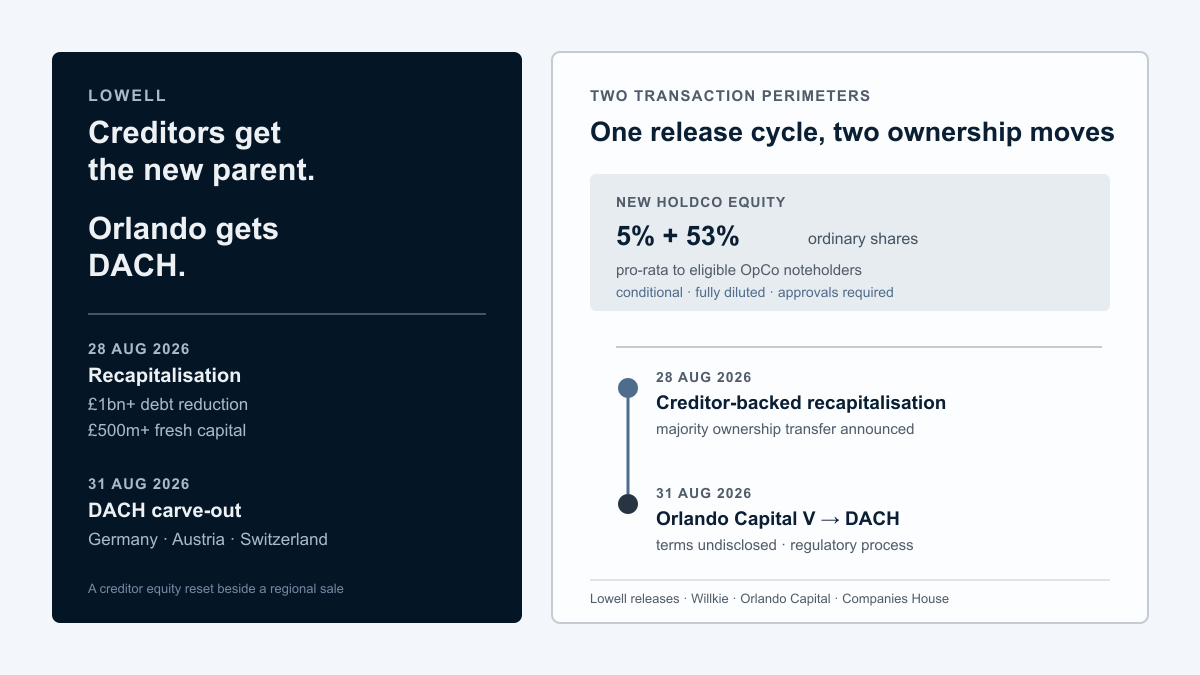
Lowell's latest balance-sheet reset is also a control reset. The company says its binding agreement will remove more than £1 billion of debt and add fresh capital, while the accompanying invitation gives eligible consenting creditors conditional equity in a new parent. Three days later, Lowell announced a separate agreement to sell its Germany, Austria and Switzerland operations to Orlando Capital V.
The public record therefore shows two economic perimeters changing in one release cycle: creditors are being offered a route into New Holdco, and a new owner is taking the DACH operating platform. It does not show that the DACH sale finances the recapitalisation, or that either transaction has closed. The recapitalisation remains subject to approvals, with completion expected in the fourth quarter of 2026 or the first quarter of 2027. The DACH business remains with Lowell until its own regulatory process is complete.
A recapitalisation that changes who sits above Lowell
Lowell's 28 August announcement and invitation describe a binding framework agreed with shareholders and requisite majorities of noteholders. Subject to regulatory approvals, majority ownership moves from existing shareholders to a newly formed investor group comprising existing creditors, including Arini Capital Management.
The company frames the transaction as a substantial deleveraging and liquidity event. Willkie, which advised an ad hoc creditor group, independently describes an approximately €2 billion recapitalisation, more than £1 billion of deleveraging and more than £500 million of new money. Lowell says the simplified structure should support future portfolio purchases and partnerships, but the public materials do not provide a pro-forma cap table or a recovery for any individual creditor.
The consented instruments span the operating-company and holding-company layers. The framework had been entered by noteholders holding approximately 75% of the €967.56 million 9.50% senior secured notes due 2028 and the €466.93 million floating-rate notes due 2029. It also covered approximately 100% of the €250 million Priority Notes due 2028 and approximately 70% of the €292.6 million Holdco PIK Notes due 2030. Those percentages describe participation in the framework at the announcement date, not the final ownership of New Holdco.
The invitation's equity blocks make the control shift more concrete:
| Creditor group | Conditional New Holdco entitlement | What the wording leaves open |
|---|---|---|
| Eligible OpCo noteholders | Pro-rata share of 5% of ordinary shares on a fully diluted basis | The shares require accession, transaction documents, KYC, approvals and the Phase 1 closing |
| OpCo holders subscribing for Cash Funding Tranche B | Pro-rata portion of a further 53% of ordinary shares on a fully diluted basis | Allocation follows the cash subscription and may be affected by oversubscription and conditions |
| Eligible Holdco PIK noteholders | Pro-rata share of 0.25% if the stated 90% PIK condition is met | The threshold, release deed, KYC and required approvals still apply |
The two OpCo blocks add to 58% arithmetically, but that is not an unconditional creditor stake. Each block is allocated pro rata, and the 53% block is tied to participation in Cash Funding Tranche B. The invitation also says that a single OpCo noteholder or affiliated group will not receive 10% or more of New Holdco until required approvals are obtained. A later shareholder filing is needed before the market can describe the post-close cap table with precision.
The old capital stack explains why the reset matters
The 2024 Metis Bidco group accounts provide a useful pre-transaction baseline. At 31 December 2024, the wider GH2 Group had €630 million, £440 million and €795 million of senior-secured notes, a £378 million revolving credit facility and three securitisation facilities. The UK group had £231 million drawn on the RCF, while total borrowings across the securitisation facilities stood at £572.1 million.
That capital stack sits behind a business that buys and collects non-performing consumer debt. The same accounts report 2.1 million consumer debt accounts acquired in 2024 with £1.8 billion of face value, and a portfolio carrying value of £1.271 billion at year-end. Cash EBITDA was £293.6 million and pre-tax profit was £9.9 million. The numbers show why debt capacity, securitisation funding and access to new money matter to Lowell's operating model. They are historical figures, not a pro-forma view of the 2026 recapitalisation.
The accounts also record that a £1.6 billion recapitalisation programme completed in the first half of 2025 and that the Wolf IV transaction completed on 4 June 2025. The 2026 announcement is therefore another change in the funding architecture, not the first time Lowell has adjusted its financing stack. The 2022 accounts show the earlier purchase of 100% of Hoist Finance UK for £342 million and the later sale of 51% of Wolf's junior notes to a third-party investor. That history demonstrates the use of asset-backed and control transactions, but it does not prove that the new DACH sale is part of the recapitalisation funding plan.
Orlando is buying a geographic operating perimeter
On 31 August, Lowell published its agreement to sell the DACH operations. The business covers Germany, Austria and Switzerland. Lowell says the operations were assembled from credit-management companies acquired since 2015 and have been run under the Lowell brand. The release says the decision followed a review of strategic options and a focus on priority markets with different returns.
Orlando Capital's buyer-side announcement calls the deal a complex carve-out. Orlando Capital V is described as a fund focused on majority investments in mid-sized DACH and Nordic companies, with €255 million raised. Neither side discloses transaction terms. Orlando says the operations and customers should see no immediate change before closing, and Lowell says the business remains part of the group while regulatory steps are completed.
That is a perimeter transfer, not a published valuation. The releases do not say whether the buyer is acquiring all shares of each DACH subsidiary, selected assets, or a mix of legal entities and contracts. They also do not identify the debt left with the perimeter, any purchase-price adjustment or the treatment of employees and intercompany arrangements. Those details will matter for understanding what Lowell retains after completion.
The timing matters because the recapitalisation and DACH agreement are close together but legally separate. Lowell's recapitalisation announcement assigns ownership to a new creditor-backed group. Its DACH announcement assigns a regional platform to Orlando. The documents do not state that Orlando's consideration is a source of the more than £500 million of fresh recapitalisation capital, and they do not connect the agreements through a shared closing condition.
What the register can and cannot tell us
The legal-entity map helps keep the claims in the right place. Lowell Group Limited is company number 08096778. Its latest filed accounts identify it as a dormant subsidiary of Metis Bidco Limited, rather than the trading platform described in the Metis consolidated accounts. Metis Bidco Limited, company number 07652466, is the UK holding company whose accounts describe Lowell's debt-purchase and collection business.
That distinction is important when reading a creditor-led ownership transfer. A Companies House PSC entry for Lowell Group or Metis Bidco can show a legal control relationship, but it cannot by itself show each bondholder's economic recovery, the full New Holdco shareholder list or the commercial terms of the DACH sale. EQT's manager acquisition of Coller illustrates the same separation between an operating manager, control entities and the assets held for investors. A legal owner at one layer is not automatically the owner of every asset or cash flow below it.
The clean conclusion is narrower than the headline. Lowell has agreed a creditor-supported recapitalisation that reduces debt and offers conditional New Holdco equity, while a separate agreement gives Orlando a path to acquire the DACH platform. Existing shareholders' precise dilution, creditor recoveries, the DACH purchase price and the final post-close structure remain unresolved.
The next filings will decide the economics
The next evidence should arrive in the closing and approval trail. A New Holdco shareholder or control filing could show how the 5% and 53% OpCo blocks were actually allocated, whether the 0.25% PIK block was triggered and how any management incentive shares affect the fully diluted denominator. Creditor notices may clarify the cash funding tranches and the new notes issued in exchange for consent.
For the DACH transaction, the decisive records will be the legal entities and financing arrangements that emerge after the carve-out. They can show which contracts, employees and liabilities moved to Orlando, what Lowell retained and whether any purchase consideration was paid at closing. Until those documents are public, the defensible reading is a creditor equity reset alongside a DACH carve-out, not a single transaction with a disclosed funding waterfall.
Continue reading
Related Research
EQT Bought Coller's Manager and Carry Rights, Not Its Fund Assets
EQT's $3.2bn Coller deal buys management and GP entities plus carry rights, while Companies House shows the UK operating manager rather than fund assets.
Seqens's Lender-to-Owner Reset Exposes a €930m Acquisition Debt Stack
Seqens says senior lenders will become shareholders, while filings show Sirona BidCo carried €930m of term debt, €29k cash and a €62m dividend.
Deutsche Telekom Agreed to Buy Both Halves of Poland's Fiberhost Split
Deutsche Telekom agreed to buy Fiberhost's open-access network and INEA's retail business, reunited after a 2021 split under one Polish holding chain.
Nexeon's £100m Round Added Capital Around an Existing KDB Stake
Nexeon's £100m investment round added capital around an existing KDB preference stake, while staged allotments leave the latest recipients unnamed in filings.