
EQT Bought Coller's Manager and Carry Rights, Not Its Fund Assets
EQT's $3.2bn Coller deal buys management and GP entities plus carry rights, while Companies House shows the UK operating manager rather than fund assets.
On this page
Conduct your own private market research
Add dossaro to Claude or ChatGPT and run source-backed register research from your own workspace.
 Add to Claude
 Add to ChatGPT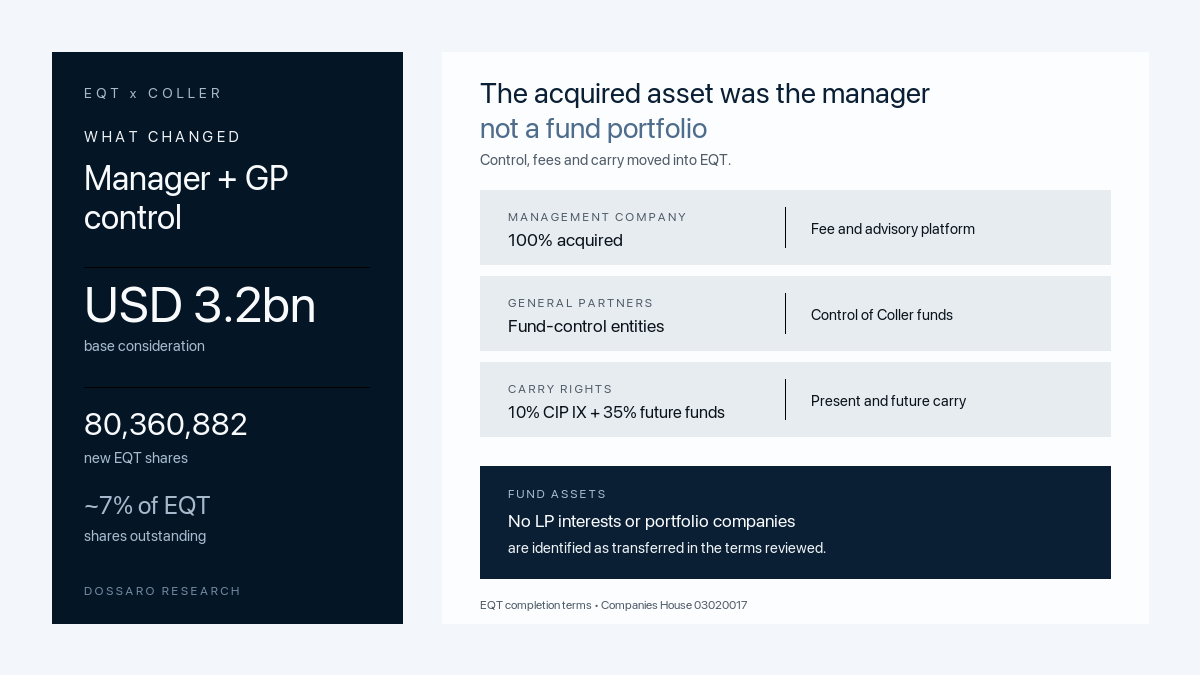
EQT's combination with Coller Capital is a purchase of the machinery that earns private-markets fees and carried interest, not a stated purchase of the portfolios held by Coller's funds. The transaction completed on 31 August 2026 with USD 3.2 billion of base consideration, mostly 80,360,882 newly issued EQT shares, equal to about 7% of EQT's shares outstanding. The package also includes about USD 65 million in cash, contingent consideration of up to USD 500 million, and rights to a substantial share of present and future carry.
The distinction matters because the announcement also describes Coller as a nearly USD 50 billion secondaries platform. Assets under management are a measure of client capital advised or managed. They are not the same thing as the legal entities that employ investment teams, sign advisory agreements, act as general partners or receive performance fees. EQT's completion release names those operating and incentive layers explicitly. The U.S. Securities and Exchange Commission filing for a Coller fund adds an independent legal consequence: a change in ownership assigns the fund's advisory agreement, which then requires a new agreement and shareholder approval.
That is a control-and-cash-flow acquisition. It gives EQT the manager, the general-partner entities that control Coller funds, 10% of the carried interest in Coller International Partners IX, and the right to invest in 35% of carry in future closed-ended Coller funds. It does not, on the evidence reviewed, establish that EQT acquired limited-partner interests or the portfolio companies held by those funds.
The deal transfers the fee and carry stack
The legal package is unusually clear about what changed hands. EQT acquired 100% of Coller's management company and the general-partner entities controlling Coller funds. It also acquired 10% of the carry in Coller International Partners IX, the most recent private-equity secondaries flagship fund. The January transaction announcement says that fund closed on 31 December 2025 with USD 10.2 billion of fee-generating commitments and a total fund size of USD 14.2 billion.
EQT will be entitled to invest in 35% of carried interest in all future closed-ended Coller funds. The wording describes an economic participation right, not ownership of the funds' underlying investments. Coller EQT will remain a distinct secondaries segment, and EQT says Coller's origination and investment process will stay independent.
| Transaction layer | What the public terms say | Economic reading |
|---|---|---|
| Management company | 100% acquired by EQT | Transfers the operating platform that earns advisory and management fees |
| General partners | Entities controlling Coller funds acquired | Moves legal fund-control positions into EQT's group |
| Present carry | 10% of carry in Coller International Partners IX acquired | Gives EQT a share of performance economics from an existing flagship fund |
| Future carry | Right to invest in 35% of carry in future closed-ended Coller funds | Extends EQT's participation to new fundraising and performance outcomes |
| Fund portfolios | No LP interests or portfolio companies identified in the terms reviewed | Assets under management remain a client-capital metric, not a transferred asset list |
This is why the headline USD 3.2 billion should not be divided by nearly USD 50 billion of AUM as though it were a purchase price for those assets. The consideration buys a platform and rights to its economics. The value can still depend on Coller's fundraising, fee base, investment performance and distribution reach, but those are future cash-flow drivers rather than a transfer of every asset in every fund.
Companies House shows the operating company beneath the brand
The UK legal manager is Coller Capital Limited, company number 03020017. It was incorporated on 9 February 1995 as Coller Cicap Limited, changed its name in 1998 and remains active at Park House, 116 Park Street, London W1K 6AF. Its SIC code is 64999, and the profile shows no charges or insolvency history.
The register is not a fund register. It describes a company that operates advisory and management businesses for private funds and investment vehicles. Its latest full accounts, for the year ended 31 March 2025 and filed on 6 January 2026, report turnover of £117.796 million, pre-tax profit of £7.659 million and shareholders' funds of £16.544 million. The accounts say the wider group was raising its ninth flagship fund, a second credit fund and perpetual funds.
Those figures anchor the acquired business at the layer where fees are booked and staff are employed. They do not value Coller's wider group, and they do not show the holdings of LP investors. The accounts are individual-company statements, while the wider group has separate entities and consolidated reporting. That limitation is important when interpreting the transaction alongside the public AUM figure.
The latest Companies House confirmation statement was made up to 1 February 2026 and reported no updates. The current PSC record lists Cicap Limited, company 02858938, as a corporate person with significant control. The entry records 75% to 100% of shares and voting rights and the right to appoint or remove directors, notified on 6 April 2016. That is a source-native control entry, not evidence of ultimate beneficial ownership and not a post-completion EQT cap table.
The distinction between direct ownership and control is familiar in fund structures. Dossaro's analysis of Highland Europe's Fund VI control chain and White Star Capital's Fund IV structure shows why a manager, a general partner, a carried-interest vehicle and a fund should not be collapsed into one “owner” field.
The consideration aligns sellers with EQT's future performance
The base consideration is principally equity. EQT issued 80,360,882 ordinary shares, corresponding to approximately 7% of shares outstanding. Existing EQT shareholders therefore absorb a clear dilution event, while Coller sellers receive a liquid stake in the acquiring platform. The final cash portion is subject to purchase-price adjustments, but EQT says approximately USD 65 million was payable in cash at completion.
The January announcement splits the base consideration among seller groups: Jeremy Coller receives approximately 72%, institutional minority sellers approximately 19%, and other key members of management approximately 9%. About 60% of the base shares received by Jeremy Coller and key persons are subject to lock-ups. The completion release also says key management members receive approximately 64% of any contingent consideration and commit to reinvest net proceeds in EQT shares.
That design makes the contingent payment a performance instrument as well as deferred price. It can reach USD 500 million, but only by reference to Coller's business performance in the twelve months up to and including March 2029. Jeremy Coller and institutional minority sellers are described as receiving contingent consideration in cash without the same reinvestment commitment. The public terms do not disclose a precise earnings multiple or the individual sellers' final proceeds.
For Coller management, the outcome is therefore two-sided. They receive ownership in EQT and remain responsible for building the secondaries platform, but a large part of the upside depends on future performance and is linked back to EQT shares. For existing EQT holders, the trade is a roughly 7% share issuance for control of a new business segment and participation in its fee and carry growth.
The fund remains a separate legal and economic layer
The SEC filing makes the separation concrete. It says a change in ownership of Coller Capital would assign the fund's investment advisory agreement, triggering its automatic termination under the agreement and the Investment Company Act. Trustees then approved a substantially identical new advisory agreement, with fees unchanged, subject to shareholder approval. The filing anticipated Coller continuing as a standalone entity under EQT ownership.
That is what a manager acquisition looks like at fund level: the adviser changes ownership, while the fund's governing documents and investor relationship require a separate consent path. It is not a transfer of every LP position into the buyer's balance sheet. Coller's underlying funds continue to have their own assets, investors, trustees or governing bodies and contractual arrangements.
The completion release says EQT's total AUM reached €341 billion, including €186 billion of fee-generating AUM, after the combination. Those totals show the strategic scale EQT is adding. They do not change the legal distinction between EQT's corporate ownership of Coller entities and the assets held for fund investors.
That separation also protects the accuracy of future reporting. If EQT later publishes a fund-level consent, a new advisory agreement, a consolidated ownership filing or a carry disclosure, it can be linked to the relevant legal layer. The current evidence supports the manager and GP transfer, the carry rights and the equity consideration. It does not support naming EQT as the owner of Coller fund portfolios.
What to watch after completion
The next evidence will be operational rather than a new headline. A post-completion Companies House filing for Coller Capital Limited or its parent could show a name, director or control change, but it may not expose the entire EQT group structure. Fund-level notices should show which advisory agreements were assigned and approved. EQT's 2026 reporting should show how Coller EQT is presented within the Secondaries segment and whether the promised fee-related earnings contribution appears.
The largest unresolved number is not the USD 3.2 billion base price. It is the cash value of the acquired and future carry rights, which depends on fund performance and fundraising. Coller's 2025 UK accounts provide a profitable operating-company anchor, while EQT's transaction terms provide the rights map. Neither source gives a precise valuation of the entire Coller group or a payout schedule for every seller.
The defensible conclusion is narrower and more useful: EQT paid mostly with new EQT equity to obtain control of Coller's manager and fund-control entities, a slice of existing carry and a right to participate in future carry. The public evidence does not show a purchase of LP fund assets or portfolio-company ownership. The economic bet is on recurring fees, distribution and performance economics, with Coller management retained and tied to the buyer's future share price.
Continue reading
Related Research
Highland Europe's €1.1bn Fund Has 95 Beneficial Owners
Highland Europe's €1.1bn Fund VI has 95 beneficial owners, with 81% non-US ownership and only 6% attributed to funds of funds in its official filing.
The Public Investors Behind White Star Capital Fund IV
White Star Capital's $250 million Fund IV spans France, Quebec and Guernsey, with Aéroports de Paris and La Caisse named as investors in public filings.
RunwayVC's €40m Fund II Sits Behind A NOK30,000 Fund Vehicle
RunwayVC's €40m Fund II is registered as a NOK30,000 alternative-investment vehicle, while a separate five-person manager carries the governance layer.
VIA Equity's €350m Fund VI Was Authorized Before Its Final Close
VIA Equity's €350m Fund VI was active in Sweden's register seven months before its close, while public disclosures stop short of naming LP commitments.