
VIA Equity's €350m Fund VI Was Authorized Before Its Final Close
VIA Equity's €350m Fund VI was active in Sweden's register seven months before its close, while public disclosures stop short of naming LP commitments.
On this page
Conduct your own private market research
Add dossaro to Claude or ChatGPT and run source-backed register research from your own workspace.
 Add to Claude
 Add to ChatGPT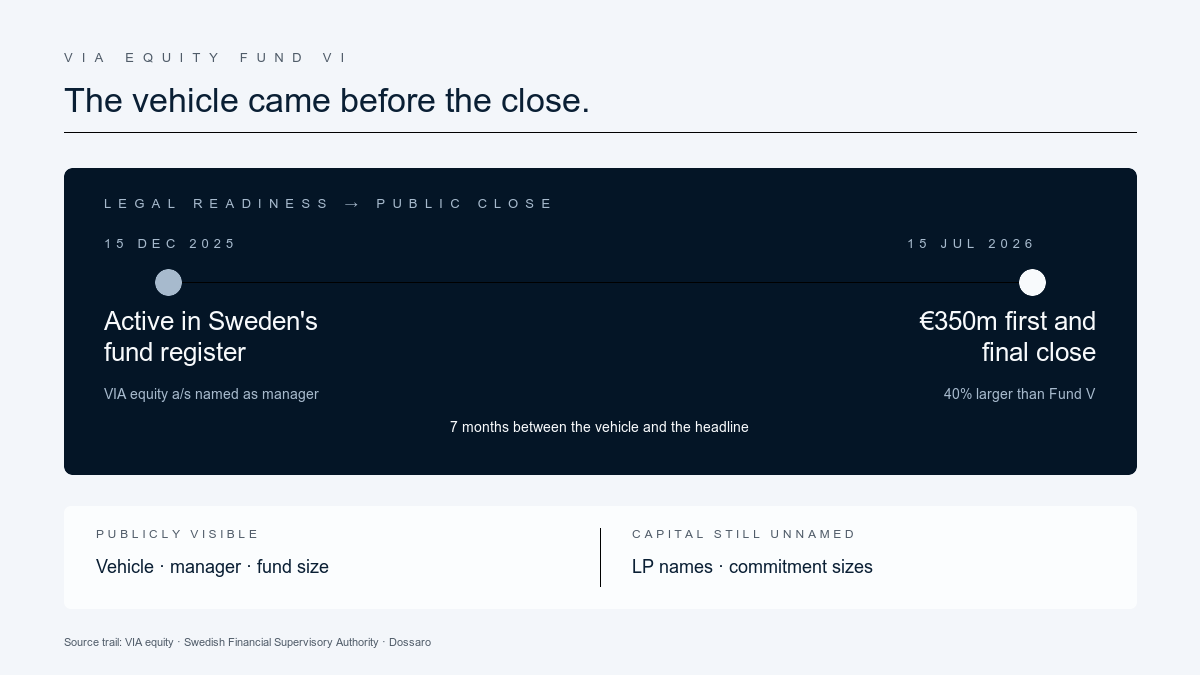
VIA Equity Fund VI K/S was already an active foreign alternative investment fund in Sweden on 15 December 2025. Seven months later, VIA equity announced the vehicle's first and final close at €350 million.
That chronology changes the way to read the fundraising headline. The legal fund identity and its manager were visible to a regulator before VIA published the size of the capital pool. The public sources still do not identify the institutions behind the commitments or the amount supplied by each one. What they show is a fund that was legally marketable before the close became a headline, followed by a fundraising disclosure that describes investor continuity more clearly than investor identity.
The fund existed before the €350m announcement
The Swedish Financial Supervisory Authority's company register lists VIA equity Fund VI K/S as an active foreign alternative investment fund. Its status date is 15 December 2025, and the entry names VIA equity a/s as the manager. The register places the fund in the European Economic Area alternative-investment-fund notification regime. It does not state that the fund had already secured €350 million on that date. It establishes the vehicle, its regulatory status and the manager attached to it.
The date is seven months ahead of VIA's 15 July 2026 announcement. That announcement calls Fund VI's €350 million the first and final close and says it was 40 percent larger than Fund V. VIA's fund information page lists Fund V at €250 million and Fund VI at €350 million, providing the comparison behind the 40 percent figure.
| Public milestone | What it establishes | What it does not establish |
|---|---|---|
| 15 December 2025 | Fund VI appeared as an active foreign alternative fund in Sweden; VIA equity a/s was named manager | That €350 million had already been committed or drawn |
| 15 July 2026 | VIA announced a €350 million first and final close | The identity or amount of each limited partner commitment |
| 2026 fund page | VIA lists Fund VI as a €350m investing vehicle | The underlying partnership or feeder allocations |
The distinction is ordinary in fund formation but important in private-market reporting. A regulatory notification makes a vehicle available for marketing under the relevant rules. It is not a receipt, a capital call or a proof that every commitment was signed. The register gives the chronology a hard legal anchor without turning the December date into an earlier close.
The close signals loyalty more than a new investor map
VIA's release says Fund VI was oversubscribed, that approximately 90 percent of commitments came from existing investors and that 18 of the 19 investors in Fund V re-upped. Those figures are a strong fundraising signal. They suggest that the manager carried a large part of its prior investor base into the new vehicle while leaving room for new capital.
They do not say which institutions supplied the money. The phrase “existing investors” is a relationship description, not a public list. It also does not show whether re-ups were the same size as in Fund V, whether a small number of large commitments dominate the total, or which new investors filled the remaining share.
VIA's own company and funds page goes one step further than the close release by giving category-level percentages for Fund VI: 3 percent from Danish family offices, 12.9 percent from Danish financial investors and 84.1 percent from international financial investors. That is a useful shape of the capital base, but it is not an LP roster. The page does not name the institutions, show individual commitment amounts or identify feeder and sidecar vehicles.
The public description therefore has two layers. The first is positive and specific: Fund VI is a €350 million vehicle managed by VIA equity a/s, and most commitments came from investors who had backed Fund V. The second is a boundary on what “investor support” means in practice: the market can see categories and re-up rates, not the names and economics of the capital providers.
A manager layer is visible; the money layer is not
The Swedish register and VIA's own disclosures align on the manager. VIA equity a/s is the named fund manager in the regulator's entry, and VIA describes the company as the management company for Fund VI and several earlier vehicles. That lets investors separate the operating manager from the limited-partnership vehicle that holds the commitments.
The distinction matters because a fund close is not the same thing as a balance-sheet raise by the management company. The €350 million is committed capital for investments, not revenue for VIA equity a/s. It also does not tell a portfolio company whether the fund's capital is concentrated in a few anchor institutions, spread across many allocators or routed through a structure that is not visible in the free public record.
This is where the comparison with other European fund disclosures becomes useful. Highland Europe's Fund VI exposes a broad beneficial-owner base through a regulatory filing, while White Star Capital Fund IV makes several institutions visible across French, Quebec and Guernsey vehicles. VIA's public surface is different. It confirms the fund vehicle, the manager and the category split, but it stops short of naming the allocators.
That is not evidence that the LP base is unusual or hidden for an improper reason. Private funds routinely disclose different layers to regulators, investors and the public. It does mean that the size of the close should not be mistaken for a public map of who bears the fund's economic exposure.
The timing changes the underwriting question
For software companies in the Nordics and the DACH region, the close creates a larger pool of potential buyout and growth capital. VIA says Fund VI will continue its strategy of investing in profitable software and IT companies across those markets. The legal identity was already in place before the July announcement, so a company approaching the manager should distinguish between three separate questions: whether the vehicle was authorized, whether capital was committed and whether a particular investment can be funded from it.
The first question is answered by the Swedish register. The second is answered only at aggregate level by VIA's close announcement. The third depends on the fund's investment pace, remaining commitments and the terms of a specific deal, none of which appear in the public sources used here.
That separation also matters for market comparisons. A €350 million headline can be compared with Fund V's €250 million size, but it cannot by itself be used to infer dry powder, investment concentration or the amount available for any one target. The 40 percent increase is a fund-size fact. It is not a valuation signal for the companies VIA may later buy.
The next documents would identify the capital behind the vehicle
The current public record supports a clear but bounded finding. VIA Equity Fund VI K/S was active in the Swedish register seven months before VIA announced its €350 million first and final close. The manager, fund size, investment strategy and broad investor categories are visible. Named limited partners, commitment sizes, feeder entities and sidecars are not.
The next decision-changing sources would be Danish partnership filings, investor commitment notices, limited-partner annual reports or fund documents released for a regulated transaction. Those records could show whether the 90 percent re-up claim reflects a broad base or a few large repeat commitments, and whether the category percentages map to identifiable institutions.
Until then, the most useful reading of the close is not that the capital is mysterious. It is that the public record separates the fund's legal readiness from the money's detailed ownership. For founders and sellers, VIA has a larger named vehicle to deploy. For investors and advisers, the remaining question is who supplied the €350 million and how that capital is structured behind the manager's public fundraising message.
Continue reading
Related Research
Highland Europe's €1.1bn Fund Has 95 Beneficial Owners
Highland Europe's €1.1bn Fund VI has 95 beneficial owners, with 81% non-US ownership and only 6% attributed to funds of funds in its official filing.
The Public Investors Behind White Star Capital Fund IV
White Star Capital's $250 million Fund IV spans France, Quebec and Guernsey, with Aéroports de Paris and La Caisse named as investors in public filings.
CuspAI's Founders Held 32.61% Before The $450m Series B
CuspAI's founders held 32.61% before its $450m Series B, while UK sovereign capital entered a company whose post-round ownership is not yet public.
EQT Bought Coller's Manager and Carry Rights, Not Its Fund Assets
EQT's $3.2bn Coller deal buys management and GP entities plus carry rights, while Companies House shows the UK operating manager rather than fund assets.