
Highland Europe's €1.1bn Fund Has 95 Beneficial Owners
Highland Europe's €1.1bn Fund VI has 95 beneficial owners, with 81% non-US ownership and only 6% attributed to funds of funds in its official filing.
On this page
Conduct your own private market research
Add dossaro to Claude or ChatGPT and run source-backed register research from your own workspace.
 Add to Claude
 Add to ChatGPT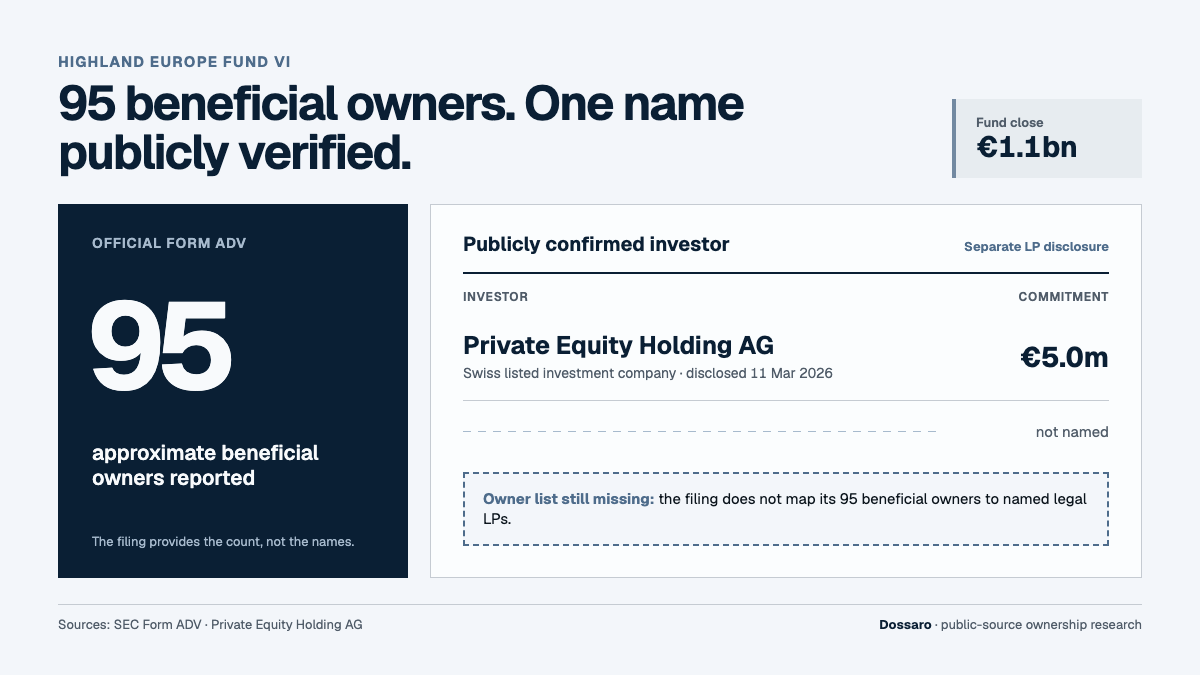
Highland Europe's new €1.1 billion growth fund has 95 beneficial owners, and 81% of its beneficial ownership sits outside the United States. Funds of funds account for only 6%, while the manager and related parties account for 0%.
Those figures appear in Highland Europe (Geneva) S.a.r.l.'s official Form ADV filing, signed in June 2026. They turn a large fund-close headline into a more useful private-market finding: Fund VI is backed by a broad, predominantly non-US capital base that is neither visibly manager-funded nor dominated by intermediary funds.
That matters for European scaleups. The capital available to Highland is not just the balance sheet of one investment firm or a narrow group of US allocators. It represents exposure distributed across dozens of beneficial owners whose commitments support a new cycle of growth-stage investments.
The filing does not name those owners. It also does not say that the 81% non-US share is European, or that 95 beneficial owners equal 95 legal limited partners. The strongest evidence establishes the shape of the capital base, not the identity of every institution inside it.
| Official Fund VI disclosure | Filed value | Decision-relevant meaning |
|---|---|---|
| Current gross asset value | $1,061,809,923 | The fund already reports assets at billion-dollar scale |
| Approximate beneficial owners | 95 | Capital exposure is distributed across a broad owner base |
| Non-US beneficial ownership | 81% | Most beneficial ownership is outside the United States |
| Fund-of-funds ownership | 6% | Intermediary funds are a minority of the disclosed ownership |
| Adviser and related-person ownership | 0% | The pool is not visibly funded by the manager itself |
The commercial takeaway is not that all 95 owners are equal. It is that Highland assembled a large outside capital pool with limited visible reliance on fund-of-funds channels.
One investor has named itself separately. Private Equity Holding AG disclosed on 11 March 2026 that it had completed a €5 million commitment to Highland Europe Technology Growth VI. That is one verified entry in the investor list, not a key to the rest of the owner base: the Form ADV's beneficial-owner count does not map one-to-one to disclosed legal limited partners.
The Official Filing Reveals The Capital Behind The Close
Tech.eu reported on 30 July that Highland Europe had closed Fund VI at €1.1 billion to invest in European technology scaleups. The announcement described a manager that has raised €3.75 billion across six funds, backed more than 80 companies and completed 30 exits.
The official adviser filing provides a different layer of information. It identifies Highland Europe Technology Growth VI Limited Partnership, a Jersey vehicle with private-fund identifier 805-8292998911. Highland Europe GPGP VI Limited is named as its general partner.
The filing reports a routine minimum investment commitment of $115,000. That figure should not be multiplied by 95 or treated as an average commitment. Large institutional commitments can sit far above a routine minimum, and beneficial-owner counts do not reveal concentration.
The same restraint applies to the owner categories.
| Filing term | What it establishes | What it does not establish |
|---|---|---|
| 95 beneficial owners | Approximate number of economic owners reported in the filing | 95 named legal limited partners or 95 equal commitments |
| 81% non-US ownership | Share of beneficial ownership attributed outside the US | 81% European ownership or a list of home countries |
| 6% funds of funds | Share attributed to vehicles that invest through other funds | Identity, fees or commitment size of those intermediaries |
| 0% adviser-related ownership | No beneficial ownership attributed to the adviser or related persons | Absence of carried interest, management fees or incentive economics |
This distinction is the locked friction in the story. A fund close communicates investment capacity. The Form ADV shows the broad source categories of that capacity, but not the subscription ledger behind them.
A Predominantly Non-US Pool Is Not Automatically European
The 81% non-US figure is commercially important because it rules out a predominantly US beneficial-ownership base. It does not identify where the capital came from.
The non-US share could include European pension funds, insurers, family offices, sovereign institutions or private wealth. It could also include allocators from Asia, the Middle East or other regions. The filing does not provide the split, so describing Fund VI as 81% European would exceed the source.
Even with that boundary, the number changes the reading of the €1.1 billion close. Highland did not need a majority-US ownership base to reach scale. That suggests demand for European growth exposure can be assembled from a materially international investor pool, even before the individual institutions are named.
This is the opposite side of the capital question examined in Dossaro's analysis of CuspAI's sovereign-backed Series B. There, the open question is what one public investor received inside a company round. Here, the filing shows how a fund's risk capital is distributed by broad owner type before that money reaches portfolio companies.
The Small Fund-Of-Funds Share Shortens One Intermediary Layer
Funds of funds account for 6% of beneficial ownership in Fund VI. That does not mean the other 94% is direct institutional capital of one kind. The filing simply rules out fund-of-funds ownership for most of the pool.
The difference matters because funds of funds add another allocation layer between the original capital provider and the portfolio company. They can broaden access and diversify manager selection, but they also introduce another set of fees, liquidity terms and reporting relationships.
With only 6% attributed to that category, Highland's capital base appears mostly sourced through other owner types. The filing does not identify whether those are pension plans, insurers, endowments, family offices or sovereign allocators. It therefore supports a statement about intermediary exposure, not a complete investor taxonomy.
For entrepreneurs, the category mix does not change the term sheet in the next financing round by itself. It can matter over a fund's life. A broader outside owner base may diversify fundraising dependence, while commitment concentration can still create pressure if a few large allocators supply most of the money. The 95-owner count reduces the likelihood of a one-owner pool but does not reveal how concentrated the commitments are.
The €1.1bn Close And $1.062bn Gross Asset Value Are Different Measures
The public close and the official filing sit close together numerically: €1.1 billion of announced commitments and $1,061,809,923 of current gross asset value. They should not be used to calculate a shortfall or conversion rate.
Commitments describe capital investors have agreed to provide under fund terms. Gross asset value is a regulatory reporting measure at a particular date and can reflect called capital, investments, cash, valuation movements and the reporting perimeter. The figures also use different currencies and dates.
Their proximity is useful only at a high level. Both place Fund VI at billion-scale. The Form ADV does not establish how much of the €1.1 billion had been called, invested or reserved when the close was reported.
This is the same discipline required when reconstructing company financings through a company-register document workflow: amounts that answer different legal or accounting questions should not be collapsed into one total merely because they look comparable.
The Next Disclosure Must Name The Concentration Risk
The Form ADV answers the first capital-base question. Highland Europe Fund VI is backed by 95 beneficial owners, 81% non-US beneficial ownership, 6% fund-of-funds ownership and no disclosed adviser-related ownership.
It leaves the decisive allocation questions open.
| Next evidence | Question it would answer |
|---|---|
| Jersey partnership or subscriber record | Which legal entities committed capital |
| Institutional allocation disclosure | Which pensions, insurers, sovereign funds or family offices participated |
| Commitment schedule | Whether a few owners supply most of the €1.1bn |
| Capital-call and investment reporting | How much capital has moved into portfolio investments |
| Side-letter or governance disclosure | Whether large owners received different information or liquidity terms |
Until those documents appear, the fair conclusion is narrower than a list of famous limited partners and stronger than a generic fund-close announcement. Highland Europe assembled a billion-euro vehicle from a broad, mostly non-US owner base with limited fund-of-funds exposure.
The next financing question is not whether Fund VI has scale. It is how concentrated the €1.1 billion really is behind those 95 beneficial owners, and which institutions carry the largest share of the risk.
Continue reading
Related Research
CuspAI's Founders Held 32.61% Before The $450m Series B
CuspAI's founders held 32.61% before its $450m Series B, while UK sovereign capital entered a company whose post-round ownership is not yet public.
Nuclear Turbines Founders Held 57.6% Before £15m Reveal
Nuclear Turbines announced £15m, while its latest register shows founders at 57.6%, IQ Capital at 15.4% and about £6.2m of cash equity filed.
ZuriQ's $25.5m Seed Created A 28.6% Preferred Block
ZuriQ's $25.5m seed closed legally in May, creating a 28.6% preferred block and adding a Quantonation-linked director before its July reveal.
Auxxo's €33.3m Fund Close Shows Why LP Count Is Not Capital Control
Auxxo's €33.3m Female Catalyst Fund II closed after staged LP entries, but Berlin filings show nominal Haftsumme is not a map of capital or control.