
Auxxo's €33.3m Fund Close Shows Why LP Count Is Not Capital Control
Auxxo's €33.3m Female Catalyst Fund II closed after staged LP entries, but Berlin filings show nominal Haftsumme is not a map of capital or control.
On this page
Conduct your own private market research
Add dossaro to Claude or ChatGPT and run source-backed register research from your own workspace.
 Add to Claude
 Add to ChatGPT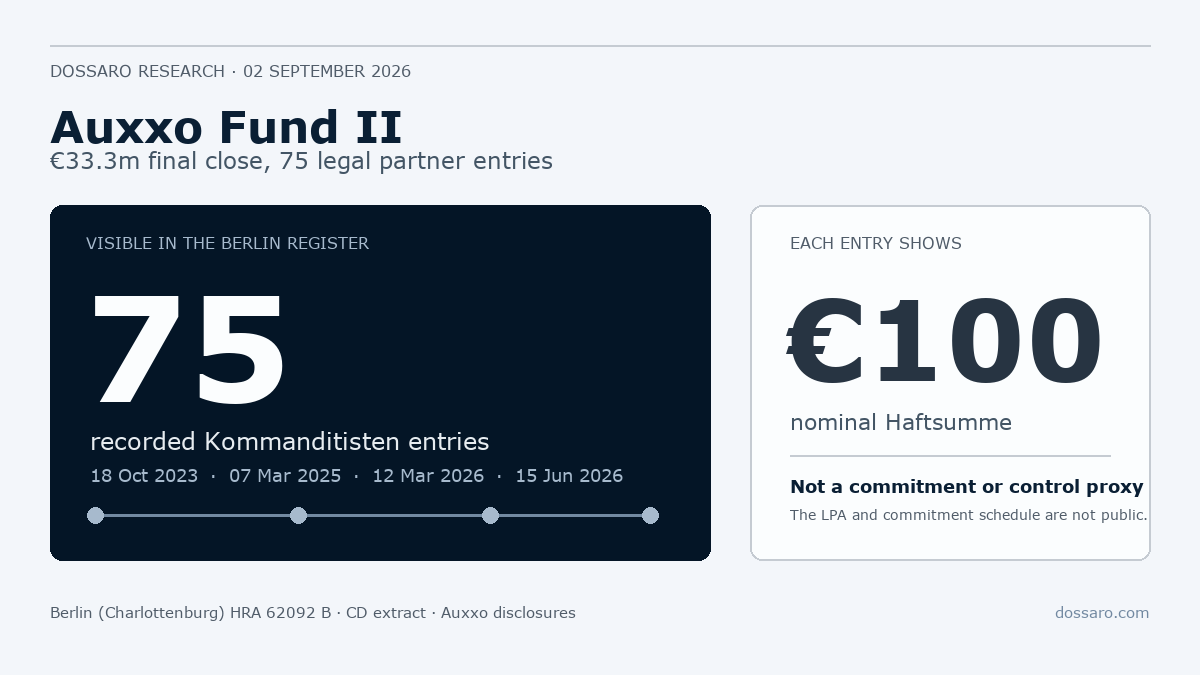
Auxxo’s reported €33.3 million final close is the end point of a fundraising process that the public German register shows arriving in waves. The current chronological extract for Auxxo Female Catalyst Fund II GmbH & Co. KG records 75 Kommanditisten entries, from the first registrations in October 2023 to a final visible group in June 2026.
Every one of those entries displays a €100 Haftsumme. That number is useful for identifying the legal form and the partners’ registered liability amount. It is not a published commitment, a share of the €33.3 million, or a control percentage. The register therefore answers when legal partners appeared, while the fund agreement still holds the answer to who supplied and controls the capital.
The distinction changes how to read the close. EU-Startups reported on 1 September that Auxxo had closed Fund II at €33.3 million, more than 75% above the €19 million first fund. Startbase independently reported the same amount and described the new founder matchmaking platform. The register adds a more precise finding: the named legal partner base was built over several entry dates, and the public documents do not allocate the headline amount among them.
The close was assembled through dated entry waves
The fund’s legal identity is exact. Auxxo Female Catalyst Fund II GmbH & Co. KG is registered in Berlin (Charlottenburg) under HRA 62092 B. The personally liable partner is Auxxo FCF II GP GmbH, registered under HRB 256885 B. Auxxo Management GmbH appears as a Kommanditist and is identified in Auxxo’s product disclosure as the manager.
The chronological extract records the following sequence:
| Register date | What the extract shows | Economic reading |
|---|---|---|
| 18 October 2023 | Initial entries for Auxxo Management, Bettine Schmitz Ventures, Gesa Miczaika and the carry pool | The vehicle existed before the public close announcements |
| 27 June 2024 | The carry-pool vehicle appears as entry four | The legal partner base was still being formed |
| 7 March 2025 | A large first wave, including Speedinvest IV FoF and an Aurum Impact entry | A broad syndication entered before the reported first close |
| 10 April and 15 October 2025 | Aurum Impact’s first entry ceased, then a later entry returned alongside further partners | Register history records changes, not commitment sizes |
| 29 January and 12 March 2026 | Entries include Arpheus, EnBW New Ventures, the European Investment Fund and Finc3 | Corporate and public-backed names entered after the July 2025 first-close account |
| 15 June 2026 | AI Unicorn Ventures, Christiane von Hardenberg, Navy Energy, Gabriele Patzschke and Carmel Rafaeli complete the visible list at 75 | The final visible legal wave predates the September final-close report |
The dates do not prove that every entry represented a new cash subscription on that day. A register entry can reflect the admission, transfer or correction of a partner. They do establish the legal chronology that a single final-close number compresses.
That chronology matters because Auxxo’s public first-close narrative and final-close narrative describe different points in the fund’s life. The company said the first close reached €26 million in July 2025 with European Investment Fund support. In the register, the European Investment Fund and EnBW New Ventures appear in the March 2026 wave. The documents support a later legal entry for those names, not a claim about when their investment decision was made or when money was called.
€100 Haftsumme is not the fund’s capital denominator
The current extract is explicit about the figure shown beside each Kommanditist: €100. It does not show a second column for each partner’s commitment or percentage. Adding the 75 nominal amounts would produce €7,500, but that arithmetic would be economically meaningless as a measure of Fund II’s size. It would simply total the register field.
Auxxo’s own product information document describes a Kommanditanteil in Auxxo Female Catalyst Fund II GmbH & Co. KG, managed by Auxxo Management GmbH. It states that the closed fund has a minimum term of ten years and references a statutory minimum commitment of €200,000 for semi-professional investors. The document does not publish the commitment schedule for the 75 named legal partners.
That is the normal separation between a German limited partnership’s registered liability amount and the contractual economics of a fund. The register makes the partner’s legal position visible. The subscription agreement and limited partnership agreement determine the amount committed, the amount called, voting rights and distributions. None of those terms can be inferred from a repeated €100 entry.
This is the same diligence trap that appears in RunwayVC’s Fund II structure. There, a Norwegian fund vehicle’s NOK30,000 of registered share capital sat beside a much larger reported first close. In Auxxo’s KG, the nominal number is attached to limited partners rather than shares, but the analytical rule is the same: a filing denominator is not automatically a capital denominator.
The LP list is informative, but not a control map
The 75 entries are still economically useful. They show a mix of fund vehicles, companies, founders, family offices and individuals. They also show how a public-backed institution and a corporate investor entered the visible legal perimeter. The European Investment Fund is listed as a Kommanditist. EnBW Energie Baden-Württemberg AG is listed and then corrected to EnBW New Ventures GmbH. Speedinvest IV FoF GmbH and the Luxembourg Roundtable vehicle are among the institutional names.
What the register does not show is just as important. It does not state whether one partner committed €100,000, €1 million or a larger amount. It does not identify capital-call timing, preferred return, carried interest, veto rights or the voting threshold for major decisions. It does not reveal whether a named person invests personally or through a wider family arrangement beyond the legal name on the entry.
Auxxo and the independent coverage also describe the LP base in gender terms. Auxxo’s ESG policy says more than half of LPs are women, mixed couples or senior female decision-makers, and EU-Startups repeats that framing. The register cannot verify that metric. It records legal names and dates, not gender identity, household composition, decision-making role or the capital share associated with any category. Inferring gender from names would be both unreliable and outside the source’s claim.
The safe conclusion is narrower and stronger: the register documents a 75-entry legal partner base built over time, while Auxxo’s own disclosures describe a women-focused investment strategy and a majority-female or mixed decision-maker LP metric. Those are related but different evidence sets. Neither source turns the LP count into a map of who controls the €33.3 million.
A staged syndication changes the commercial question
Fundraising is often described as a single event because the final close supplies a clean headline. For managers, the legal chronology can be operationally more important. Each admission can trigger onboarding, know-your-customer work, reporting obligations and new relationships with institutions that may later support portfolio companies. For founders, the difference between a large institutional anchor and a long tail of smaller LPs can affect sector access, follow-on capacity and the manager’s network.
The public documents support a staged-syndication reading without assigning a winner. The initial 2023 entries established the vehicle. A large March 2025 wave preceded the reported €26 million first close. New corporate and EIF entries appeared in 2026. The final visible entries arrived in June, before the final-close announcement. That sequence is evidence of a fund platform expanding its legal partner base, not evidence that every later entry supplied an equal slice of capital.
There is a benign explanation for the gap between the register and the headline. A fund’s limited partnership agreement can allocate commitments privately while the register displays only the amount relevant to the partner’s statutory liability. The repeated €100 is therefore consistent with a normal fund structure. It would be wrong to call the vehicle undercapitalised or to imply that the close was unpaid.
It would be equally wrong to claim that EIF, EnBW New Ventures or any named individual controls the fund simply because each appears in the extract. Control depends on the GP agreement, the LPA and any side letters. The publicly available material does not disclose those rights.
The missing ledger is the next decision-changing document
Auxxo’s final close is a meaningful financing milestone: €33.3 million, more than 75% above Fund I’s €19 million, with a first-close account of €26 million and a legal partner list that reached 75 visible entries. The register makes the timeline concrete, but it does not explain the capital allocation.
The next evidence needed is the Fund II commitment schedule or an audited fund account that identifies commitments, paid-in capital and uncalled amounts by vehicle. The GP and manager agreements would also show voting thresholds, fee flows and carried-interest rights. Those documents could reveal whether the institutional names are anchors, co-investors, equal partners or simply members of a much larger pool.
Until then, the strongest retellable finding is simple: Auxxo’s €33.3 million fund was assembled through waves of legal partner entries, but the German register’s €100 per partner is a liability marker, not a map of who supplied or controls the money.
Continue reading
Related Research
RunwayVC's €40m Fund II Sits Behind A NOK30,000 Fund Vehicle
RunwayVC's €40m Fund II is registered as a NOK30,000 alternative-investment vehicle, while a separate five-person manager carries the governance layer.
Highland Europe's €1.1bn Fund Has 95 Beneficial Owners
Highland Europe's €1.1bn Fund VI has 95 beneficial owners, with 81% non-US ownership and only 6% attributed to funds of funds in its official filing.
The Public Investors Behind White Star Capital Fund IV
White Star Capital's $250 million Fund IV spans France, Quebec and Guernsey, with Aéroports de Paris and La Caisse named as investors in public filings.
VIA Equity's €350m Fund VI Was Authorized Before Its Final Close
VIA Equity's €350m Fund VI was active in Sweden's register seven months before its close, while public disclosures stop short of naming LP commitments.