
The Public Investors Behind White Star Capital Fund IV
White Star Capital's $250 million Fund IV spans France, Quebec and Guernsey, with Aéroports de Paris and La Caisse named as investors in public filings.
On this page
Conduct your own private market research
Add dossaro to Claude or ChatGPT and run source-backed register research from your own workspace.
 Add to Claude
 Add to ChatGPT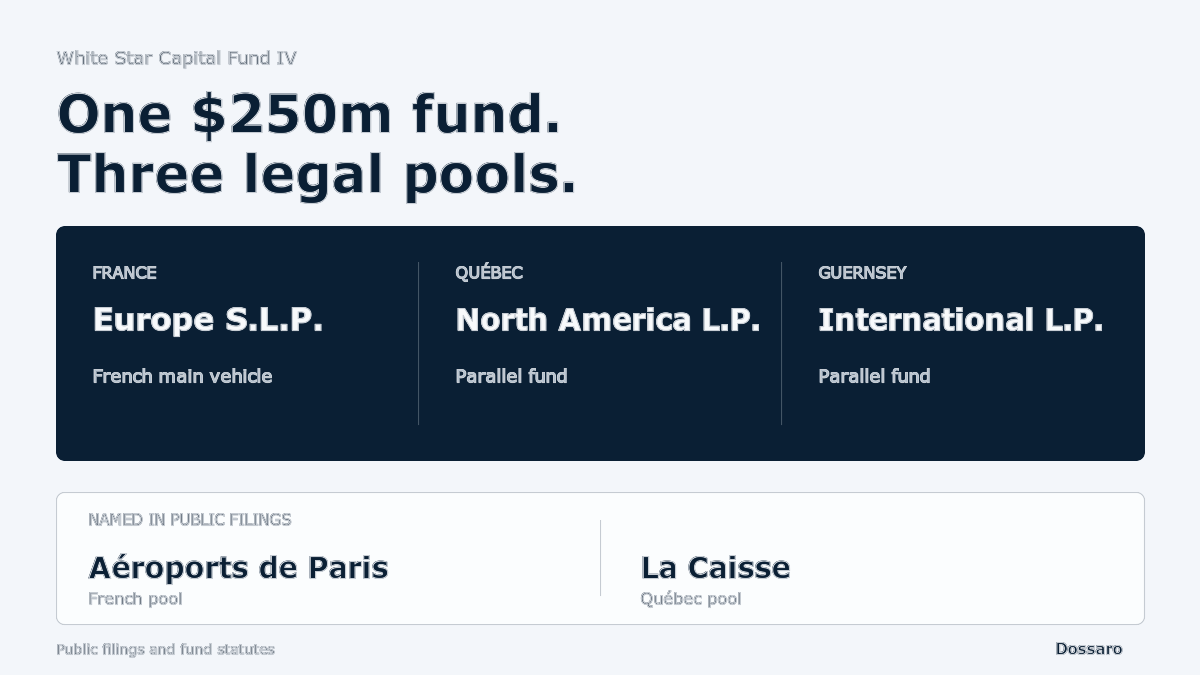
White Star Capital's $250 million Fund IV is not one legal pool with one investor list. The French formation documents describe a coordinated structure spanning France, Quebec and Guernsey, while primary financial disclosures name two institutional capital providers: Aéroports de Paris and Quebec pension investor La Caisse.
That finding changes the fund-close headline. Founders will experience White Star as one investment platform. Limited partners can enter through different jurisdictional vehicles, and the publicly visible capital base already includes institutions linked to French infrastructure policy and Quebec retirement savings.
Tech.eu reported on 5 August that White Star had reached a $250 million final close for Fund IV. Together with its North American Seed Fund and new special-purpose vehicles, the firm said it had raised more than $350 million of fresh capital to invest from seed through Series B.
One Fund Name Covers At Least Three Legal Pools
The central French vehicle is WHITE STAR CAPITAL IV EUROPE S.L.P., a professional specialised investment fund formed in December 2023. Its formation statutes name two parallel funds and allow feeder or alternative investment vehicles around them.
| Legal pool | Jurisdiction | Publicly visible role |
|---|---|---|
| White Star Capital IV Europe S.L.P. | France | Main European fund vehicle; SIREN 982540403 |
| White Star Capital IV North America Limited Partnership | Quebec | Parallel fund named in the French statutes |
| White Star Capital IV International Limited Partnership | Guernsey | Parallel closed-ended scheme registered by the GFSC |
The table does not prove that the $250 million is split evenly across three vehicles. It establishes something more basic and more useful: the fundraising brand aggregates separate legal pools.
The Guernsey Financial Services Commission independently lists the international partnership as a registered closed-ended collective investment scheme. The French statutes describe the Quebec and Guernsey entities as parallel funds and calculate certain investor approvals across combined commitments in the French fund, parallel funds and feeders.
That combined-governance mechanism matters. A limited partner may subscribe through a vehicle designed for its own jurisdiction, but important consent thresholds can still reflect the capital committed across the wider programme. The structure separates the legal containers without necessarily fragmenting the investment strategy.
Aéroports de Paris Is Named In The French Pool
Aéroports de Paris is the first identifiable institutional investor. Its 2025 consolidated financial statements list White Star Capital IV France S.L.P. among the investment funds held by Aéroports de Paris SA. The report does not publish a SIREN for that holding, so it identifies ADP with the French Fund IV structure without independently proving which related French entity received the subscription.
The disclosure does not publish ADP's commitment, paid-in capital or percentage of the fund. It does establish that the airport group is not merely adjacent to the French venture ecosystem. It supplied capital to the Fund IV vehicle before the final close.
ADP's filing also places Fund IV in a broader institutional portfolio that includes earlier White Star, Cathay Innovation and XAnge vehicles. For White Star, this is repeatable access to a strategic corporate balance sheet. For ADP, it is indirect exposure to technology companies across digital health, financial technology, industrial automation, infrastructure, data protection and sustainability tools.
| Named institution | Vehicle identified in its own disclosure | What the source proves | What remains private |
|---|---|---|---|
| Aéroports de Paris | White Star Capital IV France S.L.P. | ADP invested in the French Fund IV structure | Exact legal-vehicle mapping, commitment and ownership percentage |
| La Caisse | White Star Capital IV North America L.P. | La Caisse holds units in the Quebec pool | Exact commitment, cash called and exact fair value |
| French Treasury Tibi initiative | White Star Capital IV, approved fund list | The fund met the initiative's eligibility criteria | Any direct Treasury investment or allocation to a named partner |
The distinction in the last row is important. A government programme can channel or mobilise institutional demand without becoming an owner itself.
La Caisse Appears In The Quebec Parallel Fund
La Caisse's 2025 investment disclosure lists Société en commandite White Star Capital IV Amérique du Nord, the French-language name of the North American partnership. The holding appears as an investment in units at 31 December 2025.
The report places the investment in value category A, defined as a fair-value range from C$0 to C$200 million. It does not publish a point estimate. That range cannot be converted into a commitment and says nothing about how much capital had been called by year-end.
Even with that boundary, the disclosure is economically significant. La Caisse's presence gives the Quebec parallel fund a named source of long-duration institutional capital. It also illustrates why the structure is transatlantic rather than merely a French fund marketing into North America.
The two named investors enter different pools. ADP is visible in France. La Caisse is visible in Quebec. The French statutes then connect those pools through the common Fund IV framework.
Tibi Approval Is A Mobilisation Channel, Not An Owner List
The French Treasury's Tibi initiative page lists White Star Capital IV among the approved funds investing in unlisted companies. The same page lists Groupe ADP among the programme's partner investors.
That pairing gives useful policy context, but it should not be stretched into a cap table. Tibi approval means the fund satisfied criteria designed to mobilise institutional capital for technology companies. It does not mean the French Treasury is a limited partner. Nor does the public list prove that every Tibi partner invested in White Star Fund IV.
| Date | Public event | What became visible |
|---|---|---|
| 12 December 2023 | French Fund IV vehicle formed | Parallel pools, manager, governance and fund term |
| 31 December 2025 | ADP and La Caisse reporting dates | Two institutional investors named in different pools |
| 15 January 2026 | Treasury published its updated Tibi list | Fund IV shown as eligible under the mobilisation initiative |
| 5 August 2026 | $250m final close reported | Branded fundraising endpoint across the fund complex |
The sequence shows that the legal and institutional base preceded the final-close announcement by years. The close is a fundraising milestone, not the birth of the vehicle.
Parallel Funds Solve Real Institutional Constraints
There is a benign and ordinary explanation for this architecture. Pension investors, corporate investors and other limited partners face different tax rules, regulatory requirements, currency preferences and mandate restrictions. A parallel vehicle can let them invest alongside one another without forcing every institution into the same legal partnership.
That practical logic does not make the structure editorially trivial. It determines where an investor signs, which regulator sees the pool, where accounts may later appear and how consent rights are counted. It can also affect currency exposure, reporting and the path by which distributions return to each investor.
For founders, the most important commercial consequence is simpler. White Star can draw from a wider cross-border capital base while presenting one investment strategy. The manager says Fund IV will focus on Series A and B companies with international ambition. Separate pools can invest together in those companies even when their own investors require different legal wrappers.
The structure also makes public-source diligence harder. A search confined to the French entity will not reveal La Caisse's North American holding. A Guernsey search will confirm the international pool but not identify the complete French or Quebec investor base. Reconstructing the branded fund requires following the vehicle relationships across jurisdictions.
This is the same core problem visible in Dossaro's analysis of Highland Europe Fund VI: a fund-close headline identifies the manager and target size, while the economically decisive limited-partner layer remains only partly public. White Star offers a stronger current reading because two institutional investors and three legal pools can be tied together from primary disclosures.
The French company-register document workflow supplies the vehicle and governance layer. The institutional reports supply the investor names. Neither source class is complete on its own.
The Missing Ledger Still Matters
The public evidence supports a bounded conclusion. White Star Capital Fund IV is a cross-border complex rather than one blind pool. Aéroports de Paris invested through the French vehicle. La Caisse invested through the Quebec vehicle. A Guernsey international partnership completes the visible three-jurisdiction architecture, and the French fund is approved under the Tibi mobilisation framework.
What the evidence does not show is equally important. The complete limited-partner list remains private. The $250 million cannot be allocated among the French, Quebec, Guernsey and any feeder vehicles. No public source establishes ADP's commitment, La Caisse's commitment or either institution's percentage of the total.
The next audited fund accounts or limited-partner schedules could close those gaps. They should show commitments and capital calls by vehicle, identify additional institutional backers and explain whether the parallel pools share every investment in the same proportions.
Until those documents arrive, the strongest finding is not a guessed owner list. It is the verified beginning of one: two named public institutional investors, three coordinated legal pools and a fundraising headline that compresses them into one $250 million label.
Continue reading
Related Research
Highland Europe's €1.1bn Fund Has 95 Beneficial Owners
Highland Europe's €1.1bn Fund VI has 95 beneficial owners, with 81% non-US ownership and only 6% attributed to funds of funds in its official filing.
CuspAI's Founders Held 32.61% Before The $450m Series B
CuspAI's founders held 32.61% before its $450m Series B, while UK sovereign capital entered a company whose post-round ownership is not yet public.
Headline Bought Porsche's cylib Stake Before the EU Scale-Up Selection
Headline bought Porsche's full 5.83% cylib stake four months before the EIC selected cylib for a conditional equity anchor of its next major round.
WAD Capital's €130m Fund Separates Search From Acquisition
WAD Capital's €130m debut fund has two dated Belgian vehicles: Seed Fund I for search and Invest Fund I for acquisitions, with EIF anchoring its first close.