
WAD Capital's €130m Fund Separates Search From Acquisition
WAD Capital's €130m debut fund has two dated Belgian vehicles: Seed Fund I for search and Invest Fund I for acquisitions, with EIF anchoring its first close.
On this page
Conduct your own private market research
Add dossaro to Claude or ChatGPT and run source-backed register research from your own workspace.
 Add to Claude
 Add to ChatGPT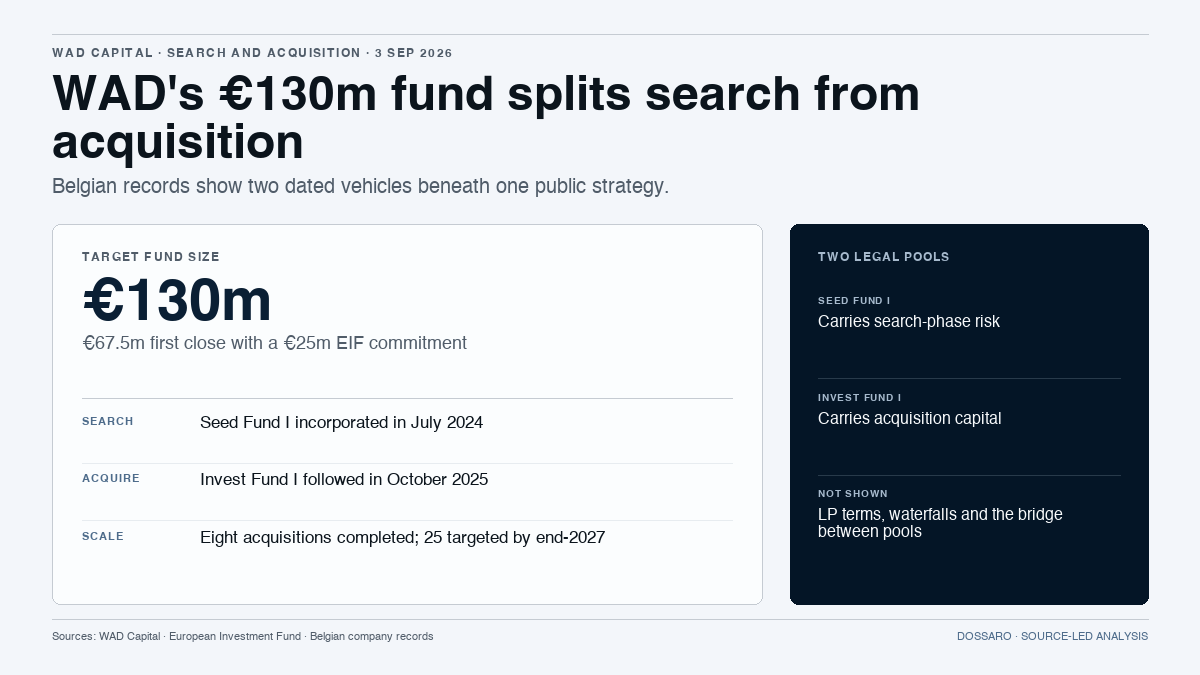
WAD Capital's €130 million debut fund is publicly described as one strategy, but Belgian records show two dated legal vehicles beneath the headline. WAD Capital Seed Fund I was incorporated in July 2024 for the search phase. WAD Capital Invest Fund I followed in October 2025 for the investment phase and has a stated ten-year duration. The separation is not a technical footnote. It identifies a point that the public fund announcement leaves open: who finances the search for a company before acquisition capital is committed.
The European Investment Fund announcement on 3 September 2026 says WAD had reached a €67.5 million first close, with a €25 million EIF commitment, on the way to a €130 million target and a €132.5 million hard cap. WAD said it had already completed eight acquisitions and was targeting 25 companies by the end of 2027. Those are meaningful scale numbers. They do not, however, turn the two legal pools into one disclosed ownership or liability stack.
The commercial question is therefore narrower and more useful than asking whether EIF owns a share of WAD's fund. The public evidence supports a search vehicle and a later acquisition vehicle, but it does not reveal their limited partners, waterfalls, subscription terms or the agreement that moves a searched opportunity into an acquisition.
The €130m headline sits over two legal pools
WAD's own disclosure page groups Seed Fund I and Invest Fund I under the phrase “the Fund” and describes an Article 8 investment strategy. Its language is commercially coherent: a searcher can source and evaluate businesses before the investment vehicle funds a transaction. The Belgian register chronology makes that operating model visible at legal-entity level.
| Vehicle or event | Public record | What it establishes | What it does not establish |
|---|---|---|---|
| WAD Capital Partners | Private limited manager, CBE 1010344179, incorporated 13 June 2024 | The manager existed before both funds | Its register does not disclose fund ownership or carry |
| WAD Capital Seed Fund I | Limited partnership, CBE 1011630123, incorporated 16 July 2024 | A separate search-phase vehicle exists | It does not disclose searcher compensation or who funds each search |
| WAD Capital Invest Fund I | Limited partnership, CBE 1029317082, incorporated 17 October 2025; ten-year duration stated in the public disclosure | A later investment-phase vehicle exists | It does not show which searched businesses it will acquire or on what terms |
| 3 September 2026 announcement | €67.5m first close, €25m EIF commitment, €130m target, €132.5m hard cap | The public fundraising scale and EIF participation | It does not allocate commitments between the two vehicles |
The entity identities and incorporation dates are visible in the Belgian CBE profile for WAD Capital Partners, the Seed Fund I profile and the Invest Fund I profile. The FSMA manager record independently confirms WAD Capital Partners and Belgian enterprise number 1010.344.179. None of those public pages is a partnership agreement.
The dates also matter. The manager was incorporated first, Seed Fund I was created a little over a month later, and Invest Fund I did not appear until roughly 15 months after the seed vehicle. That sequence is consistent with a staged model in which search activity is funded before a second pool signs the acquisition. It is not proof that the vehicles have different limited partners or different economic waterfalls.
Search risk is different from acquisition risk
A search fund has a distinctive exposure. Someone must spend time and money identifying targets, travelling, commissioning diligence and negotiating with owners before a transaction is certain. An acquisition fund, by contrast, commits capital when a company has been selected and the purchase terms are ready. Putting those activities into separate vehicles can make the risk allocation legible even when the public documents do not disclose the contract between them.
For a founder or seller, the distinction changes the practical diligence questions. Which entity signs a letter of intent? Which entity pays for the initial diligence? If the search is unsuccessful, is the cost borne by Seed Fund I, by the manager, or by prospective acquisition investors? If a target is acquired, which vehicle owns the shares and receives the operating cash flows? The public record answers none of those questions, but the two-vehicle chronology tells a counterparty not to assume that the first conversation is with the eventual owner.
The EIF release adds economic context. It says WAD focuses on business services, energy transition and healthcare companies in the Benelux, northern France and western Germany, generally with EBITDA between €1 million and €5 million. It also says the managing partners contribute 2% of the fund capital alongside family investors. That 2% signals alignment in WAD's public framing, but it is not a disclosed percentage ownership in either legal vehicle and it does not identify a particular partner's stake.
WAD's reported pipeline reinforces the staged reading. The EIF says the platform had completed eight acquisitions and had five more in its pipeline at the announcement date. A pipeline is not a commitment schedule. It can contain opportunities that never reach signing, and the release does not say whether each opportunity is financed from the search vehicle, the investment vehicle or a transaction-specific structure.
€25m is 37.0% of the first close, not 37.0% ownership
The public figures support one simple calculation: €25 million divided by the €67.5 million first close is approximately 37.0%. That ratio describes the EIF commitment relative to the disclosed first-close amount. It does not describe EIF's ownership, voting power, profit share or share of any acquired company.
The distinction is essential because private funds can have management fees, carried interest, preferred returns, recycling rules, co-investment rights and different commitment dates. Even within one strategy, the terms for a search vehicle can differ from the terms for an acquisition vehicle. The public announcement provides no limited-partner schedule and no partnership agreement that would allow those economics to be calculated.
WAD's phrase “the Fund” could mean that both legal vehicles sit inside one coordinated strategy. It might also be a communications shorthand for a structure whose legal pools have different subscribers or rights. Both readings remain possible. Treating the 37.0% arithmetic ratio as an ownership claim would go beyond the evidence.
This is the same discipline required when reading other private fund structures. Dossaro's analysis of Runway Venture Capital Fund II shows why a fund label, a manager and an investment entity should be kept distinct. For WAD, the separation is even more relevant because the legal vehicles map onto different commercial stages rather than simply different administrative labels.
What the records prove, and what they leave open
The public record proves the existence and timing of three Belgian entities, the announced first-close and target amounts, EIF's €25 million commitment, WAD's stated 2% manager contribution and the search and acquisition strategy described in the disclosure. It also supports the statement that Seed Fund I and Invest Fund I are separate legal partnerships with different incorporation dates.
It does not prove that the same family investors subscribe to both vehicles. It does not show whether Seed Fund I receives a management fee, a success fee, a carried interest allocation or reimbursement from an acquisition pool. It does not identify the entity that owns a completed acquisition, the terms offered to a searcher, or the allocation of the €67.5 million first close between search and investment commitments.
Those gaps are material for sellers. A business owner evaluating an approach from WAD needs to know who has authority to sign, who can fund the purchase price, whether the acquisition vehicle is already capitalised and how a failed process affects diligence costs. A lender or adviser needs the same information to distinguish a manager's promise from a partnership's binding obligation.
The structure may ultimately be straightforward. Separate vehicles can be an administrative choice that keeps search expenses and acquisition assets in clean accounting buckets while the same investors back both. The public evidence does not allow that benign interpretation to be confirmed or rejected. It only shows that the legal pools were created at different points in the strategy's build-out.
The next document should connect search to ownership
WAD's €130 million announcement is best read as a coordinated platform with a search-phase pool and a later acquisition pool, not as proof of one undifferentiated pot. The economic consequence is that search risk and acquisition risk can be allocated separately even while the public narrative presents one fund.
The strongest next-document watchpoint is the partnership agreement or subscription schedule for WAD Capital Seed Fund I and WAD Capital Invest Fund I. Those records could show whether the limited partners overlap, how capital calls work, and whether a searched opportunity receives an automatic path into the acquisition vehicle. The first acquisition-level shareholder or ownership filing would then show which pool ultimately holds the operating company.
Until those documents are public, the defensible finding is simple: WAD's €130 million debut strategy has two dated legal pools, and the unanswered commercial issue is who pays for the hunt before the buyout.
Continue reading
Related Research
RunwayVC's €40m Fund II Sits Behind A NOK30,000 Fund Vehicle
RunwayVC's €40m Fund II is registered as a NOK30,000 alternative-investment vehicle, while a separate five-person manager carries the governance layer.
Auxxo's €33.3m Fund Close Shows Why LP Count Is Not Capital Control
Auxxo's €33.3m Female Catalyst Fund II closed after staged LP entries, but Berlin filings show nominal Haftsumme is not a map of capital or control.
The Public Investors Behind White Star Capital Fund IV
White Star Capital's $250 million Fund IV spans France, Quebec and Guernsey, with Aéroports de Paris and La Caisse named as investors in public filings.
Mustard Seed's €150m First Close Is Already a Deployment Vehicle
Mustard Seed + Partners says nearly €150m is closed and €55m is deployed, but public records still leave LP commitments and fund control unallocated.