
RunwayVC's €40m Fund II Sits Behind A NOK30,000 Fund Vehicle
RunwayVC's €40m Fund II is registered as a NOK30,000 alternative-investment vehicle, while a separate five-person manager carries the governance layer.
On this page
Conduct your own private market research
Add dossaro to Claude or ChatGPT and run source-backed register research from your own workspace.
 Add to Claude
 Add to ChatGPT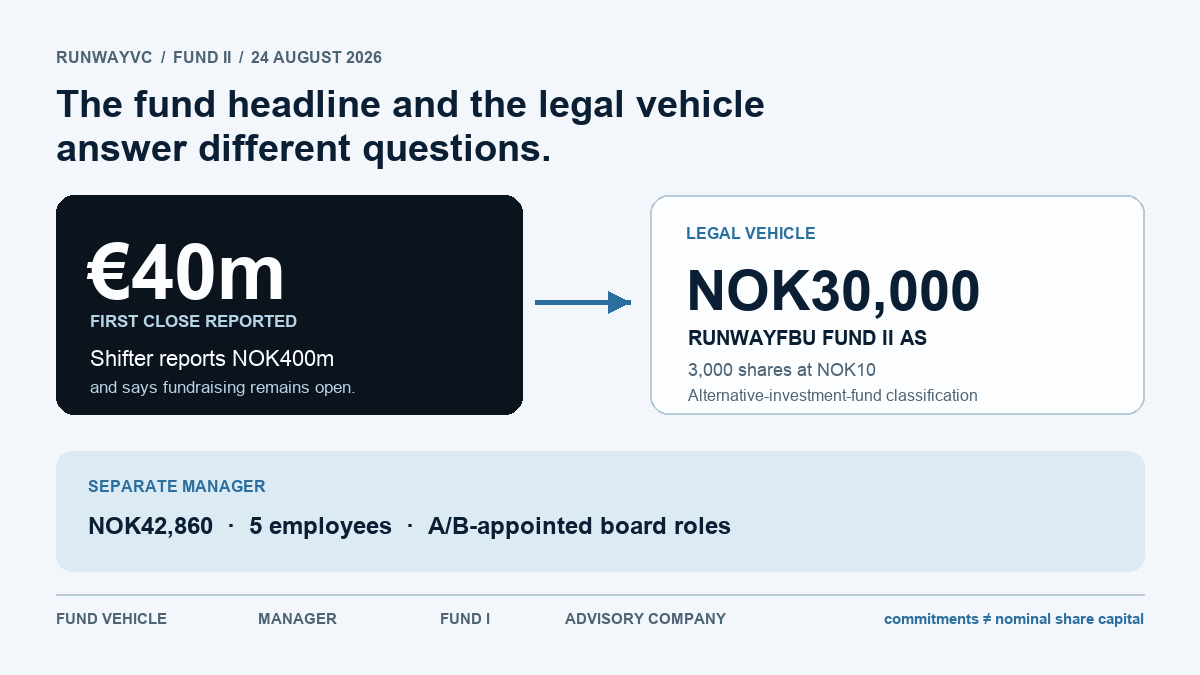
RunwayVC's reported €40 million first close sits in a legal structure that is much smaller on paper than the headline suggests: the Norwegian company registered as RunwayFBU Fund II AS has NOK30,000 of share capital, while a separate five-person management company carries the visible operating and governance layer.
That is not evidence that the close is fictitious or unpaid. It is the normal distinction between a fund's nominal company capital and the commitments made by its limited partners. It is also the distinction investors need before treating the €40 million as cash inside one operating company, or assuming that the named industrial backers own the manager.
| Legal layer | Publicly recorded fact | What it changes for a business reader |
|---|---|---|
| Fund II vehicle | RunwayFBU Fund II AS: alternative-investment-fund classification, NOK30,000 capital and 3,000 shares | The fund headline describes a commitment pool, not the vehicle's nominal equity |
| Fund manager | RunwayFBU Fund Management AS: five employees, NOK42,860 capital and A/B-appointed board roles | Visible governance sits in a separate company |
| Earlier fund | RunwayFBU Fund I AS: NOK7m capital and 1m shares | Fund I and Fund II are not one legal person |
| Advisory company | RunwayFBU AS: separate NOK30,000-capital consultancy | The Runway name spans distinct entities and purposes |
The €40m headline is a commitment pool, not operating-company equity
EU-Startups reported on 24 August that RunwayVC had reached a €40 million first close for Fund II. The article names Aker as a cornerstone investor, with Halliburton, Aker BP, Aker Solutions, KLP, Investinor and industrial-family investors among the new backers. It says the fund expects roughly 20 investments over three to five years, with typical initial cheques of NOK5 million to NOK10 million.
Norwegian outlet Shifter reported the same close as NOK400 million and said Aker led the round. It also noted that the first close remains open to additional fundraising. The two reports use different currencies for the same announcement, so this article keeps both source formulations rather than forcing an exchange-rate conversion.
The legal vehicle behind that announcement is RUNWAYFBU FUND II AS, organisation number 935081572. Brønnøysund Register Centre records it as incorporated on 4 February 2025 and registered on 21 February 2025. Its industry code is 64.312, alternative investment funds that are not securities funds. Its registered share capital is NOK30,000 divided into 3,000 shares.
The arithmetic only tells us the nominal value of the shares: NOK10 each. It does not turn NOK30,000 into the size of the fund. Limited partners can commit capital under fund agreements without that commitment appearing as share capital in the fund company. The public company entry therefore identifies the legal container, not the amount available to invest or the amount already called.
That distinction is easy to lose when a fund is described in the same language as a startup round. A startup's issued shares usually point toward its equity denominator. A fund company's nominal shares can instead sit alongside a separate commitment, custody and partnership structure. The Runway entries make that separation visible without settling the terms behind it.
A separate manager carries the visible governance layer
The second company is RUNWAYFBU FUND MANAGEMENT AS, organisation number 934190556. It was incorporated on 20 June 2024, registered on 1 October 2024 and has five employees. Its latest recorded share capital is NOK42,860 divided into 4,286 shares.
Its board lists Karl Johnny Hersvik, Karl Christian Agerup, Vegard Lofthus Devold, Anne Solhaug Tutar and Tor Bækkelund. Brønnøysund's role records mark some appointments as made by A-shareholders and others by B-shareholders. That is a governance signal, not a public cap table: the entries do not state who owns those share classes, how votes are weighted or who receives carried interest.
Fund II itself lists Tor Bækkelund as daily manager and board chair and Sagar Chandna as a board member. PwC is the auditor and Permian Business Partner the accountant. The split is practical. One legal person is classified as the investment fund; another employs the team and exposes the board structure used to run the platform.
The official RunwayFBU sustainable-finance disclosure identifies RunwayFBU Fund II AS as the Fund II product and describes an Article 8 investment strategy. That page adds product-level context, but it does not replace the fund agreement or disclose the economics between the vehicle, manager and investors.
Fund I and the advisory company are separate pieces of the history
The older structure adds another reason not to flatten every Runway-branded entity into one balance sheet. RUNWAYFBU FUND I AS, organisation number 927733269, was incorporated in 2021 under the historical name NFH 210831 AS. Its latest entry records NOK7 million of share capital divided into 1 million shares, with a capital date of 19 January 2026.
RUNWAYFBU AS, organisation number 927733250, is a separate 2021 company classified under business and administrative consultancy. Its registered capital is NOK30,000 divided into 3,000 shares. The official RunwayFBU history describes the earlier 300m-NOK RunwayFBU fund and the 2021 founding context, but the public page does not merge these legal persons into one company.
For investors, this matters at the point where a headline becomes a diligence question. Fund I's capital, Fund II's nominal shares, the manager's A/B appointments and the advisory company's activity may all sit in one commercial ecosystem, but they answer different legal questions. They do not, by themselves, establish a consolidated ownership chain or a return allocation.
The structure changes what LPs and industrial backers should ask next
RunwayVC's model explicitly connects venture capital with industrial operators. The first-close investor list includes companies that can be limited partners and potential customers or partners for portfolio companies. That makes the commitment architecture commercially relevant beyond fund administration.
The fund headline says how much backing RunwayVC has assembled. The Norwegian entries show where the vehicle and management functions sit. They do not show how much Aker, Halliburton, KLP or Investinor committed, whether the first close was fully paid in, or what rights the manager's A and B shareholders hold.
That is the same separation visible in Highland Europe Fund VI's investor structure, where the fund close and the legal ownership of its manager vehicles answer different questions. It is also why Via Equity Fund VI's authorisation date matters independently of its final-close announcement. Fund size, legal vehicle and control layer are related, but not interchangeable.
For a portfolio founder, the distinction affects who signs the investment and who can reserve follow-on capital. For an industrial LP, it affects governance, conflicts and access to the manager. For a future buyer of a portfolio company, it affects whether the industrial investor is a passive fund backer, a commercial partner or both.
The next document must connect commitments to economics
The public record already answers the vehicle question. RunwayVC's Fund II first close is being deployed through a Norwegian alternative-investment company with NOK30,000 of nominal capital, alongside a separate five-person manager and older Fund I and advisory entities.
It does not answer the return question. The next decision-changing material is the Fund II agreement and the manager's shareholder terms: limited-partner commitments, uncalled capital, management fees, carried interest, A/B voting rights and any separate general-partner or custody vehicle. Those terms would show how the €40 million first close becomes investment capacity and who controls the platform that deploys it.
Until then, RunwayVC's headline should be read as a pool of industrial and financial commitments, not as NOK30,000 of equity sitting in one company. The legal architecture is already public. The economics behind it are the part still waiting for the fund documents.
Continue reading
Related Research
Highland Europe's €1.1bn Fund Has 95 Beneficial Owners
Highland Europe's €1.1bn Fund VI has 95 beneficial owners, with 81% non-US ownership and only 6% attributed to funds of funds in its official filing.
VIA Equity's €350m Fund VI Was Authorized Before Its Final Close
VIA Equity's €350m Fund VI was active in Sweden's register seven months before its close, while public disclosures stop short of naming LP commitments.
Polarise Turned A €0.5bn Equity Deal Into A Debt Question
Polarise moved from a proposed SWI majority investment at a €0.5bn valuation to debt financing, shifting the control question to creditor protections.
Callosum's $100m Seed Put 24.1% of the Holdco Into a New Preferred Class
Callosum's $100m seed maps to a filed £57.20m Series Seed 2 issue for 24.1% of its holdco, while Atomico and Plural-linked directors joined the board.