
Polarise Turned A €0.5bn Equity Deal Into A Debt Question
Polarise moved from a proposed SWI majority investment at a €0.5bn valuation to debt financing, shifting the control question to creditor protections.
On this page
Conduct your own private market research
Add dossaro to Claude or ChatGPT and run source-backed register research from your own workspace.
 Add to Claude
 Add to ChatGPT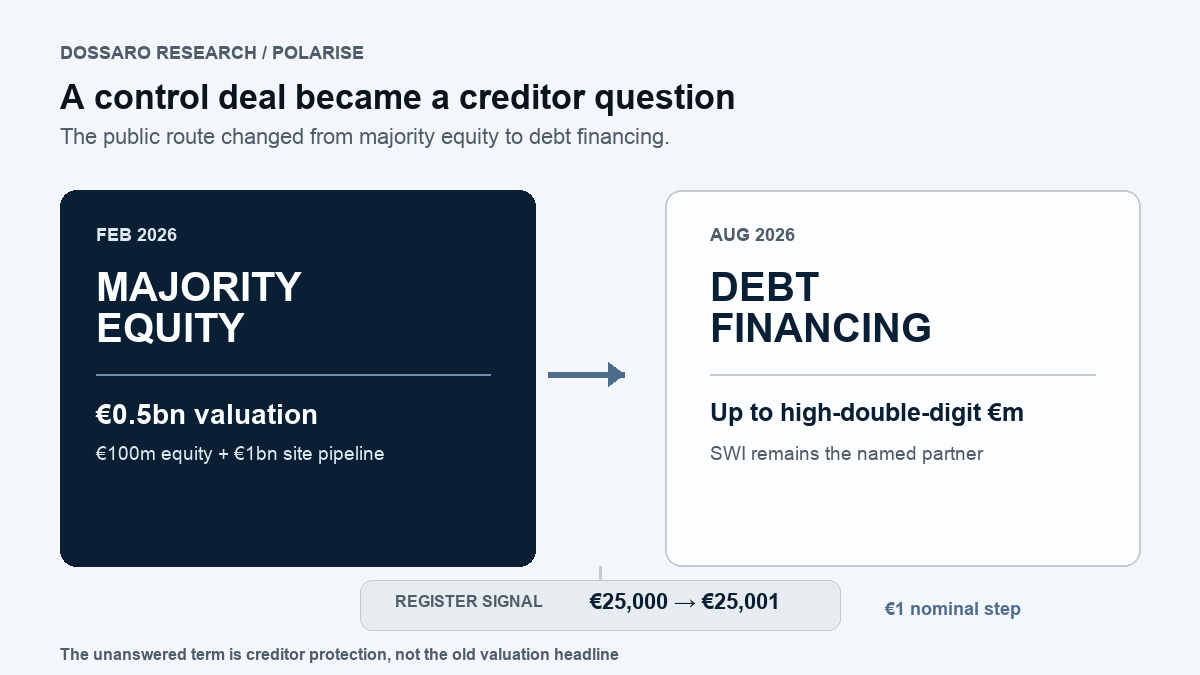
Polarise's financing story changed direction. In February, SWI Stoneweg Icona Group announced a majority investment in the German AI-infrastructure company at a €0.5 billion valuation, including €100 million of equity and a further €1 billion commitment to expand the site pipeline. On 18 August, Polarise said that agreement had been transitioned into debt financing of up to a high-double-digit-million-euro amount.
That is not a routine financing update. The public structure moved from a control investment to a creditor relationship. A Düsseldorf register extract records only a €1 nominal-capital increase to €25,001 on 19 February, close to the original announcement, rather than a large visible equity issue. The key diligence question is therefore no longer simply who owns Polarise. It is what protections SWI receives as a lender, and whether any equity upside survives in the new contract.
The public announcements do not answer that question. They do establish a sharp change in the economic route into one of Europe's most capital-intensive AI infrastructure businesses.
February promised control and expansion capital
SWI's February announcement described an agreed majority position in Polarise. It put the company's valuation at €0.5 billion once the investment completed, specified €100 million of equity for operations and added a €1 billion commitment to expand the digital-infrastructure pipeline.
The rationale was strategic as well as financial. SWI's AiOnX platform already covered 2.3 gigawatts of data-centre capacity, while Polarise supplied GPU-as-a-Service and AI-as-a-Service capabilities. The release said the combined group would build AI factories across Europe and give Polarise capital to execute acquisitions and expand its pipeline.
Polarise operates AI data centres and a proprietary cloud platform, with sites in Oslo and Munich and further capacity planned in Amberg. Its model combines physical sites, high-performance computing and software. That makes financing structure a core operating issue. Data-centre construction, power availability and GPU deployment need long-duration capital, while customer contracts and utilisation determine how quickly that capital can be repaid.
The August announcement replaced equity with debt
Polarise's 18 August statement described a debt-financing partnership with SWI of up to a high-double-digit-million-euro amount. It said the previous majority equity investment agreement had been transitioned into a debt-financing arrangement and that the new facility would strengthen Polarise's funding base.
The language is specific about the legal direction, but not about the instrument. The announcement does not state the interest rate, security package, maturity, covenants, repayment profile or any warrant or conversion rights. It also does not say whether the €0.5 billion valuation remains relevant to a future equity option.
| Date | Public or register event | Economic reading |
|---|---|---|
| 19 February 2026 | Nominal capital rose by €1 to €25,001 | No large nominal issue is visible around the equity headline |
| 24 February 2026 | SWI announced a majority investment at a €0.5bn valuation | Control and expansion capital were the public proposition |
| 11 May and 1 July 2026 | Shareholder-list states entered | Ownership paperwork continued to update, without a public holder map |
| 18 August 2026 | Polarise announced up to high-double-digit-million-euro debt | The public route shifted from equity control to creditor financing |
The term “transition” leaves room for contractual continuity. The debt could include warrants or conversion rights, or the parties could return to an equity closing later. None of those possibilities is established. What is established is that the latest public financing is debt, not the majority equity investment announced in February.
The register shows a small capital step, not a control closing
The German entity behind the announcements is Polarise Holding GmbH, Düsseldorf HRB 111523. The structured register extract records articles dated 19 December 2025 and a 19 February resolution that increased nominal capital by €1 to €25,001. Shareholder-list states were entered on 19 January, 11 May and 1 July.
That chronology gives the February announcement a legal marker, but it does not establish that SWI became the majority shareholder. A €1 nominal increase is not the size of an equity event that would itself explain a €100 million operating investment. It could accompany a broader contractual transaction, a reserved or later issue, or a structure in which the cash economics sit outside the nominal-capital movement.
The capital figure therefore changes the reading without closing it. It makes a completed large primary-equity closing less visible in the register, while leaving the actual holder percentages and any contractual rights unresolved.
The distinction is familiar in private financing. Oceanloop's debt-and-equity split shows why a large headline can combine facilities signed at different times and with different risk positions. Polarise presents a sharper change: the named strategic partner moved from announced majority owner to announced lender.
Existing shareholders may retain control, but debt moves up the stack
The economic consequences now run in two directions. Polarise preserves a financing path for its AI factories without publicly transferring majority ordinary equity to SWI. Existing shareholders may therefore retain more ordinary control than the February announcement implied. But the debt facility can sit ahead of that equity in repayment and security, depending on terms that have not been published.
For SWI, the upside profile changes. A majority stake would have delivered direct governance and participation in the platform's operating growth. A debt claim can offer priority cash returns and contractual controls, but its protection depends on collateral, covenants and the company's ability to service the facility. If the debt includes conversion or warrants, SWI may retain equity upside without holding ordinary majority control today.
For customers and infrastructure partners, the financing route is operationally relevant. Polarise's planned AI factories require power, hardware and long-term deployment commitments. A debt-funded buildout can preserve project momentum, but it also adds fixed obligations to a business whose returns depend on utilisation and customer demand. The February €1 billion expansion promise and the August debt amount should not be read as the same pool of committed capital.
The next document is the creditor package
The Article run confirmed the exact German entity and requested its register profile and shareholder-list index through Dossaro Dev. Those bounded requests timed out, so no source artifact was fetched into Dossaro storage during this run. The article relies on the completed brief's structured extract and the two public announcements, with no holder-level percentage or debt term inferred.
The decisive next record is the financing agreement or security filing that defines SWI's creditor position. The January, May and July shareholder lists could show whether any equity transfer occurred before the debt announcement. A later capital increase, warrant exercise or conversion filing would show whether the parties returned to an equity route.
Until those records appear, Polarise is best understood as a control story that became a creditor story. The €0.5 billion valuation and €100 million equity promise describe the February plan. The high-double-digit-million-euro debt announcement describes the August reality. The unresolved business question is what sits between them: ordinary control, secured lending, or a contract that keeps both routes alive.
Continue reading
Related Research
Oceanloop's €38.5m Headline Is Mostly a 2024 EIB Facility
Oceanloop's €38.5m financing headline is 83% debt tied to a 2024 EIB facility, while €6.5m equity enters a 22-position roll-up with dilution unresolved.
Flip's €22m Round Left A 10.8% Nominal Equity Signal
Flip's €22m financing followed a €6,115 legal-capital increase, revealing a 10.8% nominal equity signal without exposing investor-level economics.
Callosum's $100m Seed Put 24.1% of the Holdco Into a New Preferred Class
Callosum's $100m seed maps to a filed £57.20m Series Seed 2 issue for 24.1% of its holdco, while Atomico and Plural-linked directors joined the board.
Tekever's £220m Corvus Award Is 2.92 Times Its 2024 Turnover
The Army's £220m Corvus award is 2.92 times Tekever's 2024 turnover, while the £400m ceiling makes execution risk a private-company issue for suppliers.