
Tekever's £220m Corvus Award Is 2.92 Times Its 2024 Turnover
The Army's £220m Corvus award is 2.92 times Tekever's 2024 turnover, while the £400m ceiling makes execution risk a private-company issue for suppliers.
On this page
Conduct your own private market research
Add dossaro to Claude or ChatGPT and run source-backed register research from your own workspace.
 Add to Claude
 Add to ChatGPT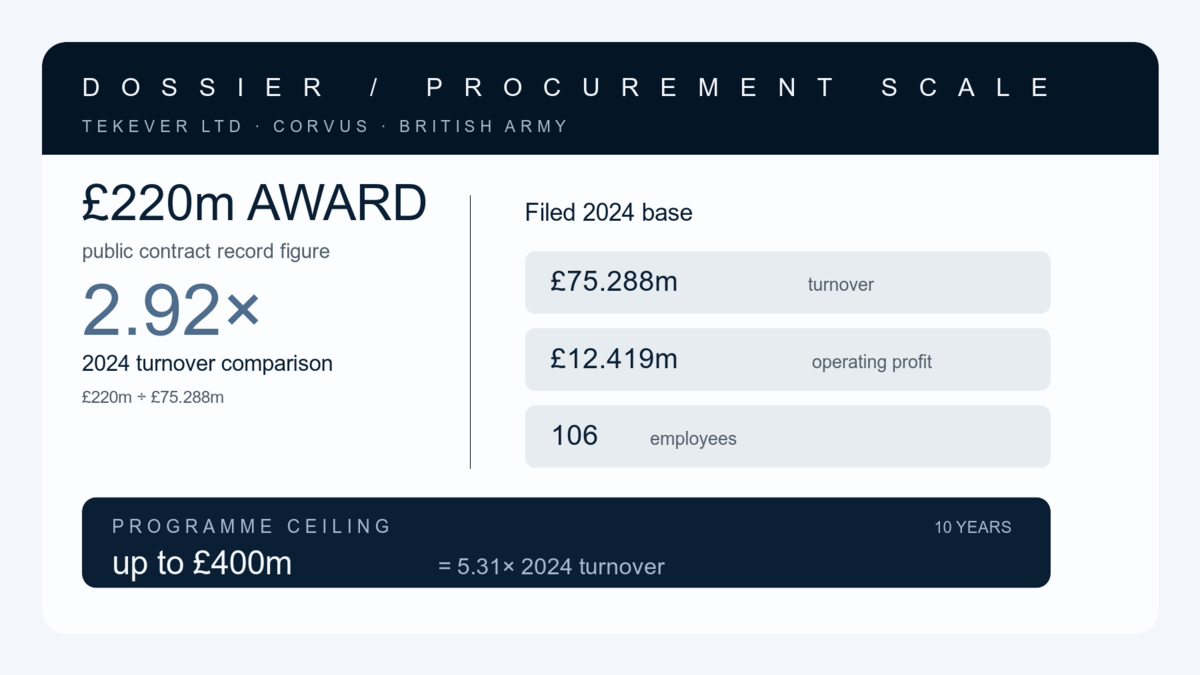
The British Army's Corvus drone programme is commercially larger than Tekever's recent UK operating base. A procurement notice records a £220 million award after eight bids, while the government's announcement describes a programme worth up to £400 million over ten years. Tekever Ltd's 2024 accounts report £75.288 million of turnover. On the first figure, the award is 2.92 times one year's turnover. On the upper ceiling, it is 5.31 times.
That comparison is not a forecast of annual revenue, backlog or profit. The procurement is staged, includes equipment and support, and the government says the larger figure is subject to contract and final approvals. It is a scale test. The public record puts a private UK company in a programme whose potential value is several times the turnover it reported before the award was announced. That makes manufacturing capacity, cash timing and delivery discipline central commercial questions rather than footnotes.
The headline range contains two different economic signals
The UK government's announcement says the Army will receive an initial six AR5 systems, with up to 24 by 2029, and describes the programme as worth up to £400 million over ten years. It says the systems will be built in Swindon, with support for at least five years and options for further work.
The public contract record mirrored by Wina records a £220 million award after eight bids. AeroTime's independent report places the award in the Army's replacement of Watchkeeper and notes that the wider tender material contains options and a multi-year delivery profile. The two public amounts therefore answer different questions. £220 million is the award figure used for the scale comparison below; £400 million is a stated programme ceiling, not committed revenue.
The government's release also gives the operational shape. Six AR5 drones are to be delivered initially, with the fleet potentially rising to 24 by 2029. The systems are intended for intelligence, surveillance and reconnaissance, and the release links the programme to jobs in Swindon and South Wales. For Tekever, this is not simply a purchase order for a finished product. It is a long delivery and support relationship that must be staffed, financed and expanded while the company remains private.
Tekever had already quadrupled turnover before Corvus
Tekever's latest filed accounts are unusually useful because they put the award against a recent growth base rather than a static start-up number. Its 2024 full accounts filed at Companies House report turnover of £75.288 million, up from £17.997 million in 2023. The same accounts report operating profit of £12.419 million, profit after tax of £9.714 million and 106 employees at year-end. The 2023 accounts report 63 employees and £2.631 million of operating profit.
The change is material: turnover rose 318%, operating profit 372% and headcount 68% in the accounts' own KPI table. Tekever was therefore entering Corvus after a year of rapid expansion, not before it had demonstrated commercial demand. But rapid growth also makes capacity comparisons more demanding. The company has to turn a much larger programme into repeatable production and support without assuming that last year's growth rate can be repeated.
| Filed 2024 base and Corvus public figures | Amount | How to read it |
|---|---|---|
| Tekever Ltd 2024 turnover | £75.288m | The latest full-year UK company revenue |
| Contract record award figure | £220m | 2.92 times 2024 turnover; a scale comparison, not annual revenue |
| Government programme ceiling | Up to £400m | 5.31 times 2024 turnover; includes future stages and options |
| Tekever Ltd 2024 operating profit | £12.419m | Filed operating result, not a margin promise for Corvus |
| Tekever Ltd employees at 2024 year-end | 106 | Reported workforce before the programme's delivery ramp |
The arithmetic is simple. £220 million divided by £75.288 million equals 2.922. £400 million divided by £75.288 million equals 5.313. Those ratios should not be presented as a revenue multiple or valuation. They show the distance between a single year's reported UK turnover and the public procurement envelope.
The cash and capacity question sits behind the ratio
The 2024 accounts show a stronger balance sheet than the headline ratio might imply. Tekever Ltd reported £24.767 million of cash at year-end and £19.506 million of net assets. Cash generated from operations was £23.357 million before tax and other cash movements. Those figures indicate an operating business with resources to support growth, but they do not reveal the working-capital terms of Corvus, the timing of milestone payments, the required inventory or the financing arrangements of the wider group.
That distinction matters in defence procurement. A supplier may have to buy components, qualify production, hire engineers and maintain support infrastructure before receiving the full economic benefit of a long programme. The government announcement's reference to an initial six systems and later expansion suggests that delivery is staged. Staging can reduce the immediate funding need, but it also makes execution and acceptance milestones consequential for cash conversion.
Tekever's 2024 report describes the company as part of the Tekever Group's unmanned-systems business and says the group operates engineering and production facilities in the UK and Portugal. The accounts identify Tekever Holdings S.A., incorporated in Portugal, as the ultimate controlling entity. A Companies House PSC filing records Ricardo Joao Rodrigues Fonseca Mendes in a 25% to 50% share band connected to a non-legal-person firm, while another filing records Tekever Holdings S.A. ceasing to be a PSC in November 2023. Those records should not be collapsed into a simple statement that Mendes alone controls the group. They show a layered ownership and control surface, which is relevant when assessing where funding and production support may sit.
The UK company's 2024 accounts also show why the next filing matters. They give a clear company-level cash and profit snapshot, but not the detailed commercial terms of the Corvus award. They do not say whether the programme is secured by customer advances, group funding, bank facilities, supplier credit or a combination. Nor do they disclose the margin profile of the AR5 systems and support services.
Capacity expansion was already under way
The Corvus announcement did not arrive in a vacuum. The sourcing brief records Tekever's acquisition of all West Wales Airport Limited for £3.2 million in July 2025 and a lease for a West Swindon industrial facility in August 2025. Those moves point to UK capacity and operating-footprint expansion before the Army announcement. The government says the AR5 systems will be built in Swindon and links the programme to South Wales jobs, so the locations are commercially relevant even though the public sources do not allocate a specific Corvus spend to either site.
This is a different exposure from the capital-and-control question in Gravis Robotics' registered Series A class. There, the key uncertainty was whether a new preferred class represented an investor's economic stake. Here, the public evidence is clearer on the programme's headline scale but thinner on the terms that convert an award into cash, margin and capacity requirements. The commercial risk transfers through delivery milestones rather than through a visible share class.
The same discipline applies to financial distress stories such as Quantios' Vista Group liabilities: the headline event is only the starting point. The useful question is which obligations and timing assumptions sit behind it. For Tekever, those assumptions include production cadence, acceptance, support duration and the treatment of optional phases.
A large award is not proof of annual concentration
There is a reasonable counter-reading. Comparing a multi-year procurement ceiling with one year's turnover exaggerates apparent concentration because the programme can run over a decade, and Tekever can add other customers. The £400 million figure explicitly includes future stages and options, while the £220 million award may cover a package of equipment and services delivered over several years. The ratios are therefore not evidence that Corvus will equal 292% or 531% of annual revenue.
That caveat does not erase the scale signal. Even the lower award figure is almost three times 2024 turnover, after turnover had already quadrupled. A programme of that size can change a private company's financing needs and operating priorities even when it is spread across multiple years. It can also create supplier and customer concentration in practice if production and support are built around one anchor programme.
For the Ministry of Defence, the exposure runs the other way. The Army is relying on Tekever and its group to deliver a new AR5 capability, replace Watchkeeper and maintain support over the initial term. The public sources establish the programme's intent and broad value, but they do not establish the detailed remedies, performance measures or substitution options if delivery slips.
The next document should explain how the award becomes cash
The strongest public conclusion is narrow. The Corvus procurement places a £220 million award, and potentially a £400 million ten-year programme, against Tekever Ltd's £75.288 million 2024 turnover. That is a 2.92-times comparison on the award figure and a 5.31-times comparison on the ceiling. Tekever had already shown rapid growth, profit and cash generation, and it had expanded UK capacity before the announcement.
What remains unresolved is the conversion mechanism. The next decision-changing documents are the underlying contract or a release that sets out milestones, options, payment terms and support obligations; Tekever's next accounts should show whether Corvus changes deferred income, working capital, headcount and margin. A group-level filing could clarify how the Portuguese parent funds or consolidates the programme. Until those records appear, the headline is best read as an execution and risk-transfer story: a private supplier's public programme envelope is several times its latest annual turnover, but the terms that determine who carries the financing and delivery burden are still outside the public release.
Continue reading
Related Research
SoftBank's $200m Gravis Round Created A 12.63% Series A Class
Gravis's $200m SoftBank round created a Series A class equal to 12.63% of nominal shares and added two board members, not a takeover.
Vista's Quantios Deal Crosses £92m Of On-Demand Group Liabilities
Vista's Quantios deal crosses £92m of on-demand group payables and registered Jersey-share security created 69 days before the sale announcement.
Neuraspace Secured €15.6m With €14.39m Of State Funding Undisbursed
Neuraspace secured €15.6 million while Portugal's register showed €14.39 million of awarded project funding still undisbursed, exposing a liquidity timing gap.
Polarise Turned A €0.5bn Equity Deal Into A Debt Question
Polarise moved from a proposed SWI majority investment at a €0.5bn valuation to debt financing, shifting the control question to creditor protections.