
Vista's Quantios Deal Crosses £92m Of On-Demand Group Liabilities
Vista's Quantios deal crosses £92m of on-demand group payables and registered Jersey-share security created 69 days before the sale announcement.
On this page
Conduct your own private market research
Add dossaro to Claude or ChatGPT and run source-backed register research from your own workspace.
 Add to Claude
 Add to ChatGPT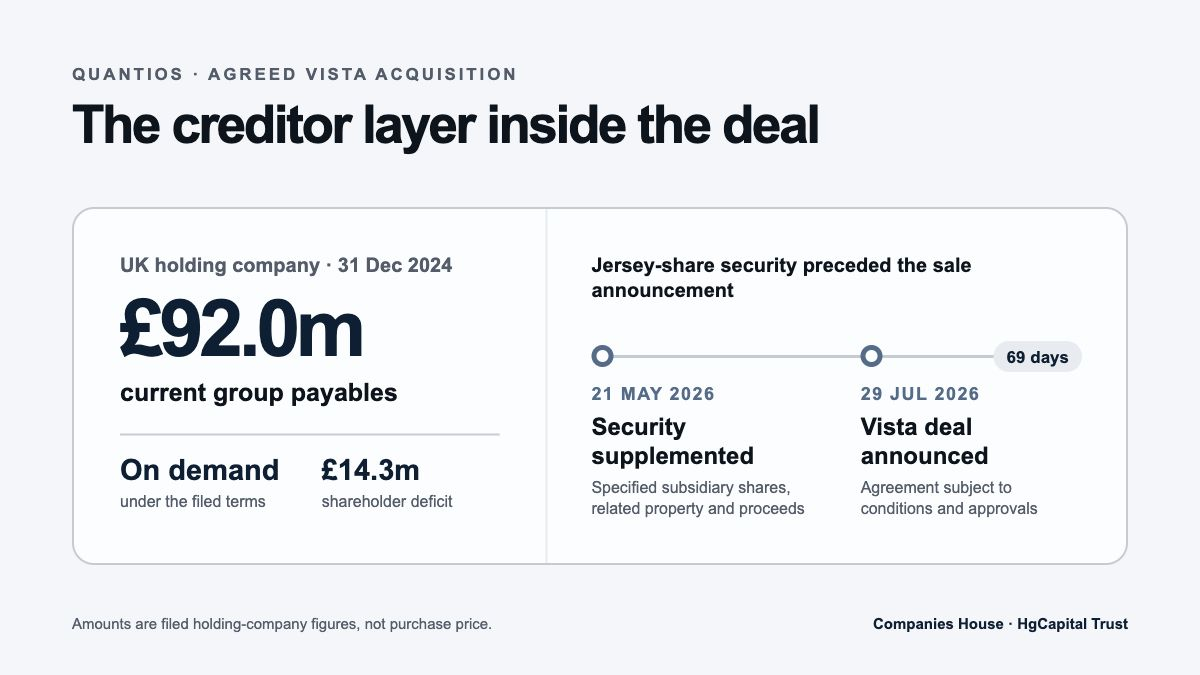
Vista Equity Partners' agreed purchase of Quantios crosses a UK holding company that reported £92.009 million of current amounts owed to group undertakings at the end of 2024. Those balances were unsecured, interest-bearing and repayable on demand.
The creditor structure had also changed shortly before the deal. On 21 May 2026, Quantios Ltd granted GLAS Trust Corporation supplemental security over specified shares and related property in its Jersey subsidiary. Hg announced the Vista agreement 69 days later, on 29 July.
These filings do not show that Vista will assume £92 million of debt. The liability is an intercompany balance, not identified as external financial debt, and the May instrument may be ordinary financing housekeeping. They do show that the acquisition must pass through a layer of group funding and lender collateral before ownership can move cleanly.
That is the missing context behind a sponsor-to-sponsor software exit. HgCapital Trust said its own share of Hg's Quantios investment was worth approximately £13 million on the announced transaction, a £3 million or 31% uplift over its 31 March carrying value. That is one listed trust's equity-value datapoint, not the purchase price or enterprise value.
The Holding Company Reported A £14.281m Deficit
Quantios Ltd sits above operating subsidiaries in the UK, Jersey, Guernsey, Singapore, Australia, Luxembourg and other markets. It was formerly called TrustQuay Ltd and became Quantios when Hg combined TrustQuay and ViewPoint in 2023.
The company's 2024 accounts filed at Companies House show the balance sheet at that holding-company level, not a consolidated view of the entire trading group.
| Quantios Ltd measure | 31 Dec 2024 | Economic reading |
|---|---|---|
| Investments in subsidiaries | £72.032m | Carrying value of the operating-company interests |
| Amounts owed by group undertakings | £5.570m | Unsecured and repayable on demand |
| Amounts owed to group undertakings | £92.009m | Current, unsecured and repayable on demand |
| Shareholders' deficit | £14.281m | Net liabilities at the UK holding company |
| Comprehensive loss | £6.457m | Loss for the 2024 reporting period |
The £92.009 million payable was 1.28 times the £72.032 million carrying value of the subsidiary investments. That ratio is not a valuation test: investments are recorded at accounting cost, while group balances can reflect acquisitions, treasury funding and reorganisations. It does show how strongly the holding company's asset position depended on financing from elsewhere in the group.
The two directions of intercompany funding were also unequal. Quantios Ltd had £5.570 million due from group companies and £92.009 million due to them, a net difference of £86.439 million. Both sides were repayable on demand, but they carried different disclosed interest rates. The receivable accrued 5.75%, while the payable note referred to 3% and 12% rates on intercompany treasury and loan balances respectively.
An on-demand term does not mean the lender was demanding payment at the reporting date. A parent or sister company can roll, waive, capitalise or refinance an internal balance. The term matters because continued support is a choice made elsewhere in the ownership chain, and a sale can require that choice to be reset.
Lenders Held Security Over The Jersey Subsidiary
The supplemental security agreement names Quantios Ltd as grantor and GLAS Trust Corporation as security agent. It covers specified shares in Quantios (Jersey) Ltd, related property and the proceeds of that collateral.
The document did not create the financing architecture from scratch. It refers to a senior facilities agreement and intercreditor agreement dated 28 October 2022, plus an existing Jersey security agreement dated 20 December 2022. The May 2026 instrument supplements that earlier framework and states that the security is continuing and first-priority, subject to the agreement's qualifications and the intercreditor terms.
That distinction is important. The filing is evidence of collateral, not of a new loan draw, missed payment or distress. It does not disclose the external facility balance on 21 May or the amount that may remain when Vista closes.
It nevertheless places the Jersey operating interest inside the lender perimeter. An equity buyer cannot treat that pledged subsidiary as freely transferable without addressing the secured parties' rights. Release, replacement or refinancing therefore becomes part of the closing mechanics even if the security was routine.
The Security Preceded The Sale Announcement By 69 Days
The chronology is tighter than the public deal narrative suggests.
| Date | Filing or event | What it establishes |
|---|---|---|
| 28 Oct 2022 | Senior facilities and intercreditor agreements | The referenced lender framework begins |
| 20 Dec 2022 | Existing Jersey security agreement | Earlier collateral over the Jersey interest |
| 21 May 2026 | Supplemental security created | Shares, related property and proceeds enter the updated security package |
| 24 May 2026 | Charge registered | The security becomes visible on the UK public record |
| 29 Jul 2026 | Hg announces Vista agreement | Sale agreed 69 days after the security was created |
| Q3 2026 | Expected completion window | Still subject to customary conditions and approvals |
Proximity is not causality. The public documents do not say that the May supplement was created to prepare the sale or because lenders demanded more protection. It could have followed a subsidiary reorganisation, a facility amendment or routine collateral maintenance.
The practical connection is narrower. When the sale was signed, the buyer and sellers were dealing with a currently registered charge tied to a pre-existing financing framework. A completion process must determine whether that framework is repaid, refinanced, released or carried into the new structure.
The £13m Disclosure Is Not The Deal Price
The HgCapital Trust announcement says HGT expected about £13 million of proceeds for its share of Hg's investment. It compared that amount with a £10 million carrying value at 31 March 2026 and reported a £3 million or 31% uplift.
HGT is a listed investment trust that invests alongside Hg funds. Its disclosed proceeds represent only its own participation. They exclude the portions attributable to the Hg funds, EQT and any other holders. The rounded £3 million difference also calculates to 30% on the rounded £10 million base, so the reported 31% should not be reverse-engineered into a more precise valuation.
EQT's sale announcement confirms that it is also selling an interest. It presents Quantios as a global software platform serving close to 700 organisations after the combination of ViewPoint and TrustQuay.
The operating scale explains Vista's interest. Trust and corporate-services providers manage regulated entities across jurisdictions, creating demand for recurring software, data migration and compliance workflows. Vista can underwrite product expansion and operational improvement across that installed base.
The available figures still do not bridge from operating scale to consideration. No public source states the purchase price, total sponsor proceeds, debt-like items or cash retained in the perimeter.
Intercompany Funding Is The Strongest Counter-Reading
Calling the £92.009 million a debt load without qualification would overstate the evidence. It was money owed inside the group. Internal balances can be accounting consequences of how a sponsor funded acquisitions and placed assets, rather than claims that a buyer must service after closing.
The same caution applies to the £14.281 million deficit. Negative equity at a holding company does not establish insolvency, because subsidiary values may exceed their recorded cost and group lenders may provide continuing support. Quantios' owners were able to agree a sale to a specialist software investor, which is evidence that the operating platform attracted strategic value.
This counter-reading does not make the filings irrelevant. It identifies the key allocation question. Someone must decide what happens to the £92.009 million payable, the senior facilities and the Jersey security before equity value can be distributed and control can transfer.
That is similar to the distinction in Qureight's preferred-equity and HSBC-security stack: a financing headline describes the equity event, while filed instruments show which claims and protections sit around it. The instruments do not determine the outcome alone, but they define the order in which value and control can move.
The Next Filing Will Show Whether The Creditor Layer Cleared
Hg said the transaction was expected to complete in the third quarter of 2026, subject to customary conditions and approvals. Until completion is announced, Vista has agreed to buy Quantios but does not yet have confirmed control.
The next decision-changing evidence is concrete. A satisfaction or release filing for the May charge would show that the registered security had been cleared. Completion statements or later accounts could show whether the intercompany payable was repaid, waived, capitalised, refinanced or left inside the acquired group.
Without those documents, the safe conclusion is structural rather than distressed. Vista is buying a software platform through a holding company funded heavily by related parties and connected to a secured lender framework. The £92.009 million balance is not the purchase price and is not proven debt assumed by Vista. It is the creditor layer the public deal announcement leaves unresolved.
Continue reading
Related Research
Qureight's $20m Round Sat Above Preferred Equity and HSBC Security
Qureight's $20m Series B followed a £2m senior C1 issue and four HSBC security filings, placing lenders and preferred capital ahead of older equity.
FNZ Built A €3bn Custody Bank Before Reported Sale Talks
FNZ Bank's reported €400 million-plus sale follows a custody carve-in that produced €3.0 billion of assets and €250.1 million of book equity.
Street Group's Founders Held 92.8% Before Hg's £200m Deal
Street Group's founders held 92.8% before Hg's deal valued the company above £200m, mapping to more than £185m of paper value at 12.5 times 2025 revenue.
Rail Europe's Parent Had Negative Equity Before Omio Deal
Rail Europe's parent reported negative equity and its operating company lost €6.27m before Omio's proposed acquisition, putting price and debt at the centre.