
Qureight's $20m Round Sat Above Preferred Equity and HSBC Security
Qureight's $20m Series B followed a £2m senior C1 issue and four HSBC security filings, placing lenders and preferred capital ahead of older equity.
On this page
Conduct your own private market research
Add dossaro to Claude or ChatGPT and run source-backed register research from your own workspace.
 Add to Claude
 Add to ChatGPT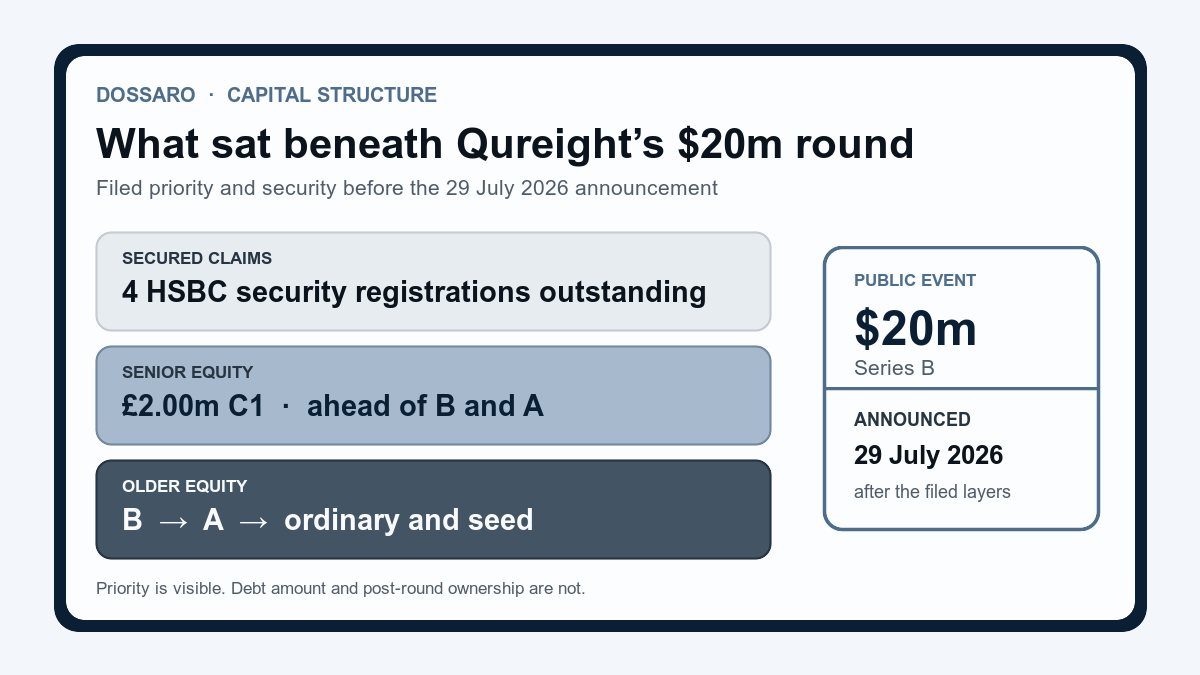
Source record available
QUREIGHT LIMITED · 11132399
Open the legal identity and 2 reviewed filings behind this analysis.
Qureight's $20 million Series B arrived after the medical-imaging data company had already added two layers of downside protection to its capital structure. A March filing records £2.00 million of new C1 shares that rank ahead of older investor classes. The UK charge register also shows four outstanding security interests in favour of HSBC Innovation Banking, two created in February and two in June.
That does not turn the round into debt, and it is not evidence of distress. It does change the economic reading. Company liabilities are met before shareholders receive exit or liquidation proceeds, and the C1 class then gets its contractual priority before older B and A shares. The financing headline therefore sits above a stack in which lenders and newer preferred capital have protection that ordinary ownership percentages do not show.
| Public headline | Filed evidence before the announcement | Economic reading |
|---|---|---|
| $20m Series B led by Molten Ventures | £2.00m C1 allotment on 31 March 2026 | New preferred capital was already visible |
| Growth funding for clinical-trial infrastructure | C1 ranks ahead of B and A in the filed waterfall | Older equity takes downside after the senior preference |
| Equity syndicate named publicly | Four outstanding HSBC security registrations | Secured liabilities sit outside the equity ownership headline |
The important conclusion is narrow. The filings reveal priority, not the final ownership map. They do not show which investor received the C1 shares, how the announced $20 million was allocated or how much Qureight owed HSBC.
The £2m C1 Issue Came Four Months Before The Headline
Tech.eu reported Qureight's Series B on 29 July 2026. Molten Ventures led the round, with Hargreave Hale AIM VCT, XTX Ventures, Guinness Ventures, Meltwind and Ascension participating. Axios independently reported the same round size and syndicate.
The public story is commercially straightforward. Qureight provides imaging and data infrastructure for clinical trials, and the new capital is intended to expand its platform and international reach. The register supplies the missing financing sequence.
On 31 March, QUREIGHT LIMITED allotted 14,757 C1 ordinary shares at £135.53 each. The stated consideration was £2,000,016.21. Immediately after the allotment, the filing recorded 268,128 issued shares, making C1 about 5.50% of that issued share count.
| Calculation | Filed input | Result |
|---|---|---|
| C1 consideration | 14,757 × £135.53 | £2,000,016.21 |
| Immediate C1 share-count position | 14,757 ÷ 268,128 | 5.50% |
| Time to public Series B report | 31 March to 29 July | About four months |
The 5.50% figure is not a post-round cap table. It is the class's share-count position immediately after one allotment, before any later Series B issuance that may not yet appear in the public filing sequence. It also says nothing by itself about votes or fully diluted ownership.
The timing supports two possible readings. C1 may have been a separate bridge-like preferred issue, or it may have been an early closing of the round announced in July. The public documents do not settle that question, so adding £2 million to $20 million would manufacture a total that the evidence does not support.
C1 Sits At The Front Of The Equity Waterfall
The same Companies House filing reproduces the distribution priority attached to the capital. After the token payment to the deferred class and the settlement of company liabilities, C1 receives its aggregate issue price before the older B and A classes. Ordinary and seed shares participate in the residual pool only after those senior amounts have been addressed.
| Priority stage | Position in the filed structure | Practical consequence |
|---|---|---|
| Company liabilities | Before shareholder distributions | Creditors are paid before equity value is divided |
| C1 shares | First substantive investor preference | Up to the C1 issue-price amount is protected ahead of older investors |
| B shares | After C1 | The prior preferred class is subordinated to the new C1 layer |
| A shares | After B | A absorbs downside after both newer preferred classes |
| Ordinary and seed residual | After senior preference stages | Headline ownership matters most once the stack is covered |
This ordering matters most when an exit value is constrained. If enterprise value comfortably exceeds liabilities and all preference amounts, the waterfall may have little effect on the relative outcome. If value falls closer to the protected amounts, legal priority can matter more than a simple percentage of shares.
That is the commercial friction hidden by a round announcement. New money can finance growth while also moving older investors and ordinary holders further back in the downside queue. Qureight's filing establishes that C1 obtained this protection. It does not establish a specific future payout.
The structure resembles the preferred-capital issue behind Perceptual Robotics' funding stack, where equity type changed the meaning of the public financing total. Here, however, secured bank claims add another layer outside the shareholder waterfall.
Four HSBC Registrations Add Secured-Creditor Protection
The official Companies House charge register lists four charges in favour of HSBC Innovation Banking Limited, all still outstanding at the evidence cutoff. Two were created on 24 February 2026 and two on 5 June 2026.
| Date created | Charge codes | Filed feature | What remains unknown |
|---|---|---|---|
| 24 February 2026 | 111323990001 and 111323990002 | Fixed security and negative-pledge provisions | Facility limit, amount drawn and repayment profile |
| 5 June 2026 | 111323990003 and 111323990004 | Fixed security and negative-pledge provisions | Whether these extend one relationship or document separate facilities |
| 3 August 2026 cutoff | All four outstanding | No satisfaction filing recorded | Current secured balance and release conditions |
A fixed charge can give a lender recourse to specified assets and restrict the company from granting competing security. A negative pledge reinforces that protection by limiting later encumbrances. That is economically different from holding preferred shares: a secured lender relies on contractual repayment and charged assets, while an investor relies on the equity waterfall after liabilities.
The filing count must not be mistaken for a debt total. Four registrations can relate to several accounts or instruments under one banking relationship. The public forms do not disclose four facility amounts, so there is no defensible number to add up.
Security is also not synonymous with financial trouble. Venture-backed businesses commonly use secured facilities for working capital, receivables or runway alongside equity. The relevant fact is risk allocation. The security gives HSBC protection that shareholders do not have, while the new C1 class receives better downside ordering than older equity.
That contrasts with Modo Energy's secured debt facility, where the filed charge could be tied to a publicly disclosed £13.5 million financing. Qureight's documents establish the secured relationship, but not its size.
The Timeline Shows A Deliberate Layering, Not A Debt Total
The sequence compresses the structural changes into five months.
| Date | Event | Defensible interpretation |
|---|---|---|
| 24 February 2026 | First two HSBC charges created | Secured bank protection enters the visible structure |
| 30 March 2026 | New capital terms adopted | C1 is placed ahead of older equity classes |
| 31 March 2026 | £2.00m C1 allotment | Senior preferred capital is issued |
| 5 June 2026 | Two further HSBC charges created | The secured relationship is extended or supplemented |
| 29 July 2026 | $20m Series B reported | Growth-equity headline arrives after the priority layers |
The filings are therefore useful even without a complete cap table. They show that the round did not enter a blank corporate shell or a single-class ownership structure. Anyone assessing the value of older shares, future employee equity or another financing must account for both creditor security and the staged investor preferences.
The method is reproducible through the UK Companies House data source: match the exact legal entity, read allotments together with the attached capital terms, then reconcile the charge register by creation and satisfaction status. The documents answer different questions and should not be collapsed into one financing number.
The Next Filings Will Decide Who Actually Moved Back
The missing document is the post-round ownership state. A new SH01, confirmation statement or member register could show how many Series B shares were issued and whether the March C1 holders overlap with the publicly named syndicate. It would also reveal how much the pre-round classes were diluted on a straight share-count basis.
For the debt side, a facility disclosure or later satisfaction filing could show whether the four HSBC registrations support one facility, multiple facilities or several secured accounts. Until then, the amount of bank exposure and its maturity remain outside the defensible claim boundary.
Qureight's financing story is therefore not that debt secretly replaced equity. It is that the $20 million round entered a company where downside had already been ordered. Liabilities came first, C1 sat ahead of older preferred shares, and four HSBC security registrations remained open. The next ownership and charge filings will determine which investors moved back in the queue, and how much secured capital stood ahead of them.
Continue reading
Related Research
Modo Energy Put Its Brands Behind $17m Of Venture Debt
Modo Energy called CIBC's $17m package growth funding. UK charges show fixed and floating security over its business and two core trademarks.
Perceptual Robotics' Senior D Class Now Holds 69% Of Shares
Perceptual Robotics paired about £2.1m of preferred equity with public support, while its senior D class now represents 69% of issued shares.
Dwelly's $170m Round Mixed Founder Liquidity With Secured Debt
Dwelly's filings show £44.3m of new Series B cash, 19,406 founder shares sold to EQT and General Catalyst, and Trinity secured across the business.
Oshen's $5m Round Began Before the Announcement
Oshen's founders held 94.5% before its $5m round, while June resolutions authorised a potential 24.3% share envelope and ratified earlier ASAs.