
Oshen's $5m Round Began Before the Announcement
Oshen's founders held 94.5% before its $5m round, while June resolutions authorised a potential 24.3% share envelope and ratified earlier ASAs.
On this page
Conduct your own private market research
Add dossaro to Claude or ChatGPT and run source-backed register research from your own workspace.
 Add to Claude
 Add to ChatGPT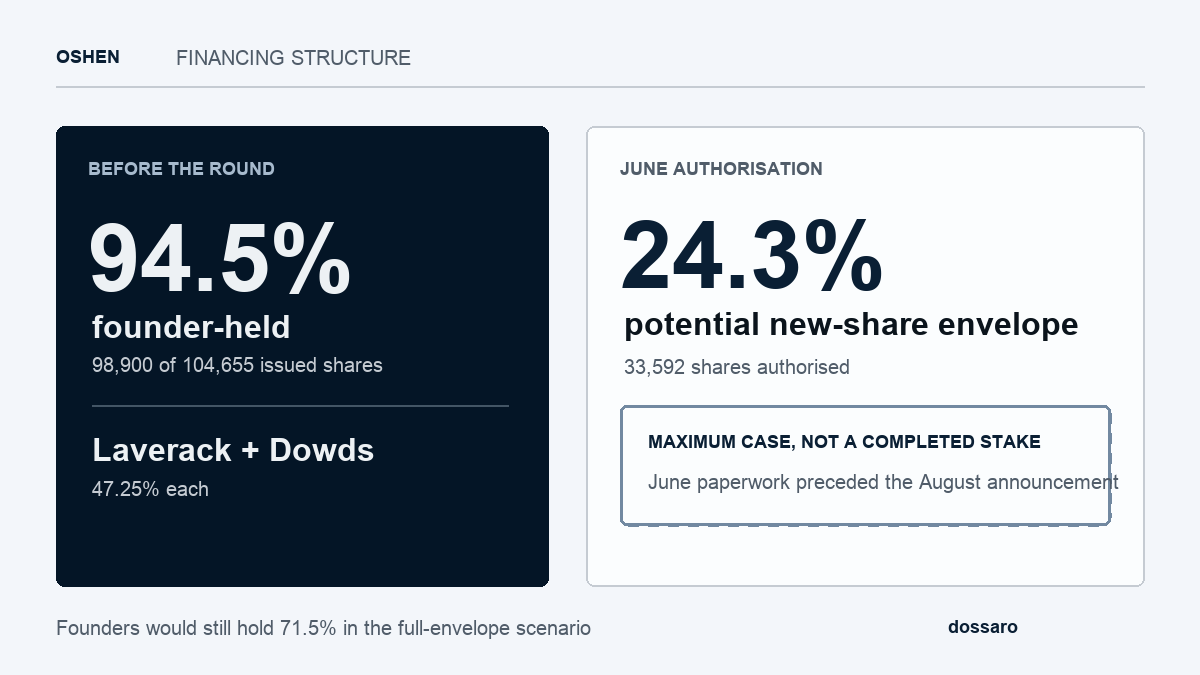
Oshen's $5 million financing was announced on 21 August as a production push for its C-Star ocean robots. The Companies House record shows that the financing did not begin on announcement day. Two months earlier, the founders still held 94.5% of Oshen, while written resolutions had already approved a set of subscription instruments and a possible new-share envelope equal to 24.3% of the post-issue company.
That envelope is an authorisation ceiling, not a completed investor stake. The filings do not show how many shares were ultimately issued, who received them or when the cash arrived. They do show that the round had a contractual and corporate history before Lunar Ventures, AlbionVC, Twin Track, Concept Ventures and angel investors were named publicly.
| Register position | What the filings show | What it means |
|---|---|---|
| Before the announced round | 104,655 issued shares; Anahita Laverack and Ciaran Dowds held 49,450 each | The founders held 94.501% together |
| June authorisation | 32,403 shares for advance-subscription agreements, 783 ordinary subscription shares and 406 adviser shares | Up to 33,592 new shares could be issued under the resolutions |
| Simple maximum case | 33,592 ÷ 138,247 post-issue shares | The authorised envelope equals 24.299% of the potential post-issue total |
| Full-envelope scenario | Founders' 98,900 shares ÷ 138,247 | Their simple combined position would fall to 71.539%, still a majority |
The public round is a manufacturing story, but the filings expose its timing
TechFundingNews reported that Plymouth-based Oshen raised $5 million led by Lunar Ventures to increase production of its C-Star uncrewed surface vehicles. AlbionVC, Twin Track and Concept Ventures also participated, alongside angels who would act as advisers. The company said it was producing 15 robots every six weeks and had roughly 100 more units ordered. The funding report also described the vehicles' work in Category 5 hurricane conditions.
That public framing is commercially clear. Oshen says the constraint is manufacturing capacity rather than proof that the technology works. Its robots collect ocean data for defence, weather and scientific users, and the new capital is intended to support a much larger production cadence.
The register adds a different fact: the corporate machinery for the financing was already being approved. Written resolutions dated 19 June 2026 authorised the directors to issue up to 32,403 shares in connection with certain advance-subscription agreements, 783 ordinary shares under a subscription agreement and 406 ordinary shares under an adviser subscription letter. The resolutions also disapplied pre-emption rights and adopted new articles, which were filed on 14 July.
The sequence matters because an advance-subscription agreement can document a commitment before an allotment appears in a later statement of capital. It would be wrong to convert the June ceiling into a completed 24.3% holding, but it is equally incomplete to describe the financing as a transaction that started with the August press release.
A concentrated founder base leaves room for a large first outside block
Oshen was incorporated on 8 April 2022 with one £1 ordinary share held by Anahita Laverack. The historical record then shows a 100,000-share base. In December 2022, pre-emption waivers authorised transfers of 49,450 shares and 1,100 shares. The April 2023 shareholder state records Laverack with 49,450 shares, Ciaran Dowds with 49,450 and Kate Pesenti with 1,100.
The later confirmation statements keep that holder list unchanged through April 2026. John Jones held 11 shares, TJC Holdings B.V. 860 and Sequana Holdings Ltd 3,784. The issued total had reached 104,655, so the two founders held 98,900 shares, or 94.501% of the company. Each founder was recorded as a person with 25–50% of the shares and votes and the right to appoint or remove directors.
This starting point changes how the $5 million should be read. The round is not a rescue of a company whose founders had already been diluted into a small minority. It is the first visible institutional financing after a period in which the founders retained overwhelming registered ownership. A fully allotted envelope would create a meaningful outside block while leaving the founders with a simple majority on the issued-share arithmetic.
The arithmetic is straightforward but bounded. Adding all 33,592 authorised shares to the 104,655 already issued produces 138,247 shares. The new shares would be 24.299% of that total. The founders' 98,900 shares would be 71.539%. These figures describe the maximum authorised envelope and a simple issued-share denominator. They do not include option pools, preferences, conversion terms, shareholder agreements or any shares that were not ultimately allotted.
The June resolutions also ratified earlier subscription conduct
The most unusual filing language is not the number of shares. The June resolutions approved, authorised and ratified the directors' conduct in entering certain advance-subscription agreements before the necessary prior approval had been obtained. The documents do not say that the company or its directors acted fraudulently, and the filing does not identify the investors or the cash dates.
Retrospective corporate approval can be routine housekeeping in a fast-moving financing. A company may sign commercial documents while a board or shareholder consent is still being assembled, then adopt resolutions that remove uncertainty about authority. The safe conclusion is therefore narrow: at least some financing commitments predated the public announcement, and the company later approved the earlier conduct and the related issuance capacity.
This is also why the adviser allocation should stay separate from the investor round. The resolutions authorise 406 ordinary shares under an adviser subscription letter, distinct from the 32,403 shares tied to the advance-subscription agreements and the 783 shares under another subscription agreement. No recipient is named in the public filing. The adviser line is not evidence that an adviser owns a particular percentage, and the article does not assign it to any named person.
The distinction resembles the instrument-level reading in Qureight's staged Series B, where equity tranches and a secured facility carried different economic consequences. Oshen's public coverage gives the total round and the manufacturing goal; the register separates the possible share channels and makes the timing visible.
What the filings do not yet prove
There is no post-round SH01 or shareholder list in the evidence pack that identifies Lunar Ventures, AlbionVC, Twin Track, Concept Ventures or the angel advisers as registered holders. The June resolutions do not state the amount already paid under any advance-subscription agreement, the issue price, the conversion formula or whether the full 33,592-share ceiling was used.
For the same reason, the article does not say that investors already own 24.3%, that all $5 million arrived before 21 August or that the founders surrendered control. Even in the maximum simple-share scenario, the founders retain more than 70% of the issued shares. Contractual vetoes, board rights, preference economics and unissued options could still change practical control and downside allocation.
The public record also cannot establish why the earlier approvals were incomplete. It may reflect ordinary timing pressure, a financing close split into several instruments or a later clean-up of documentation. The evidence does not support a motive or a finding of wrongdoing.
The next allotment will settle the financing economics
The next useful document is a statement of capital or shareholder filing showing which of the authorised shares were actually allotted and at what price. That filing should allow the public $5 million headline to be compared with the registered share count without treating a ceiling as a completed investment. A new articles or shareholder-agreement filing could also reveal preference, conversion and board terms that the June resolutions do not expose.
Until then, Oshen's round has a precise but limited story. The company entered the announcement with founders holding 94.5% of the registered shares. June paperwork had already approved prior advance-subscription agreements, disapplied pre-emption rights and authorised up to 33,592 new shares, equal to 24.3% of a potential post-issue total. The financing was publicly announced in August as a manufacturing scale-up, but its legal and economic preparation was already underway.
Continue reading
Related Research
Callosum's $100m Seed Put 24.1% of the Holdco Into a New Preferred Class
Callosum's $100m seed maps to a filed £57.20m Series Seed 2 issue for 24.1% of its holdco, while Atomico and Plural-linked directors joined the board.
Qureight's $20m Round Sat Above Preferred Equity and HSBC Security
Qureight's $20m Series B followed a £2m senior C1 issue and four HSBC security filings, placing lenders and preferred capital ahead of older equity.
Metal Morph's £700k Round Followed A 12-Day Founder Control Reset
Metal Morph raised £700,000 after its 50/50 founder structure changed 12 days after incorporation, leaving one active registered controller in the public record.
Agon's $30m Launch Round Used Four Seed Classes And Rewrote Control
Agon's $30m launch round became £23.02m of filed cash across four Seed classes, while founder and investor board rights moved into the articles.