
Metal Morph's £700k Round Followed A 12-Day Founder Control Reset
Metal Morph raised £700,000 after its 50/50 founder structure changed 12 days after incorporation, leaving one active registered controller in the public record.
On this page
Conduct your own private market research
Add dossaro to Claude or ChatGPT and run source-backed register research from your own workspace.
 Add to Claude
 Add to ChatGPT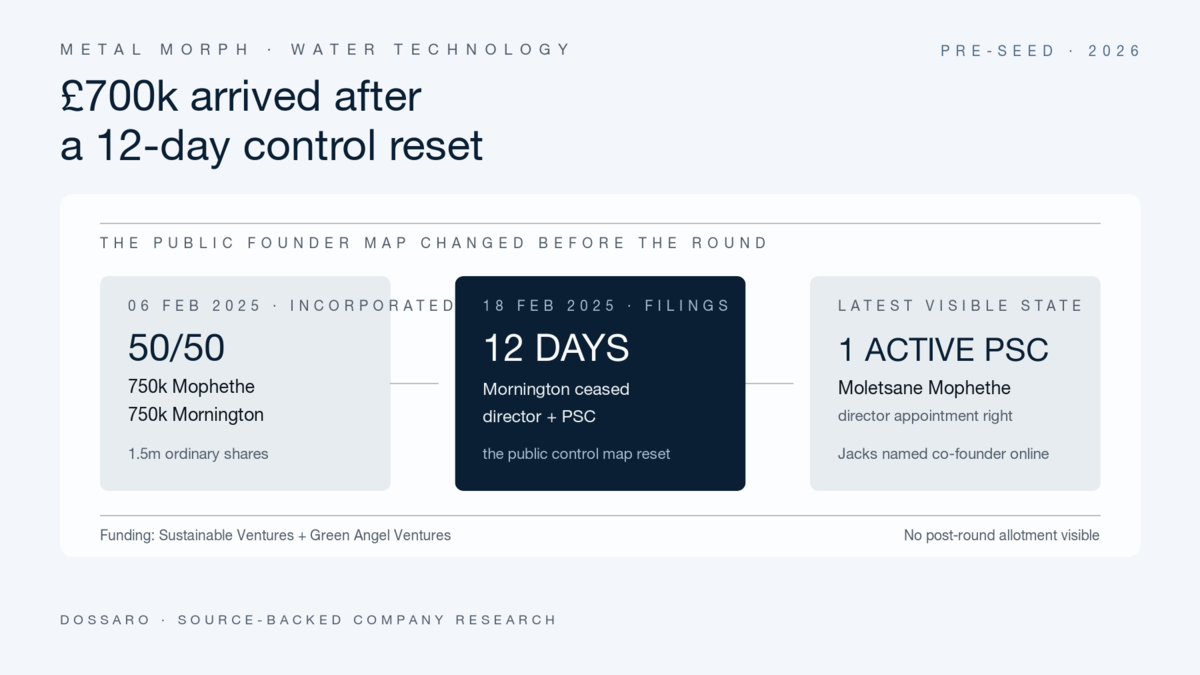
Metal Morph raised £700,000 after its formal founder structure had already changed. Companies House shows the London water-technology company incorporated with Moletsane Mophethe and Anne-Charlotte Mornington holding 750,000 ordinary shares each. Twelve days later, Mornington ceased to be a director and a person with significant control (PSC). Mophethe is now the only active PSC visible on the register.
That sequence does not prove that Mornington sold her shares, lost all economic interest, or was forced out. It does show that the company receiving a pre-seed round co-led by Sustainable Ventures and Green Angel Ventures no longer presented the same formal founder and control map as the one created at incorporation.
The distinction matters for underwriting. Investors can see a rapid legal control reset, a current website that names Mophethe as founder and chief executive and Thomas Jacks as co-founder and chief commercial officer, and no public post-round allotment or investor vehicle. They cannot yet see the exact ownership split after Mornington's cessation, the round's dilution, or the private governance rights agreed with the investors.
The Company Was Created As A 50/50 Founder Structure
Metal Morph Ltd was incorporated on 6 February 2025 under Companies House number 16235318. The incorporation filing records 1.5 million ordinary shares. The initial shareholdings allocate 750,000 shares to Mophethe and 750,000 to Mornington, a 50/50 split.
The same incorporation package records both founders as directors and both as PSCs. Each was reported as owning more than 25% but not more than 50% of the shares and voting rights, with the right to appoint or remove directors. The broad PSC bands do not state that each held exactly half after incorporation, but the initial shareholding schedule does.
| Date | Public record | What it establishes |
|---|---|---|
| 6 February 2025 | Incorporation and initial shareholding | 1.5m ordinary shares, 750,000 each to Mophethe and Mornington |
| 18 February 2025 | TM01 and PSC07 filings | Mornington resigned as director and ceased as a PSC |
| 19 February 2026 | Confirmation statement | No updates reported; the latest statement still shows the post-cessation public state |
| July 2026 | Metal Morph funding FAQ | £700,000 pre-seed co-led by Sustainable Ventures and Green Angel Ventures, with Aqcelerator and Found Capital participating |
| 13 August 2026 | Independent funding report | Round, pilot funding and utility-market framing reported publicly |
The legal entity therefore began with two named founders carrying the same visible block of ordinary equity. The filings then changed the formal control perimeter before the financing became public.
Twelve Days Later, One Founder Left The Register's Control Map
Companies House records four relevant filings on 18 February 2025. Mornington's director appointment ended, and a PSC cessation filing removed her from the active control list. Mophethe remains an active director and PSC. The current PSC page lists him as owning more than 25% but not more than 50% of shares and voting rights and as having the right to appoint or remove directors.
The filing sequence is precise but narrow. A PSC record captures statutory control conditions that must be reported to Companies House. It does not publish the company's register of members, a shareholders' agreement, transfer consideration, board minutes or the complete set of investor consent rights.
Mornington's cessation therefore leaves several economically different possibilities open. She may have transferred some or all of her shares. She may have retained a holding below the PSC threshold. She may still have contractual rights that do not create an active PSC entry. Or the company may have reorganised its founder and board arrangements without a fully public explanation. The current record does not choose among those possibilities.
What it does rule out is a simple description of the company as an unchanged 50/50 founder venture. The incorporation schedule and the latest PSC page describe different formal states. That is the decision-relevant fact for anyone reading the funding announcement alongside the register.
The £700k Round Is An Operating Bet, Not A Visible Cap Table
The independent CFOtech report published on 13 August 2026 says Metal Morph raised £700,000 in a pre-seed round co-led by Sustainable Ventures and Green Angel Ventures. It names Aqcelerator and Found Capital as additional backers. The report says the money will support technology that recovers aluminium- and iron-based treatment chemicals from municipal and industrial wastewater for reuse.
Metal Morph's current company site gives the same commercial framing. It describes a patent-pending process for recovering spent coagulants, says the pre-seed closed in 2026 and identifies the four funding participants. The site's FAQ dates the round to July 2026 and says the company is preparing a seed round for 2027.
The company also reports 50-plus tests across three drinking-water treatment plants, with 90% of spent coagulants recovered at 95% purity. It says the tests indicated a 26% reduction in coagulation-related operating costs and up to an 89% reduction in coagulant supply-chain emissions. Those are company-reported results, not an audited operating history, and the article uses them only to explain what the new money is intended to validate.
The funding story is therefore concrete even though the cap table is not. Metal Morph is trying to move a resource-recovery process from laboratory and pilot work toward industrial deployment. The round is a financing commitment to that operating path. It is not, on the public evidence, a disclosed allocation of shares among the four named backers.
No post-round statement of capital, allotment filing or investor holding is visible in the public Companies House filing history reviewed for this article. That means the £700,000 headline cannot be translated into an investor percentage or a post-money valuation without importing terms that have not been published.
The Current Team Page Changes The Public Founder Story
Metal Morph's current team page names Mophethe as founder and chief executive and Jacks as co-founder and chief commercial officer. The CFOtech coverage also describes the business as founded by Mophethe and focuses on his water-scarcity experience in Lesotho. Mornington is not named on the current team page.
That presentation is not proof of a share transfer. A website can reflect operating roles, a change in public spokespersons or a decision to describe the current team rather than the incorporation history. But it creates a clear public-versus-filed contrast: the legal entity began with two equal initial shareholders, while the current company narrative foregrounds Mophethe and Jacks.
This is similar to the discipline required when reading a financing-linked control change at Kinematic Trees. A register can show that a legal condition changed on a particular date without proving who gained the practical benefit or why. The useful output is the dated structural change and the question it creates for the next document, not a motive assigned from silence.
The same caution applies to Jacks. His current title as co-founder and chief commercial officer establishes a public operating role. It does not establish that he owns shares, holds a PSC condition, or received part of the 2026 round.
Why The Reset Matters To Investors And Operators
For early-stage investors, founder continuity is not only a people question. It affects who can appoint directors, who is accountable for the original product thesis, and whether the ownership map used in diligence still matches the one in the latest company presentation.
Metal Morph's public evidence creates three separate underwriting tasks:
- Reconcile the founder history. The incorporation schedule gives Mornington 750,000 ordinary shares, while the February 2025 filings remove her director and PSC status. The current register does not disclose the economic path between those states.
- Locate the financing instrument. The funding announcements identify the amount and investors but not the share class, issue price, subscriber allocation or investor rights. A round can include ordinary shares, an advance subscription instrument or private contractual protections that are invisible in a short announcement.
- Separate operating traction from ownership. Utility partnerships, pilot results and the Ofwat grant help explain the commercial case. They do not answer who owns the company or who controls its board after the round.
The formal reset is therefore a risk-allocation fact. It may have simplified decision-making ahead of fundraising, or it may reflect a founder departure that changed the company's economics. The public sources do not establish which. A careful reader should preserve both the commercial opportunity and the unresolved control question.
The Next Documents Would Close The Evidence Gap
The most useful next document is the register of members or a filed statement of capital showing whether any post-incorporation transfer or allotment has been recorded. That would clarify whether Mornington retained shares and whether the 2026 investors received newly issued equity.
The executed shareholders' or investment agreement would answer a different question. It could show board nomination rights, reserved matters, founder vesting, information rights, transfer restrictions and any investor consent thresholds. None of those terms should be inferred from the active PSC record.
The latest confirmation statement, made up to 19 February 2026, reports no updates. That is useful as a cutoff, not as proof that no private change occurred afterward. The financing was announced later, and a future confirmation statement or allotment filing could materially change the public picture.
The evidence supports a precise conclusion. Metal Morph raised £700,000 to develop wastewater chemical-recovery technology, but the round arrived after a rapid formal founder-control reset: a 50/50 incorporation became a company with one active registered PSC 12 days later. The public record does not show whether Mornington retained economic rights, whether Jacks owns equity, or what the investors received.
That boundary is commercially important. It tells an investor to underwrite the technology and the team while separately requesting the cap table and governance documents that connect the funding headline to actual ownership and control.
For comparison, Edgify's triple-vote structure shows how a public filing can expose unusually strong founder voting rights. Metal Morph presents the inverse diligence problem: the public record exposes a change in who is formally visible, but not the private allocation or contractual reason behind it.
Continue reading
Related Research
Kinematic Trees' £585k Round Coincided With A Board-Control Reset
Kinematic Trees issued 185,714 ordinary shares for £584,999.10, about 15.7% post-money, as a founder's registered majority-board right disappeared.
Mindgard’s $30m Round Followed A Founder Threshold Drop And A US Subsidiary Pledge
Mindgard raised a $30m Series A after its founder fell below the UK PSC threshold and First Citizens took security over its entire US subsidiary.
Edgify's New Class Can Turn 16% Of Equity Into 36.5% Of Votes
Edgify's authorised Seed Prime class can represent 16.1% of equity but 36.5% of votes, while Rank and Mangrove receive specific governance rights.
Oshen's $5m Round Began Before the Announcement
Oshen's founders held 94.5% before its $5m round, while June resolutions authorised a potential 24.3% share envelope and ratified earlier ASAs.