
Edgify's New Class Can Turn 16% Of Equity Into 36.5% Of Votes
Edgify's authorised Seed Prime class can represent 16.1% of equity but 36.5% of votes, while Rank and Mangrove receive specific governance rights.
On this page
Conduct your own private market research
Add dossaro to Claude or ChatGPT and run source-backed register research from your own workspace.
 Add to Claude
 Add to ChatGPT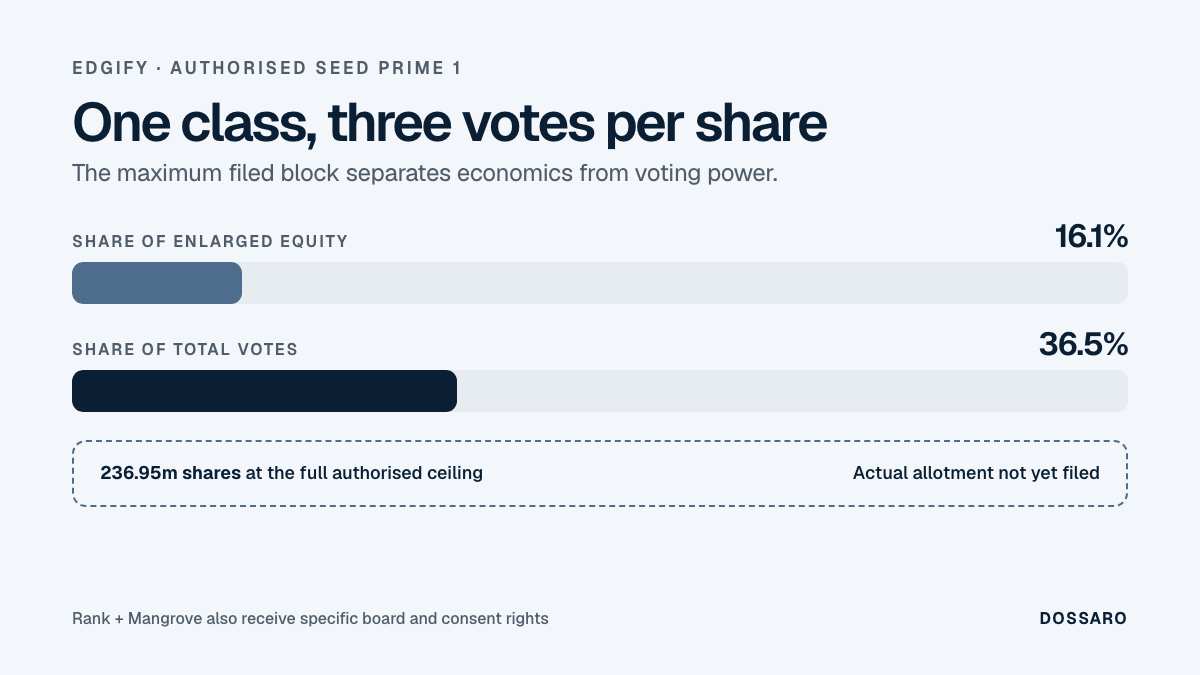
Edgify's new investor class can turn 16.1% of the company's enlarged equity into 36.5% of its votes. That is the maximum effect of 236,950,000 Seed Prime 1 shares authorised in the edge-AI company's latest filings, not evidence that the entire block has already been issued.
The asymmetry sits behind a fresh financing headline. Axios reported on 10 August that Edgify raised a $9 million Series A from Rank Ventures and Mangrove Capital Partners. The public report names the capital and investors. The Companies House filings show how much influence the new terms can carry.
Each Seed Prime 1 share receives three votes under articles filed on 30 July. Every other share receives one. The same articles give Rank and Mangrove specific board and consent rights. If the authorised class is issued in full, the result would be a sizeable minority of the equity with more than one-third of the vote.
That matters because financing rounds do more than set valuation and dilution. They can redistribute the ability to block decisions, appoint directors and shape board procedure. In Edgify's case, the filed terms concentrate those levers around the two investors named in the Series A report.
Three Votes Per Share Create A 20-Point Gap
Edgify's last visible confirmation statement, made up to 23 December 2025, recorded 1,234,487,024 shares. Resolutions passed on 28 April and renewed on 9 July authorised up to 236,950,000 Seed Prime 1 shares.
At that ceiling, the enlarged share count would be 1,471,437,024. The new class would therefore represent 16.1% of equity. Its 710,850,000 votes, however, would sit inside a total of 1,945,337,024 votes, producing 36.5% of voting power.
| Maximum authorised calculation | Seed Prime 1 | Enlarged company | Class share |
|---|---|---|---|
| Equity | 236,950,000 shares | 1,471,437,024 shares | 16.1% |
| Votes | 710,850,000 votes | 1,945,337,024 votes | 36.5% |
The 20.4 percentage-point gap is not a loose estimate of investor influence. It follows directly from the three-vote right and the filed maximum. Nor is 36.5% a majority. It is a large minority position that could matter for resolutions, negotiations and coalition-building, depending on the actual allotment and how other holders vote.
This distinction between economics and influence also changes how dilution should be read. Existing shareholders could give up a much larger share of voting power than their economic dilution alone suggests. That is a different mechanism from a simple post-round ownership change such as Axiom Equity moving ahead of Risk Ledger's founder. Edgify's new terms build the leverage into the class itself.
Rank And Mangrove Receive Rights Beyond The Vote Count
The articles place Rank and Mangrove into the company's governance architecture by name. Rank can appoint a director. Mangrove has its own appointment right. Defined investor consent requires Mangrove together with a Rank director, and the ordinary board-quorum rule requires a Mangrove director to be present before an adjourned-meeting fallback can apply.
| Filed governance term | Practical significance |
|---|---|
| Rank director appointment right | Gives Rank a direct route into board representation |
| Mangrove director appointment right | Gives Mangrove its own board seat mechanism |
| Investor consent requires Mangrove plus a Rank director | Makes both investor groups relevant to protected decisions |
| Ordinary board quorum requires a Mangrove director before fallback | Gives Mangrove procedural importance at the first board meeting |
These rights do not prove that either investor controls Edgify on its own. They do show that the financing terms allocate influence through several channels at once: votes, director appointments, consent and board procedure.
The last visible shareholder statement adds context. It listed 356,150,587 preferred shares for Mangrove V Investments. Rank Ventures SPV I LLP held 161,914,622 Senior Seed shares, while Vauban Nominees held 55,761,788 shares as trustee for Rank Ventures SPV VI. Those are pre-round positions, not a current cap table, but they show that both investor groups already had substantial economic interests before the latest authorisation.
Rank Ventures says it led an Edgify Seed Extension in autumn 2022. An Octopus Ventures portfolio page independently names Rank, Mangrove, Sony and Octopus among Edgify's investors. Neither source discloses the 2026 allotment, so the current distribution still cannot be reconstructed.
The Class Price Does Not Reconcile The $9m Round
The articles assign the Seed Prime shares a starting price of £0.012661. Multiplying that figure by the full 236,950,000-share authority produces £2,999,523.95, or about £3.0 million.
That calculation does not mean Edgify raised only £3.0 million. It also does not show that the $9 million report is wrong. The two numbers describe different things: one is a filed starting price applied to an authorised share ceiling, while the other is a reported financing amount.
Several structures could bridge the difference. The round could use another class, debt, a secondary component, a different final issue price or capital supplied across more than one step. The filings available at the evidence cutoff do not establish which explanation applies. Treating any of them as fact would outrun the documents.
The gap is nevertheless useful. It identifies the exact evidence still missing and prevents the public round amount from being casually mapped onto the new class. Until an allotment return appears, the £3.0 million figure is a class-price reference, not disclosed proceeds.
The Authorisation Is A Ceiling, Not A Completed Cap Table
The strongest counter-reading is straightforward: Edgify may issue fewer than 236,950,000 Seed Prime 1 shares. A partial issue would reduce both the equity and voting percentages. The final block could also be divided among investors, so the class's aggregate voting weight would not automatically belong to one holder.
Triple-vote rights and investor consents can be understood as protection for capital providers taking risk in a private company. They need not imply day-to-day operational control. The articles also include an adjourned-meeting fallback for board quorum, limiting how far the initial Mangrove attendance requirement should be stretched.
Those limits are important, but they do not make the structure immaterial. The company has authorised a class that can carry more than twice as much voting weight as its economic share, and it has paired that class with investor-specific governance terms. That is the commercial finding visible today.
The Next Filing Will Show How Much Power Actually Moved
Edgify's financing SH01 is now the decision-changing document. It should disclose how many shares were allotted, their class and their issue date. A later confirmation statement can show the allocation among named shareholders.
Together, those filings will answer whether the authorised 36.5% voting block became a completed position, whether the class was only partly used and which investors received it. They may also help reconcile the roughly £3.0 million class-price calculation with the reported $9 million Series A.
Until then, the defensible conclusion is narrower but still consequential: Edgify authorised a triple-vote investor class capable of converting 16.1% of equity into 36.5% of votes, while giving Rank and Mangrove additional governance rights. The round's final ownership map remains open.
Continue reading
Related Research
Risk Ledger's £24m Round Put Axiom Ahead Of Its Founder
UK filings show Axiom became Risk Ledger's largest individual shareholder as £18.5m of cash allotments trailed the announced £24m Series B headline.
Wordsmith's $114m Funding Sits Above A £1 UK Subsidiary
Wordsmith AI has announced $114 million of funding above a one-share UK subsidiary, while Ross McNairn's latest register state preserves founder control rights.
Greyparrot's Series B Shifts A Sub-£120m Sale Shortfall To Founders
Greyparrot's filed terms protect Series B as if a founder-led sale valued the company at £120m, with any shortfall deducted from founder proceeds.
Nuclear Turbines Founders Held 57.6% Before £15m Reveal
Nuclear Turbines announced £15m, while its latest register shows founders at 57.6%, IQ Capital at 15.4% and about £6.2m of cash equity filed.