
Wordsmith's $114m Funding Sits Above A £1 UK Subsidiary
Wordsmith AI has announced $114 million of funding above a one-share UK subsidiary, while Ross McNairn's latest register state preserves founder control rights.
On this page
Conduct your own private market research
Add dossaro to Claude or ChatGPT and run source-backed register research from your own workspace.
 Add to Claude
 Add to ChatGPT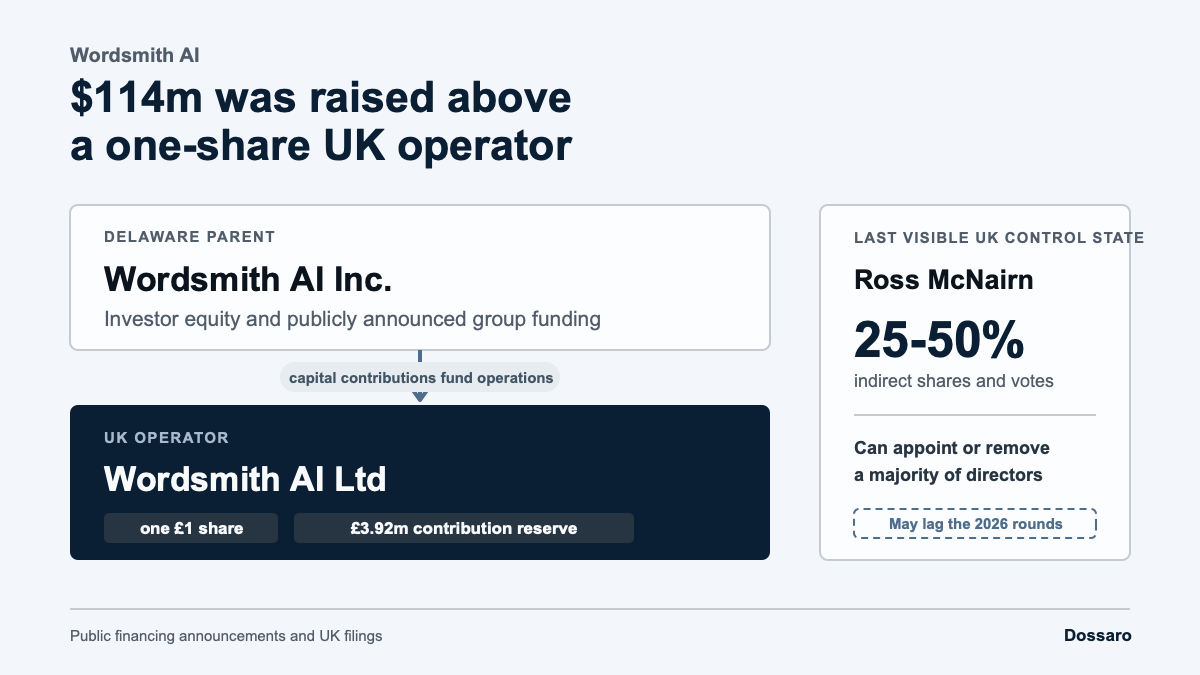
Wordsmith AI has now announced $114 million of funding, but the British company building and selling the product still has one issued share with a nominal value of £1. That share belongs to Wordsmith AI Inc., a Delaware corporation that sits above the Edinburgh-based operator.
The structure puts the investor cap table and the operating balance sheet on different legal levels. Intact Private Capital, FT Ventures, Highland Europe and Index Ventures appear in Wordsmith's public financing announcements. The UK filing record instead shows a wholly owned subsidiary whose 2024 accounts carried £3.92 million in a capital-contribution reserve.
Companies House also names co-founder Ross McNairn as an indirect controller with more than 25% but no more than 50% of shares and votes, plus the right to appoint or remove a majority of directors. That is the latest visible UK control state, not a post-August cap table. The June and August 2026 financings may have changed his economics before a new filing appears.
For investors, employees and counterparties, the distinction is practical. Equity is raised above the company where UK staff, customer contracts, cash and operating liabilities sit. Understanding Wordsmith therefore requires reading the parent-level financing story together with the subsidiary-level accounts.
The Investor Story Sits At The Delaware Parent
Wordsmith AI Ltd was incorporated on 31 October 2023 with a single ordinary share subscribed by Wordsmith AI Inc. The UK company's 2024 accounts identify that Delaware corporation as its 100% shareholder and ultimate controlling party.
| Legal layer | Publicly visible fact | Commercial consequence |
|---|---|---|
| Wordsmith AI Inc. | Delaware parent owns at least 75% of the UK operator | The group investor cap table sits above the operating subsidiary |
| Wordsmith AI Ltd | One issued £1 ordinary share, owned by the parent | UK equity filings do not allocate the venture investors |
| Ross McNairn | Latest UK record shows 25-50% indirect shares and votes plus majority-board appointment rights | Founder control can persist through the parent even when the subsidiary is wholly owned |
The percentages in the table are not additive. Wordsmith AI Inc. directly owns the UK share, while McNairn's filing describes indirect control through the ownership chain. A founder can therefore be a registrable controller of a subsidiary without appearing as its direct shareholder.
That distinction became more important on 5 August. Wordsmith announced a $14 million Series B extension, led by Intact Private Capital, with FT Ventures becoming a shareholder and Highland Europe and Index Ventures participating as existing investors.
Two months earlier, Wordsmith had announced a $70 million Series B that took total funding to $100 million. Adding the extension brings the publicly announced total to $114 million. The company also said revenue had grown more than fourteenfold in twelve months and that more than 500 companies used the platform.
Those operating claims are company statements. The legal structure is separately visible in the Companies House control record, which lists the Delaware parent and McNairn as the two active controllers. A Companies House research workflow can keep the direct parent shareholding, indirect PSC control and later filings separate instead of flattening them into one ownership percentage.
Ross McNairn Retains The Last Visible Founder-Control Position
McNairn's control entry reaches beyond an ownership band. Companies House records more than 25% but no more than 50% of indirect shares and voting rights, together with the right to appoint or remove a majority of directors.
That combination matters more than a percentage alone. Venture financings can dilute economic ownership while leaving selected governance rights intact. A board appointment right can preserve strategic influence even after outside investors acquire a large share of the economics.
The filing states that McNairn's control was effective from incorporation. It therefore describes the historic ownership chain rather than a control transfer in 2026. It also cannot establish his exact position after the $70 million round and the $14 million extension.
The correct investor question is narrower: how much of the visible founder-control package survived the two 2026 closings? The next parent cap table or UK control update should show whether McNairn remains above the 25% reporting threshold and whether the board appointment right changed.
The UK Operator Was Funded Through Capital Contributions
Wordsmith AI Ltd's accounts to 31 December 2024 show how money had reached the operating company before the latest rounds. The subsidiary reported a £3.92 million capital-contribution reserve while its nominal share capital remained £1.
| UK operator metric at 31 December 2024 | Reported amount | What it indicates |
|---|---|---|
| Cash | £3.18m | Liquidity held in the operating subsidiary |
| Capital-contribution reserve | £3.92m | Parent support recorded without issuing new UK shares |
| Accumulated loss | £0.69m | Cumulative cost base before the 2026 expansion |
| Net assets | £3.23m | Balance-sheet equity after accumulated losses |
| Average employees | 8 | A small operating base before the announced scaling plan |
The reserve is not proof that a particular venture round supplied £3.92 million. It is evidence of the funding route used by the group through the end of 2024: capital arrived from above without changing the one-share structure of the subsidiary.
That route gives the parent flexibility. Investors can subscribe at the Delaware level, while the parent sends operating capital into Britain as contributions, intercompany funding or another documented transfer. The UK company can expand without placing each new investor on its own share register.
It also separates risk. Parent investors own an interest in the wider group. UK employees and customers contract with a subsidiary whose cash, assets and liabilities are local. In a financing, acquisition or restructuring, the rights attached to parent stock and the resources actually available to the operator are related but not identical.
This parent-operator split also appears in other legal-technology transactions. Dossaro's analysis of Wexler before its sale to Legora showed how preferred equity, board representation and cash sat inside the UK target itself. Wordsmith uses the opposite visible pattern: the investor equity sits above the British operator.
The Financing Headline And The Operating Accounts Answer Different Questions
The public sequence shows how quickly the gap between those two levels has widened.
| Date | Public or filed event | What changed |
|---|---|---|
| 31 October 2023 | UK subsidiary incorporated | Delaware parent subscribed for the single £1 share |
| 31 December 2024 | First visible accounts period ended | £3.92m contribution reserve and £3.18m cash recorded in Britain |
| 3 June 2026 | $70m Series B announced | Publicly announced total funding reached $100m |
| 5 August 2026 | $14m extension announced | Intact and FT Ventures joined the investor group |
The timeline does not identify how much of the 2026 money has entered the UK company. It shows why the next accounts matter. Wordsmith said in June that it planned to scale to about 300 people by year-end across the United States, United Kingdom and Europe. The 2024 UK accounts averaged eight employees.
Moving from that base to a multinational workforce requires capital to be allocated among group entities. The parent financing headline measures fundraising capacity. The subsidiary accounts will eventually show where operating cash, payroll and losses accumulated.
For venture investors, that is an underwriting question about governance and cash mobility. For employees and commercial partners, it is a question about which entity employs people, signs contracts and holds enough liquidity to perform them. For a potential acquirer, it defines the transaction perimeter: parent stock may carry the group economics, while operating assets and obligations remain distributed below it.
The Next Filing Must Connect Funding To Control
The affirmative record is already useful. Wordsmith AI Inc. owns the British operator. The operator has one £1 share. Its 2024 balance sheet shows parent capital contributions rather than UK share issuance. Ross McNairn's latest visible record preserves a 25-50% indirect control band and the right to appoint most directors.
The missing document is the current parent cap table. It should allocate the 2026 financings among Intact Private Capital, FT Ventures, Highland Europe, Index Ventures and the other investors, and show McNairn's fully diluted ownership after the extension. The next UK accounts should then show how much new capital was sent into the operating company.
Until those records arrive, Wordsmith's funding should be read as a two-level structure. More than $100 million has been announced around the Delaware parent. The British operator beneath it still presents a one-share legal shell with a real operating balance sheet. The next disclosure must connect those two levels and show how much founder control survived between them.
Continue reading
Related Research
Wexler's Founders Held 54%, But £4.66m Ranked First
Legora bought a Wexler that was 54% founder-owned on its last visible share count, but £4.66m of seed preference ranked ahead of ordinary shares.
Volta's $300m Raise Had A 30.5x Nominal Share-Price Ladder
Volta's $300m raise hid a 30.5x nominal price ladder from $58 Seed shares to $1,769.91 Series A stock, plus preferred rights and $2m of debt set-off.
CuspAI's Founders Held 32.61% Before The $450m Series B
CuspAI's founders held 32.61% before its $450m Series B, while UK sovereign capital entered a company whose post-round ownership is not yet public.
Adaptyv's $40m Series A Sits Above a Parent-Owned Swiss Lab
Adaptyv announced a $40m Series A, while its Swiss Sàrl record shows a US-parent-owned launch and no public post-round investor split or dilution map.