
Wexler's Founders Held 54%, But £4.66m Ranked First
Legora bought a Wexler that was 54% founder-owned on its last visible share count, but £4.66m of seed preference ranked ahead of ordinary shares.
On this page
Conduct your own private market research
Add dossaro to Claude or ChatGPT and run source-backed register research from your own workspace.
 Add to Claude
 Add to ChatGPT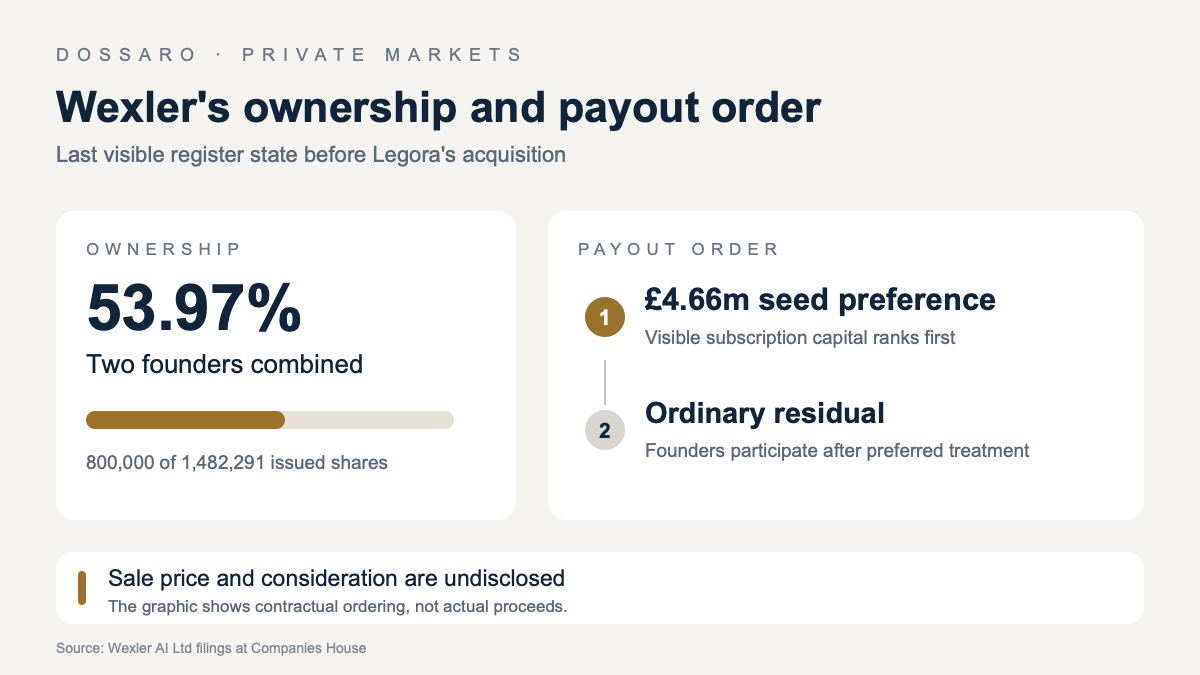
Source record available
WEXLER AI LTD · 14460752
Open the legal identity and 3 reviewed filings behind this analysis.
Wexler was 53.97% founder-owned on its last visible share count before Legora announced the acquisition. Co-founders Kush Madlani and Gregory Mostyn each held 400,000 ordinary shares. But those 800,000 shares did not by themselves set the payout order: approximately £4.66 million of visible seed subscription capital ranked ahead of ordinary shares under Wexler's filed terms.
That makes the undisclosed acquisition price the central economic fact. At a price close to the preference stack, contractual ordering can matter more than headline ownership. At a substantially higher price, the founders' majority becomes more representative of the value available after the preference is satisfied or the investors choose the better as-converted outcome.
Wexler announced on 29 July that Legora is acquiring the London litigation software company. The release says Wexler's 18-person team will form the founding team of Legora's London engineering hub and calls the transaction Legora's fifth acquisition of 2026. Neither the release nor independent acquisition coverage discloses the price, consideration form or shareholder proceeds.
| Public transaction fact | Last visible filed state | Decision-relevant consequence |
|---|---|---|
| Legora announced the acquisition on 29 July | Wexler had 1,482,291 issued shares after its March allotment | The pre-deal capital structure can be measured, but the closing structure cannot |
| Wexler had an 18-person team | Founders held 800,000 ordinary shares | The target was founder-majority-owned on a straight share count |
| Wexler had raised seed capital | Three seed classes represented £4.66m of visible subscription capital | Preferred capital stood ahead of ordinary shares in the filed distribution order |
| Price and consideration were not disclosed | No post-closing member update was visible | Actual founder and investor proceeds cannot be calculated |
The commercial consequence is not that founders necessarily lost their majority economics. It is that ownership percentage and payout priority answer different questions. The founders had the largest collective position. Seed investors had contractual protection that could become decisive depending on what Legora paid and how the deal was structured.
Two Founders Held 53.97% Of The Last Visible Shares
Wexler's 2025 confirmation statement lists Madlani and Mostyn with 400,000 ordinary shares each. A later allotment filed on 20 March 2026 added 1,341 ordinary shares and brought the total issued share count to 1,482,291.
Using that later denominator, each founder held 26.99% and the pair held 53.97%. The calculation is a straight issued-share count. It does not include unissued options, closing adjustments or any securities created after the evidence cutoff.
| Holder | Last visible shares | Class | Straight share-count position |
|---|---|---|---|
| Kush Madlani | 400,000 | Ordinary | 26.99% |
| Gregory Mostyn | 400,000 | Ordinary | 26.99% |
| Pear Ventures IV | 203,144 | Seed 1 | 13.70% |
| EF Investment II | 133,398 | Seed 2 | 9.00% |
| Myriad Ventures Fund I | 131,621 | Seed 1 and Seed 3 | 8.88% |
| Seedcamp VI | 60,943 | Seed 1 | 4.11% |
| LegalTech Fund II | 60,943 | Seed 1 | 4.11% |
The table shows why this was a material founder outcome rather than only a product acquisition. Each founder's visible stake was almost twice Pear's and roughly three times the EF or Myriad position. Together, the founders controlled a majority of the issued shares.
It does not follow that they received 53.97% of the consideration. The seed classes carried different distribution rights, and an acquisition can also include transaction-specific treatment such as conversion, rollover equity, retention packages or earn-outs. None of those closing terms is public.
£4.66 Million Of Seed Capital Sat Ahead Of Ordinary Shares
Wexler's articles adopted in July 2025 define the preference amount for the three seed classes. Combining the filed issue prices with the visible share counts produces £4,661,990.26 of subscription capital.
| Seed class | Visible shares | Filed issue price | Visible subscription capital |
|---|---|---|---|
| Seed 1 | 358,887 | £10.9355 | £3,924,608.79 |
| Seed 2 | 133,398 | £1.0869 | £144,990.29 |
| Seed 3 | 97,764 | £6.0594 | £592,391.18 |
| Total | 590,049 | £4,661,990.26 |
The three classes do not have the same price because they came from different financing steps. Wexler publicly described a $1.4 million pre-seed and later announced a $5.3 million seed round. Those dollar headlines should not be forced into a direct reconciliation with the £4.66 million figure. The currencies, announcement scopes and legal closings differ.
The filed distribution order is clearer. After liabilities and any nominal deferred-share payment, seed shareholders rank ahead of ordinary shareholders. For each seed share, the holder receives the greater of its preference amount or the amount available on an as-converted basis, subject to the assets available and the full terms.
In plain language, seed investors are protected against a simple pro rata split that would send value to ordinary shareholders before the preference is addressed. If the as-converted share is worth more, they can participate on that basis. The structure protects downside without automatically capping upside.
The Sale Price Decides Whether 54% Looked Like 54%
The public record does not support a transaction model with a specific price. It does support a scenario framework that shows why the missing number matters.
| Acquisition-value scenario | Likely importance of the seed preference | What can be concluded |
|---|---|---|
| Consideration near or below £4.66m | Potentially central | Ordinary proceeds could be heavily constrained, but actual treatment is unknown |
| Consideration moderately above £4.66m | Material to the first part of the waterfall | Residual value may reach ordinary holders after preferred treatment |
| Consideration far above £4.66m | Less important relative to total value | Straight ownership may become more representative, subject to conversion and deal terms |
| Legora equity, earn-out or mixed consideration | Depends on valuation and security terms | Cash proceeds cannot be inferred from share counts |
This is a sensitivity map, not a claim about the deal price. Calling the acquisition an acqui-hire would go beyond the evidence. So would saying the investors recovered £4.66 million or that either founder received 26.99% of the proceeds.
The same distinction appears in Dossaro's analysis of Street Group's founder ownership before the Hg transaction. A visible founder percentage can frame the potential outcome, but price, dilution, class rights and the form of consideration determine what that percentage means at closing.
For private-market readers, the Wexler case is particularly useful because the two economic signals point in opposite directions. The ownership register says founders were in the strongest collective position. The articles say seed investors had the stronger first claim. Both can be true at once.
Legora Bought A Specialist Team And A Capital Structure
Wexler says it was founded in January 2023 by Mostyn and Madlani. Its acquisition release reports eightfold year-on-year revenue growth and more than 400% net revenue retention. Those are company statements, not figures independently reconstructed from filed accounts.
The strategic rationale is easier to verify at the product level. Wexler focuses on extracting and verifying facts from large litigation records. Legora says the product will become a fact layer underneath its wider legal workflows, while Wexler's engineers establish the buyer's London engineering hub.
That can justify a premium well above the preference stack. A specialist product, customer relationships and an experienced engineering team can be worth more inside a larger platform than as a stand-alone company. If the acquisition consideration was comfortably higher, the preference may have operated mainly as negotiated insurance rather than the defining payout mechanism.
The counterposition matters because a preference is not evidence of a weak exit. It is a contractual map for allocating value across possible outcomes. Without the acquisition price, the map can be read but the final route cannot.
The named holders also bring different incentives. Pear led Wexler's seed announcement, while Seedcamp, LegalTech Fund and Myriad participated across the financing history. The founders retained majority ownership after those rounds. That suggests Wexler combined external capital with unusually strong founder retention on the visible register.
Researching that combination requires keeping documents separate. The UK Companies House data-source workflow uses confirmation statements to identify holders, allotments to update share counts and articles to interpret class rights. No one document answers all three questions.
The Closing Documents Will Reveal The Founder Outcome
The acquisition announcement establishes strategic intent and named participants. The filed record establishes the last visible ownership and preference order. The missing transaction documents carry the actual financial conclusion.
| Next document | Decision-relevant answer |
|---|---|
| Acquisition agreement or deal summary | Price, cash-versus-stock mix, earn-out and closing adjustments |
| Post-closing member register or confirmation statement | Which Wexler securities converted, transferred or remained outstanding |
| Legora annual report and acquisition note | Purchase consideration and acquired assets, if separately disclosed |
| Investor realization announcement | Whether seed investors exited, rolled over or retained exposure |
| Founder disclosure | Cash, buyer equity, retention terms or continuing ownership |
Until one of those sources appears, the evidence supports a bounded conclusion. Legora announced the acquisition of a company whose founders held 53.97% of the last visible issued shares. Approximately £4.66 million of seed subscription capital stood ahead of ordinary shares in the filed distribution order.
That structure makes Wexler a genuine founder exit story, but not yet a measurable founder payout story. The decisive question is no longer who held the most shares. It is what Legora paid and whether the price was high enough to make ownership percentages more important than preference priority.
Continue reading
Related Research
Street Group's Founders Held 92.8% Before Hg's £200m Deal
Street Group's founders held 92.8% before Hg's deal valued the company above £200m, mapping to more than £185m of paper value at 12.5 times 2025 revenue.
Lightning Reach's Sale Replaced Founder Control And Flattened Its Share Stack
UK filings show Lightning Reach's founder lost control on 1 July as a buyer took at least 75% of rights and converted 256,163 shares into one ordinary class.
Mistral's Koyeb Acquisition Split A €27.8m Exit Between Cash And Shares
A French contribution report values Koyeb at about €27.8m and shows 36% of its shares rolled into Mistral, splitting liquidity from future upside.
Moa Technology's £22.2m Round Put £44.4m First In Line
Moa Technology's £22.2m Series C created 46.4% of its issued shares and a roughly £44.4m first claim after accounts warned the round was essential.