
Adaptyv's $40m Series A Sits Above a Parent-Owned Swiss Lab
Adaptyv announced a $40m Series A, while its Swiss Sàrl record shows a US-parent-owned launch and no public post-round investor split or dilution map.
On this page
Conduct your own private market research
Add dossaro to Claude or ChatGPT and run source-backed register research from your own workspace.
 Add to Claude
 Add to ChatGPT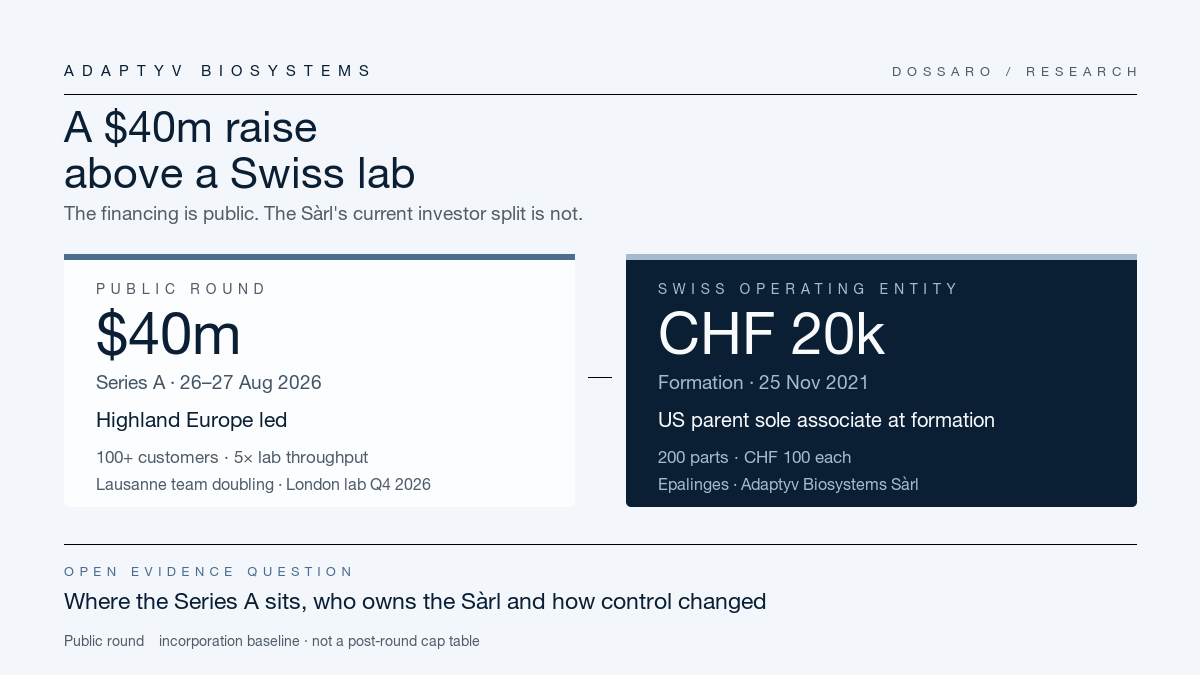
Adaptyv Biosystems announced a $40 million Series A at the end of August, presenting the financing as the next step for an automated protein-design laboratory. The Swiss legal record adds a less visible but commercially important baseline. Adaptyv Biosystems Sàrl was incorporated with the US parent, Adaptyv Biosystems, Inc., as its sole associate and CHF 20,000 of capital. The available register evidence does not show who received the new Series A shares, whether the round sits in the Swiss vehicle or a parent company, or how the economics changed.
That is not a contradiction between the announcement and the register. They answer different questions. The announcement describes capital raised for growth. The Swiss record describes how the operating entity began. Putting those layers together shows why the funding headline cannot be used as a current Swiss cap table.
The $40m round is a public scaling event
Biopôle reported on 27 August 2026 that Adaptyv had raised $40 million in a Series A led by Highland Europe. ACE Ventures, byFounders and Y Combinator were named as participating or returning investors, with ACE describing the raise as a follow-on to its $8 million seed round in late 2024. Highland's company page lists the financing as its latest Adaptyv news on 26 August. The sources agree on the amount, lead investor and timing, even though they do not publish an allocation by legal entity or shareholder.
The commercial case is visible in the same public accounts. Adaptyv says it now serves more than 100 customers and has increased laboratory throughput fivefold over the previous year. The company plans to double its Lausanne team and open a London office and laboratory in the fourth quarter of 2026. Customer examples reported by Biopôle include Chai, Boltz, Roche and Novo Nordisk. Those facts explain the use of capital as an expansion programme, not as a disclosure of who owns the operating company after the round.
The public sources also leave several legal questions unanswered. They do not state a valuation, share price, share class, conversion right or preference waterfall. They do not say whether Highland, ACE, byFounders or Y Combinator subscribed for shares in Adaptyv Biosystems Sàrl, in a parent company, or through another financing vehicle. A press release can identify an investor syndicate without identifying the company that issued its securities.
The Swiss vehicle began with one US associate
The official Swiss commercial register publication dated 25 November 2021 records the formation of Adaptyv Biosystems Sàrl in Epalinges. Its articles were adopted on 4 November 2021. The notice states social capital of CHF 20,000, divided into 200 parts of CHF 100. It names Adaptyv Biosystems, Inc. of Wilmington, United States, as the sole associate, holding all 200 parts at formation.
The same notice names Julian Englert as president with individual signing authority and Daniel Nakhaee-Zadeh Gutierrez as manager with individual signing authority. It describes a purpose centred on protein engineering using synthetic biology and nanofluidics, with permission to create subsidiaries, participate in other businesses and provide financing or guarantees. The current Zefix profile confirms the entity as active, with UID CHE-364.352.615, legal seat Epalinges and an incorporation date of 25 November 2021.
The CHF 20,000 figure is a formation fact, not a measure of the business's value. It is the stated nominal capital at the moment the Swiss operating vehicle entered the register. The arithmetic is simple: 200 parts multiplied by CHF 100 equals CHF 20,000. It does not describe later funding, assets, revenue, intellectual property or the price paid by any later investor.
| Evidence point | Verified record | What it supports | What it leaves open |
|---|---|---|---|
| Series A announcement, 26 to 27 August 2026 | $40m round led by Highland Europe, with ACE Ventures, byFounders and Y Combinator named in coverage | A current financing announcement and investor framing | Issuer, allocation, valuation and legal instrument |
| Swiss formation publication, 25 November 2021 | CHF 20,000 capital in 200 CHF 100 parts; Adaptyv Biosystems, Inc. as sole associate | The Swiss Sàrl started as a wholly US-parent-owned vehicle | Any post-2021 ownership or financing change |
| Current Zefix profile | Adaptyv Biosystems Sàrl, UID CHE-364.352.615, active in Epalinges | Exact entity identity and current register status | Current holder list, voting agreement and investor rights |
| Public evidence available at the sourcing cutoff | No shareholder allocation or unified ownership filing for the Series A | A bounded gap between round headline and legal holder map | Where the round sits and how control or dilution changed |
The table separates dates and sources because the time gap is the point. The 2021 document can establish incorporation lineage. It cannot establish a 2026 ownership position without a later filing or a transaction document.
Why the parent and lab boundary matters
Adaptyv's operating footprint is described in Lausanne, and the company is adding London capacity. Its Swiss Sàrl is therefore an important local vehicle for employees, facilities and contracts. That role does not make it the automatic issuer of the Series A. A group can raise capital in a parent while funding a subsidiary through equity, loans or ordinary operating transfers. The public announcements do not identify which path Adaptyv used.
The incorporation record does establish a clear starting relationship: one US corporate associate held all 200 Swiss parts when the Sàrl was formed. That is useful evidence of the original ownership chain, but it is not a beneficial-ownership conclusion about 2026. The public record does not say whether the parent still holds all parts, whether new associates entered, or whether the Sàrl's capital was increased after formation.
This entity boundary is the same discipline used in Breedr's Series B parent and operating-company analysis, where a financing announcement and the legal issuer describe different layers of a group. Wordsmith AI's Delaware parent record shows why a parent-company filing can be decisive for control while leaving an operating brand's local structure less visible. The names in a funding release are not a substitute for identifying the issuer and the security.
A $40m headline is not a Swiss cap table
The strongest conclusion is a negative one with practical value: no public source reviewed here gives a current post-round cap table for Adaptyv Biosystems Sàrl. The official SHAB publication is a formation notice. The Zefix profile is a current identity record. Neither contains a Series A allotment, shareholder schedule, issue price or investor percentage. The announcements give the round amount and investor names but not the legal ownership mechanics.
That means several tempting calculations are not defensible. There is no basis for converting $40 million into a percentage of the Swiss Sàrl, estimating founder dilution or stating that Highland owns a particular stake. There is also no basis for calling the Swiss parent relationship a continuing 100% position after the raise. The only percentage supported by the formation record is the sole-associate position at incorporation, when the US parent held all 200 parts.
The distinction has commercial consequences. If the financing was raised at a parent, new investors may have exposure to group-level intellectual property and future subsidiaries rather than a direct position in the Swiss lab. If the Sàrl issued new parts, the local register would become the relevant place to look for a capital increase or new associate. If the group used debt or an internal transfer, neither a press release nor the 2021 formation notice would reveal the investor's downside protection. The available evidence cannot choose among those scenarios.
This is why a source-backed ownership workflow keeps the announcement, entity profile and filing history separate. Dossaro's private-company ownership research workflow is designed for that boundary: resolve the exact legal entity first, then connect each claim to the document that can support it. Here, the exact entity is clear, while the post-round holder map is not.
What the record proves, and what comes next
The evidence supports five bounded findings. Adaptyv announced a $40 million Series A on 26 to 27 August 2026. Highland Europe led it, and ACE Ventures, byFounders and Y Combinator were named alongside the lead in public coverage. The company reports more than 100 customers, fivefold laboratory-throughput growth and a planned London office and laboratory in the fourth quarter. Separately, Adaptyv Biosystems Sàrl was incorporated in Epalinges on 25 November 2021 with CHF 20,000 divided into 200 parts, all held at formation by Adaptyv Biosystems, Inc. The current Zefix profile confirms that exact Swiss entity remains active.
The evidence does not support a current investor percentage, a valuation, a price per share, a founder dilution figure or a claim that the Series A was issued by the Swiss Sàrl. The announcement and the formation notice are compatible, but they leave the legal financing layer unconnected.
The next decision-changing documents would be a Swiss capital-increase or associate-change filing, a parent-company allotment or shareholder record, and any public articles or subscription instrument that sets out voting and preference rights. Until one of those appears, the defensible retelling is precise: Adaptyv's $40m Series A sits above a Swiss lab that began as a wholly US-parent-owned Sàrl, while the current investor split and post-round control remain unfiled.
Continue reading
Related Research
Breedr's $27m Series B Did Not Add Shares to Its UK Operating Company
Breedr announced a $27m Series B, but BREEDR LIMITED's latest UK filed accounts show unchanged capital, £32.6k cash and £2.5m net liabilities.
Wordsmith's $114m Funding Sits Above A £1 UK Subsidiary
Wordsmith AI has announced $114 million of funding above a one-share UK subsidiary, while Ross McNairn's latest register state preserves founder control rights.
The Exploration Company’s $450m Series C Is Not Yet Visible in Its German Parent Register
The Exploration Company announced a $450m Series C, but its latest German parent shareholder list still shows €194,197 of capital and no new round entry.
CloudNC’s $20m announcement sits beside a voting preferred-share filing
CloudNC announced $20m, while its latest SH01 records 44.9m voting Series B shares with priority economics, no named allottees and no direct currency match.