
The Exploration Company’s $450m Series C Is Not Yet Visible in Its German Parent Register
The Exploration Company announced a $450m Series C, but its latest German parent shareholder list still shows €194,197 of capital and no new round entry.
On this page
Conduct your own private market research
Add dossaro to Claude or ChatGPT and run source-backed register research from your own workspace.
 Add to Claude
 Add to ChatGPT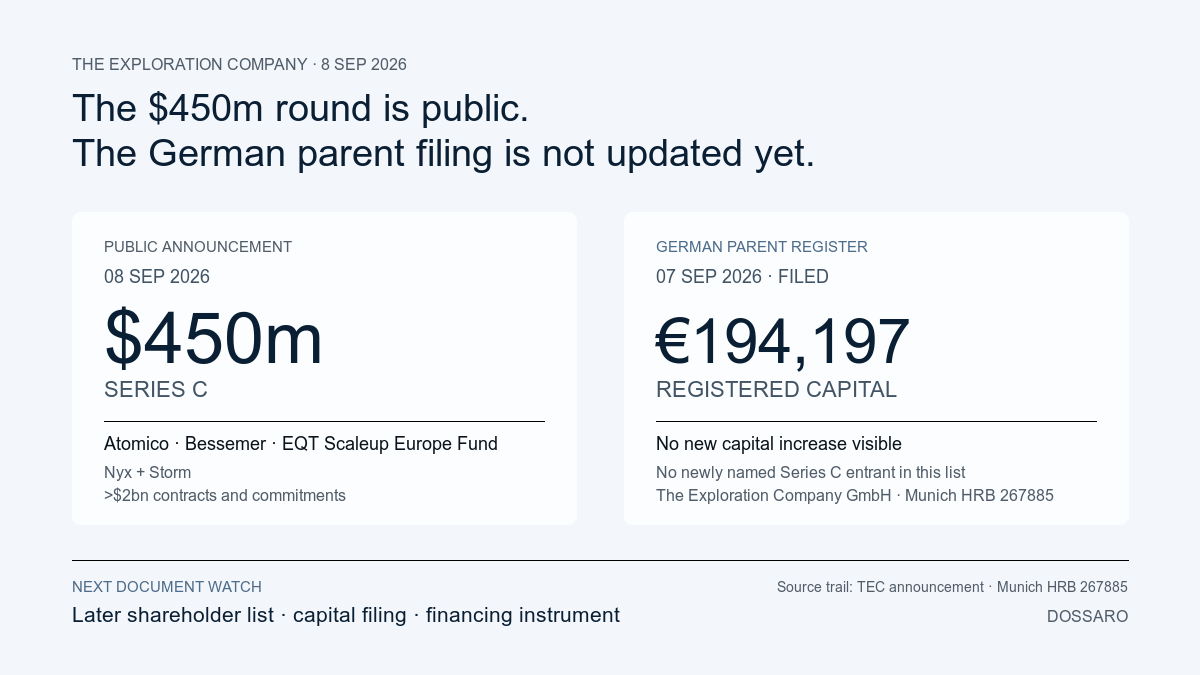
The Exploration Company’s $450 million Series C is a record-sized European space financing, but the latest shareholder list for its German parent still shows the legal state that preceded the announcement. The list was notarized on 3 September 2026 and filed on 7 September. It states €194,197 of registered capital and does not show a new capital increase or a newly named Series C investor.
That is a timing and entity finding, not evidence that the financing failed. The company announced the round on 8 September, saying it was co-led by Atomico, Bessemer and EQT’s Scaleup Europe Fund, with Balderton, Plural, Cherry Ventures and Red River West among existing backers. The public announcement and independent TechCrunch coverage establish the commercial event. The German filing establishes what had, and had not, appeared in the parent company’s equity record immediately beforehand.
For investors, suppliers and prospective partners, the distinction matters. A headline funding amount describes a financing event. A shareholder list describes the registered ownership state of one legal entity at one point in time. Until a later list, capital filing or instrument document connects the two, the new post-round ownership cannot be reconstructed from this German parent register alone.
A record round with a legal timing question
The company’s official announcement puts the financing at $450 million and calls it the largest Series C for a European space company. It says the capital will advance the Nyx reusable capsule and Storm reusable high-thrust LOX and biomethane engine. The same release cites more than $2 billion in contracts and commitments, 10 Nyx missions booked and total funding of approximately $680 million. It also says the business has more than 550 employees.
The independent account is consistent on the headline facts. TechCrunch reports the 8 September date, the $450 million size and the Atomico, Bessemer and EQT-managed Scaleup Europe Fund co-lead group. Tech.eu separately reports the round, the three co-leads, Bessemer partner Alex Ferrara joining the board, the Nyx and Storm programmes, and the company’s contract backlog. YPOG also confirmed its advice to Cherry Ventures on the financing.
The filing and announcement therefore answer different questions:
| Question | Public financing record | Latest German parent shareholder list |
|---|---|---|
| When? | Series C announced 8 September 2026 | List notarized 3 September and filed 7 September 2026 |
| How much? | $450m Series C; total funding about $680m | €194,197 registered capital; no new capital increase visible |
| Who? | Atomico, Bessemer and EQT Scaleup Europe Fund co-led; existing investors participate | Existing named holders remain; no newly named Series C entrant is identified |
| What changes? | Nyx, Storm and commercial scale are the stated use of funds | The legal parent baseline remains the latest registered holder map |
The table is not a contradiction in the narrow legal sense. It is a visible gap between a current commercial announcement and the most recent public parent-company ownership document.
What the 7 September list actually shows
The company imprint identifies the German entity as The Exploration Company GmbH and gives the Munich commercial-register number HRB 267885. The latest shareholder list uses that identity and states total capital of €194,197. Its notarial certificate says the changed entries were made under a 3 September deed and otherwise agree with the list created in March 2026.
The visible movements are small. Byway Capital SAS is shown with 2,861 shares, or 1.47325%, acquired from Hartwood JV SAS under a purchase deed dated 8 September 2025. The pooling vehicle is shown with 5,445 shares, or 2.80385%, compared with 5,245 in the March list. Those adjustments do not resemble a new $450 million primary issuance in the German parent.
The principal named holders in the latest baseline include Hélène Huby at 16.04659%, EQT Ventures III at 10.66237%, Orbital Ventures at 9.75813%, Balderton at 8.44297%, RRW II Growth at 7.10928%, Plural II at 4.70399% and Cherry Ventures IV at 4.3703%. These are legal percentages in the filed list. They are useful as a pre-Series-C reference point, but they are not a valuation, a post-money cap table or a statement of voting control.
The list also names Bessemer-related entities among the existing holders. That does not resolve the round timing. The document does not label any position as a new Series C allotment, identify a new issue price or state that a particular holder subscribed in the announced financing. The bounded conclusion is that no newly named Series C entrant or capital increase tied to the announcement is visible in this latest German parent list.
The announcement and the register run on different clocks
Private-company financings often have several legal steps. A round can be announced while subscription documents, conditions, regulatory approvals or a later shareholder list are still being processed. It can also be completed through a holding company, a subsidiary or an instrument whose conversion is registered later. The public sources do not say which explanation applies here.
That uncertainty should not be turned into a negative claim. The company says the financing was raised, the independent coverage repeats the amount and the legal adviser confirms involvement. The German list simply has an earlier filing position than the headline event. Even the small Byway and pooling changes show why legal-entity and document dates need to be read together: an entry can reflect a deed executed earlier, not the date on which a market announcement appears.
This is the same discipline needed in other private financings. In Ground A’s pre-seed, a register capital increase makes the new-share block measurable, but the filing still cannot price the round or establish preference rights. The Exploration Company currently presents the inverse problem: the commercial round is clear, while the matching parent-company share issuance is not yet in the accessible list. In INLEAP’s cumulative funding record, the value comes from reconciling several financing events rather than treating one announcement as the complete cap table.
Why the gap matters commercially
The money is intended to fund a business with unusually long execution cycles. Nyx is a reusable capsule designed for cargo missions, and the company says 10 missions are already booked. Storm is a reusable engine programme. More than $2 billion of contracts and commitments provide commercial context, but they do not specify how much is signed revenue, conditional work, customer deposits or future option value. The announcement does not provide that breakdown.
For a new investor, the missing registered update affects basic diligence questions. Which legal entity received the subscription? Were the proceeds issued as ordinary shares, preferred shares, a convertible instrument or a combination? Did existing holders take part pro rata? Do the round documents give the co-leads board, consent or preference rights that are not visible in a simple shareholder list? None of those questions can be answered from the €194,197 figure.
For commercial counterparties, the entity boundary is equally important. Contracts may sit with operating subsidiaries while financing sits at a parent. A buyer, lender or strategic partner needs to know which company owns the relevant intellectual property, employs the programme team and can grant the required security or approvals. The public announcement gives a group-level growth story. The register provides only one legal slice of that group.
The board appointment reported by TechCrunch and Tech.eu is a governance signal, but it is not a substitute for the legal financing terms. A director joining the board does not by itself establish voting control, investor consent rights or an ownership percentage. The same caution applies to the named funds: their participation in the public round does not let a reader assign a post-round stake without the issue terms.
What can and cannot be inferred
The evidence supports four firm statements. The Exploration Company announced a $450 million Series C on 8 September 2026. The announcement names Atomico, Bessemer and EQT’s Scaleup Europe Fund as co-leads and describes existing investors participating. The German parent is The Exploration Company GmbH, Munich HRB 267885. Its latest list, filed one day before the announcement, states €194,197 capital and carries forward the existing holder baseline with only small visible adjustments.
The evidence does not support a valuation, an exact dilution percentage, an issue price, an investor-by-investor post-money stake, a beneficial-ownership conclusion or a claim that the financing was not completed. It also does not show whether the round was legally issued at the German parent, another group company or through an instrument that will appear in a later filing. The register is a dated record, not a live transaction dashboard.
That boundary is useful rather than frustrating. It tells a diligence team where to focus instead of inviting a made-up cap table. It also prevents the opposite error: treating the unchanged €194,197 figure as proof that the round is merely promotional. The public and legal records can both be true because they describe different stages and entities.
The next filing should connect cash to rights
The next decision-changing document is a later German shareholder list or capital filing that names the Series C entrants. If the financing used convertibles or another instrument, the relevant subscription or conversion document may appear before the ownership percentages change. Articles of association, a shareholder agreement or a group-company filing could also explain where the $450 million sits.
Until that evidence is public, the strongest defensible reading is precise: The Exploration Company announced a very large Series C, but its latest German parent shareholder list still shows the €194,197 pre-round capital state. The gap is a legal-timing and entity question, not a verdict on the financing. For the next review, watch the Munich register for a new shareholder list, capital increase or instrument filing that connects the company’s commercial headline to registered rights.
Continue reading
Related Research
Ground A's €9.1m pre-seed leaves each founder at 22.75%
Ground A's €9.1m pre-seed created 31.75% of new shares, leaving each founder vehicle at 22.75% and Vsquared Ventures III at 14.17% in the latest register.
INLEAP’s €20m Funding Headline Was Cumulative; Founders Held 80% in the 2025 List
INLEAP says it has raised about €20m since founding, while its latest filed shareholder list shows founder holding companies with 80% and outside holders with 20%.
HyImpulse's €50m Round Lands on a 76.43% Holding Block
HyImpulse's €50m financing meets a register where HylImpulse Holding and Schwarz Holding held 76.43% before the round, leaving post-round control unresolved.
Arlequin's €28m Series A Follows a 31% Seed Issuance With Ratchet Protection
Arlequin's €28m Series A follows a 31% seed issuance with ratchet protection and a 279,500-BSPCE capacity, while price and new stakes remain undisclosed.