
Volta's $300m Raise Had A 30.5x Nominal Share-Price Ladder
Volta's $300m raise hid a 30.5x nominal price ladder from $58 Seed shares to $1,769.91 Series A stock, plus preferred rights and $2m of debt set-off.
On this page
Conduct your own private market research
Add dossaro to Claude or ChatGPT and run source-backed register research from your own workspace.
 Add to Claude
 Add to ChatGPT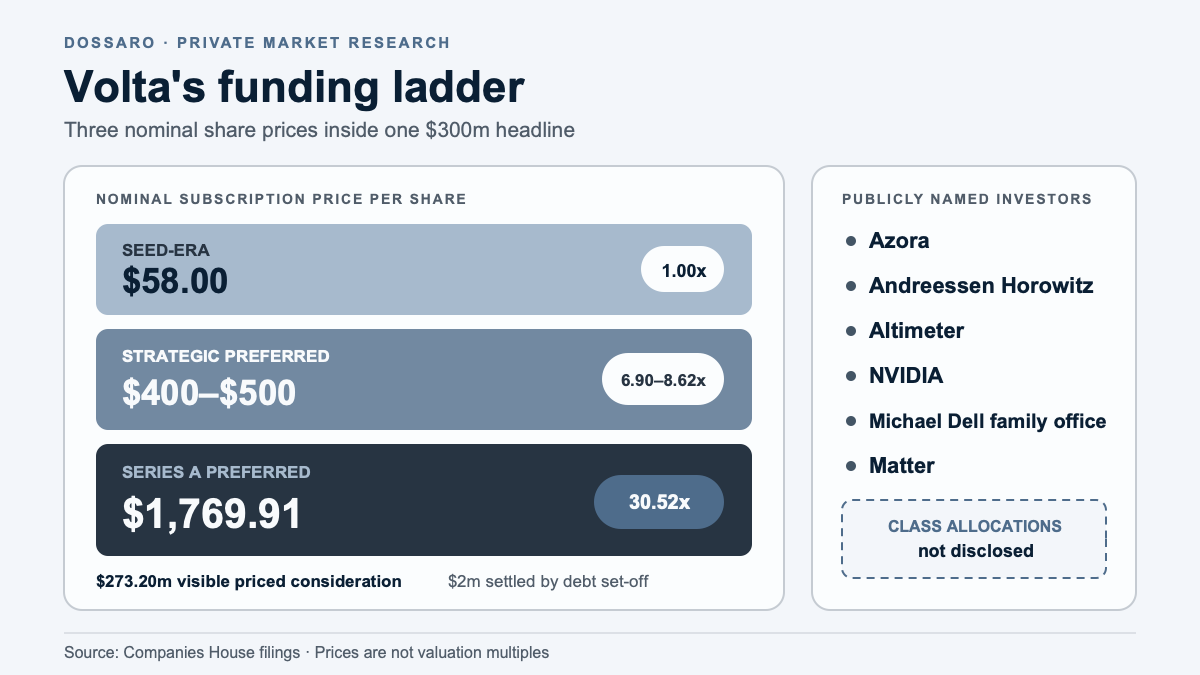
Volta Infrastructure Holdings' visible financing moved from $58 Seed-era shares to Series A shares priced at $1,769.9115. That is a 30.52-fold nominal subscription-price increase inside the company's announced $300 million Seed and Series A funding headline.
The middle of the ladder was just as important. Strategic Preferred shares appeared at $400 and $500 each before the July Series A issue. Across the priced allotments reconstructed from UK filings, Volta recorded about $273.20 million of consideration. At least $2 million of the early Preferred consideration was settled by cancelling debt already owed by the company rather than with fresh cash.
The result is not one economically uniform round. Early, strategic and late investors entered at different nominal prices and dates. Preferred capital also received downside and governance rights. The filings do not identify which publicly named investor bought which class, so the price ladder can be measured without assigning its benefits to an unsupported owner.
| Visible financing cohort | Nominal price per share | Timing in filed sequence | Price relative to $58 |
|---|---|---|---|
| Seed-era Preferred and B2 ordinary | $58.00 | 28 April to 5 June 2026 | 1.00x |
| Strategic Preferred | $400.00 to $500.00 | 25 June to 17 July 2026 | 6.90x to 8.62x |
| Series A Preferred | $1,769.9115 | 14 to 17 July 2026 | 30.52x |
The table measures filed prices, not a 30.52-fold increase in Volta's company valuation. Different classes can carry different conversion ratios and rights. It does show how sharply the nominal entry price rose as the company moved toward its public launch.
Three Price Cohorts Sat Inside One Funding Headline
Volta was incorporated in the United Kingdom on 9 January 2026. Its Companies House profile identifies an active private company whose registered activity is computer-facilities management.
Independent launch coverage reported that Volta emerged publicly on 5 August with about $300 million raised across Seed and Series A at a reported $2.4 billion valuation. The company also presented a multi-billion-dollar compute agreement and a separate infrastructure programme with Azora.
Volta's own site now states that it has more than $250 million of committed institutional capital. It describes a model built around power, entitled land and deployment-ready campuses, with a project pipeline above one gigawatt.
The filing history adds the sequencing missing from that launch story. Reading it through a UK Companies House filing workflow keeps each allotment and statement-of-capital document separate instead of flattening them into one round.
A replacement allotment return filed on 27 July records 256,552 Preferred shares and 10,431 B2 ordinary shares at $58 each. It also records 17,555 B2 ordinary shares at $140.33. A separate return adds another 350 B2 shares at $140.33.
The next stage moved to Strategic Preferred. On 25 June, 8,000 shares were priced at $400 and 155,000 at $500. Later allotments added another 80,000 Strategic Preferred shares at $500. The Series A then created 75,992 shares at $1,769.9115.
That sequence matters because timing changes risk. The $58 cohort entered while the company was newly formed and before the public launch. Strategic capital paid a much higher price. Series A paid the highest nominal price after Volta had advanced its financing and commercial story.
This resembles the repricing visible in Inforcer's Series C, where dated allotments exposed a sharp step-up hidden by a single funding announcement. Volta's spread is far larger, but the same discipline applies: share price is useful only when class rights and denominators are kept in view.
The Visible Priced Allotments Add Up To $273.20 Million
The allotments make most of the announced funding traceable. Multiplying each filed share count by its stated price produces $273,196,737.36 of visible priced consideration.
| Filed allotment group | Shares | Price per share | Calculated consideration |
|---|---|---|---|
| Preferred | 256,552 | $58.00 | $14.88m |
| B2 ordinary at first price | 10,431 | $58.00 | $0.60m |
| B2 ordinary at second price | 17,905 | $140.33 | $2.51m |
| Strategic Preferred at first price | 8,000 | $400.00 | $3.20m |
| Strategic Preferred at second price | 235,000 | $500.00 | $117.50m |
| Series A Preferred | 75,992 | $1,769.9115 | $134.50m |
| Visible priced consideration | $273.20m |
The reconstructed total sits $26.80 million below the rounded $300 million announcement. That is not evidence of missing cash. Earlier financing, rounding or instruments outside these visible priced allotments may explain the difference. A complete subscription schedule is needed before the announcement can be reconciled line by line.
One part of the visible total was explicitly not new cash. The replacement return says $2 million of the Preferred subscription price was satisfied by setting off debt Volta already owed. The rest of that consideration was cash.
Debt set-off can be an ordinary closing mechanic. A lender or early backer exchanges a claim against the company for equity, reducing debt while increasing share capital. Economically, it means the stated consideration and fresh bank-account inflow are not identical.
The distinction is material in an infrastructure business. Volta says it works at the capital-intensive layer of power, land and data-centre deployment. Readers assessing runway or construction capacity need to separate cash available for new projects from liabilities converted into equity.
Preferred Capital Bought More Than A Higher Share Price
The articles adopted on 25 June give preferred investors both downside and governance protections. On a distribution, preferred holders receive the greater of their preference amount or the proceeds available on an as-converted basis before ordinary shareholders receive the remainder.
That is not a guaranteed recovery. If the company has insufficient proceeds, contractual priority cannot create value that does not exist. It does put preferred capital ahead of ordinary holders in the distribution order while preserving upside when conversion produces the better result.
| Filed feature | Legal effect | Commercial reading |
|---|---|---|
| Preference versus conversion | Preferred receives the greater of its preference amount or as-converted proceeds | Downside priority plus equity upside |
| Preferred voting | Preferred votes on an as-converted basis | Governance influence accompanies the capital |
| B2 ordinary and Deferred shares | Described as non-voting | Share count alone does not measure voting power |
| Investor-consent provisions | Selected actions require investor approval | Control cannot be inferred from nominal ownership alone |
The June reorganisation adds another boundary. The filings show 400,000 existing Preferred shares becoming 400,000 Deferred shares while 400,000 Seed Preferred shares appeared. The safest reading is a class recapitalisation. It is not evidence that an investor lost its economic stake, nor that 400,000 new cash-funded shares were issued.
This is why a simple cap-table denominator would be misleading. Volta's capital includes voting and non-voting shares, preferred protections and class changes. A proper valuation comparison needs the conversion terms and the fully diluted share count attached to each financing date.
The Investor Names Are Public, Their Classes Are Not
Public coverage names a high-profile investor group around Volta. The register evidence reviewed here does not allocate that group across Seed, Strategic and Series A.
| Publicly named investor | Public role in the Volta story | What the reviewed filings do not show |
|---|---|---|
| Azora | Investor and infrastructure-programme partner | Share class, count or price |
| Andreessen Horowitz | Named investor | Share class, count or price |
| Altimeter | Named investor | Share class, count or price |
| NVIDIA | Named strategic investor | Share class, count or price |
| Michael Dell's family office | Named investor | Share class, count or price |
| Matter | Named investor | Share class, count or price |
The names matter because they identify the institutions and strategic parties around the business. They do not answer who received the cheapest entry price, who paid the Series A price or who holds the strongest consent rights.
Assigning those economics by reputation would be tempting and wrong. A strategic partner need not own Strategic Preferred. A publicly described lead need not hold every share in the latest class. Nominee vehicles can also obscure the economic holder until the register of members or a subscription schedule becomes public.
A 30.52x Share-Price Ratio Is Not A 30.52x Valuation Jump
The strongest counter-reading is also the most important technical limit. A $58 Seed share and a $1,769.9115 Series A share are comparable as nominal subscription prices, but not automatically as equal slices of the company.
Conversion ratios, anti-dilution terms, option pools, share subdivisions and recapitalisations can change how much ownership each share represents. The Series A may also have been priced after milestones that materially reduced commercial risk. Paying more after de-risking is the ordinary logic of staged venture finance.
Volta's rapid development makes that logic plausible. The company moved from incorporation in January to institutional allotments in spring and a public launch in August. During that period it presented a large infrastructure pipeline and a major customer contract. Later investors could rationally pay more because the probability and scale of a commercial outcome had changed.
The price ladder still deserves attention. A 30.52x nominal spread across a few months is large enough that investors, employees and potential counterparties should not treat the $300 million as one undifferentiated block. Each cohort bought a different point on the risk curve.
The Member Register Will Show Who Bought Each Risk Layer
Two documents would turn this class-level reconstruction into owner-level economics.
The first is the post-financing register of members or confirmation statement. It should identify which legal holders own the Seed, Strategic and Series A shares. The second is the subscription schedule. It should reconcile the announced $300 million across cash, the $2 million debt set-off, earlier financing and any instruments not visible in the priced allotments.
Those records would answer who benefited from the $58 entry price, who paid $1,769.9115, and whether strategic partners hold different rights from financial investors. They would also make a reliable fully diluted valuation comparison possible.
Until then, the durable finding is narrower. Volta's announced $300 million spans at least three nominal price levels, most of it can be reconstructed from public allotments, and preferred capital received more than a headline valuation. The financing moved risk and price sharply between cohorts, but the owner names behind each cohort remain the next disclosure.
Continue reading
Related Research
Inforcer Doubled Its Implied Valuation As Old Shares Entered Series C
Inforcer's filed Series C nearly doubled its implied value in nine months, while one-third of the preferred class came from existing ordinary shares.
Greyparrot's Series B Shifts A Sub-£120m Sale Shortfall To Founders
Greyparrot's filed terms protect Series B as if a founder-led sale valued the company at £120m, with any shortfall deducted from founder proceeds.
CuspAI's Founders Held 32.61% Before The $450m Series B
CuspAI's founders held 32.61% before its $450m Series B, while UK sovereign capital entered a company whose post-round ownership is not yet public.
9fin Authorised 139,527 Shares for Its Employee Secondary
9fin authorised 139,527 existing shares for its employee secondary, implying £7.45m at the Series C price before conversion into preferred stock.