
9fin Authorised 139,527 Shares for Its Employee Secondary
9fin authorised 139,527 existing shares for its employee secondary, implying £7.45m at the Series C price before conversion into preferred stock.
On this page
Conduct your own private market research
Add dossaro to Claude or ChatGPT and run source-backed register research from your own workspace.
 Add to Claude
 Add to ChatGPT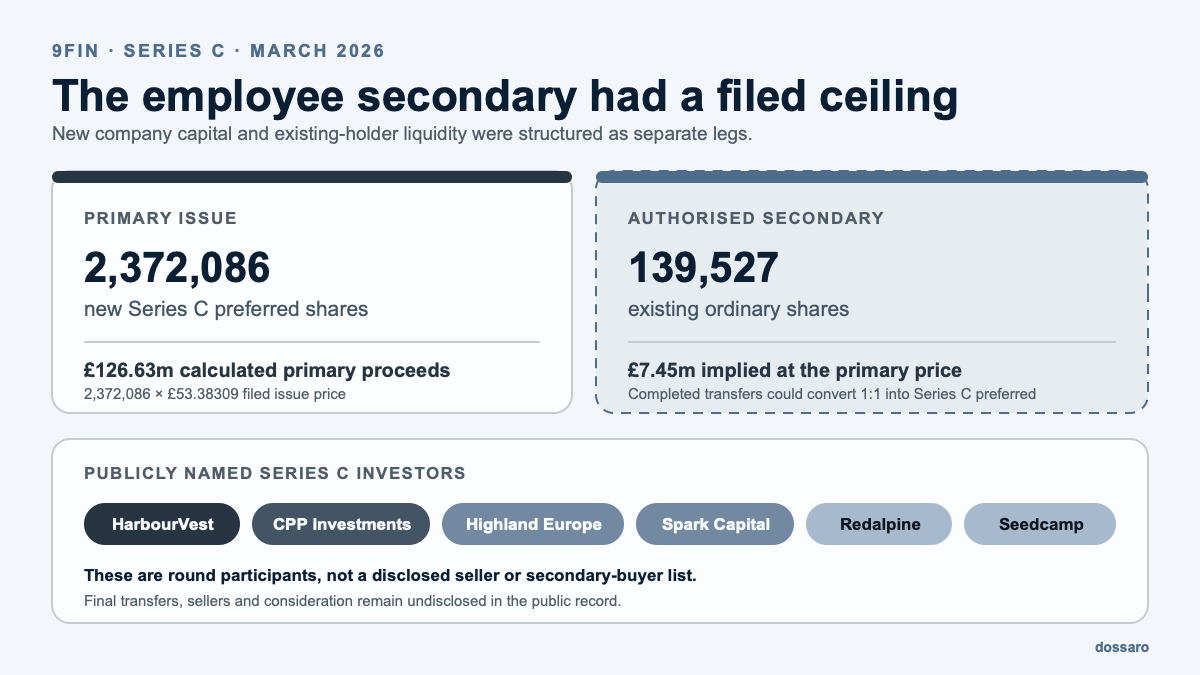
Source record available
9FIN LIMITED · 10451957
Open the legal identity and 3 reviewed filings behind this analysis.
9fin authorised up to 139,527 existing ordinary shares for its first employee secondary, then gave completed transfers a route into the new Series C preferred class. At the £53.38309 price paid for each newly issued Series C share, the authorised block implies £7.45 million of potential seller liquidity.
That figure is an inference, not a disclosed purchase price. The resolutions make each redesignation conditional on a completed transfer, stamped documents or tax approval, and delivery of the seller's certificate or an indemnity. They do not reveal how many shares ultimately moved, who sold them or what buyers paid.
The filing still changes the economic reading of 9fin's first employee share sale. This was not simply an informal option for staff to cash out. It was a separately authorised transaction alongside a large primary raise, and buyers could receive the transferred shares with the new preferred-share protections.
| Transaction leg | Filed or public amount | Economic effect |
|---|---|---|
| New Series C preferred shares | 2,372,086 shares at £53.38309 | £126.63m of calculated primary subscription proceeds for the company |
| Initial Secondary Sale authorisation | Up to 139,527 existing ordinary shares | Potential liquidity for existing holders, subject to completed transfers |
| Same-price illustration | £7.45m | Implied value only if the secondary matched the primary issue price |
| Relative scale | 5.88% of the primary Series C share count | A meaningful but bounded liquidity leg beside the new-money round |
The table separates money for the company from money potentially paid to existing holders. The $170 million fundraising headline is not interchangeable with the £126.63 million calculated from the UK allotment, but the filing lets readers see the primary and secondary mechanics separately.
The Secondary Was Built Into the Series C
The sequence is unusually clear in 9FIN LIMITED's Companies House filing history. Written resolutions circulated on 16 March 2026 and passed on 18 March created the Series C preferred class, authorised the primary allotment and waived existing transfer pre-emption rights for up to 139,527 shares.
On 20 March, the company allotted 2,372,086 new Series C preferred shares at £53.38309 each. Multiplying the filed count by the issue price gives £126,629,280.43 of primary proceeds.
Resolution 4 dealt with the other side. Existing ordinary shares transferred in the Initial Secondary Sale could be redesignated one for one as Series C preferred shares after the required transfer documents were received. Resolution 5 waived transfer restrictions for up to the same 139,527-share ceiling.
The commercial consequence is straightforward. Sellers could turn part of an illiquid private-company position into cash. Buyers did not have to remain exposed to the legacy ordinary-share economics after completion. They could receive the same new class created for the round.
That pairing also distinguishes 9fin from a transaction where employees simply sell ordinary stock and buyers accept its existing position in the waterfall. A similar separation between new money and existing-holder liquidity appears in Dossaro's analysis of Dwelly's mixed financing stack, although the disclosed mechanics are different.
The Public Round Names Seven Capital Sources
9fin's Series C announcement names HarbourVest as lead and CPP Investments as a participant, alongside existing investors Highland Europe, Spark Capital, Redalpine and Seedcamp. The British Business Bank separately said it invested $20 million as part of the round in partnership with Redalpine.
| Publicly named capital source | Disclosed Series C role |
|---|---|
| HarbourVest | Lead investor |
| CPP Investments | Participant and existing 9fin client |
| Highland Europe | Participating earlier investor |
| Spark Capital | Participating earlier investor |
| Redalpine | Participating earlier investor; British Business Bank partner |
| Seedcamp | Participating earlier investor |
| British Business Bank | $20m investment announced as part of the round |
These are the publicly named sources of Series C capital. The announcements do not allocate the 139,527 secondary shares among them, so the table is not a list of secondary buyers or current ownership percentages.
The Resolutions Name 55 Shareholders and Vehicles
The written resolutions provide a different list. They identify the members entitled to vote when the document circulated in March 2026. That makes the filing useful for finding named shareholders and shareholder vehicles around the round, including both founders, earlier investors and many individuals.
It does not make any of them a confirmed seller. The resolutions include a seller-neutral transfer authorisation and no seller-by-seller schedule.
| Member type | Names shown in the March 2026 resolutions |
|---|---|
| Institutional and investment vehicles | Redalpine Capital VI; Redalpine Venture Partners; Redalpine Summit Fund; Seedcamp III LP; SC Nation I LP; 500 Startups IV LP; Al Seed Nominees Limited for AI Seed Fund; Hut 8 Management Limited; LCIF LLP; Fly Ventures Fund I; Al Seed Ltd; Deep Tech Investment Ltd; Ilavska Vuillermoz SCA SICAV RAIF; Ilavska Vuillermoz XII SCS; Spark Capital VII LP; Spark Capital Founders' Fund VII LP; Highland Europe Technology Growth V LP; 9F Fund I |
| Individuals | Steven Hunter; Hussam El-Sheikh; Nick Smith; Kristian Brauten-Smith; Sebastian Potocean; Paul Forster; Vanessa Gibson Post; Bruce MacKenzie; Ahmed Husain; Sanjeev Jeyakumar; Jonathan Cochrane; James Gozney; Nikhil Shah; Sarang Karkhanis; Sarah Warhurst; Anne Sophie Moinade; Nazar Sharif; Richard Holden; Alan Morgan; Claus Jorgensen; Henriane Mourgue d'Algue; Pranav Garg; Ka Wun Nicolle Liu; Morgan Muranyi; Huw Simpson; William Caiger-Smith; Jainisha Amin; Benjamin Dickerman; Ryan Fuentes; Elijah Jackson; Jacob Laxton; Will Macadam; Fin Strathern; Marcela Vega; Sami Vukelj; Aino Makisalo; Omer Hashmi |
The register document therefore offers a substantial ownership lead list. It does not show each member's percentage, distinguish employee holders from other individuals or establish which names remain on the cap table after the secondary. Those questions require later shareholder records or the transfer agreements.
For researchers, this is exactly why the underlying UK Companies House document trail matters. A funding announcement names the round investors. The corporate resolutions can expose the wider member base that had legal voting rights when the transaction was approved.
Preferred Conversion Improved the Buyer Position
Calling the transferred block “employee shares” describes its origin story, not necessarily the economics buyers held after completion. The resolutions say transferred ordinary shares were to be redesignated into Series C preferred shares on a one-for-one basis.
Preferred shares can affect who gets paid first in a downside or exit scenario. 9fin's filed share particulars place the new Series C class ahead of earlier preferred and ordinary classes in the liquidation sequence. The economic choice is therefore asymmetrical: an existing holder can sell ordinary shares for liquidity, while a buyer can receive the new senior security after the transfer closes.
That does not show an unfair price or prove that employees received worse terms. The sale was optional, and 9fin says it covered administration costs and offered independent financial advice. The structure is notable because it solved two objectives at once: employee liquidity and investor protection.
The Primary Capital Still Carried the Larger Burden
The company's 2025 accounts show why the primary financing mattered. Revenue more than doubled, but 9fin was still consuming cash and reporting a large loss before the Series C.
| 2025 group financial measure | Filed result |
|---|---|
| Revenue | £31.4m, up 114% |
| Pre-tax loss | £21.09m |
| Operating cash outflow | £11.71m |
| Year-end cash | £26.87m |
The secondary did not fund that operating requirement. Money paid for transferred existing shares would go to sellers, while primary subscription money went into the company. Even at the same-price illustration, the £7.45 million secondary ceiling was less than 6% of the calculated £126.63 million primary issuance.
This supports a balanced reading. 9fin gave eligible staff a route to realise some private-company wealth, while keeping the dominant transaction leg focused on the company's growth and cash needs. Sifted reported that more than half of eligible staff participated, but the public documents do not connect that participation rate to the full authorised share block.
The Seller List Is the Missing Document
The most important unresolved evidence is not another funding announcement. It is the secondary paperwork referenced by the resolutions.
Stamped stock-transfer forms or the share purchase agreements would identify who sold, who bought, how many shares completed transfer and what consideration changed hands. Until those documents appear, £7.45 million should remain an implied same-price ceiling, not a reported payout.
The public record already establishes the transaction's architecture: up to 139,527 old shares, a one-for-one route into Series C preferred, and a secondary leg equal to 5.88% of the newly issued Series C count. The next disclosure will decide whether that authorised opportunity became the full employee-liquidity event suggested by the headline.
Continue reading
Related Research
Dwelly's $170m Round Mixed Founder Liquidity With Secured Debt
Dwelly's filings show £44.3m of new Series B cash, 19,406 founder shares sold to EQT and General Catalyst, and Trinity secured across the business.
Inforcer Doubled Its Implied Valuation As Old Shares Entered Series C
Inforcer's filed Series C nearly doubled its implied value in nine months, while one-third of the preferred class came from existing ordinary shares.
Salesforce Raised Its SPREAD Stake Through A Founder Secondary
German shareholder lists show Salesforce acquired 612 existing SPREAD shares from two founder vehicles, raising its stake from 5.5% to 6.7% without new capital.
Greyparrot's Series B Shifts A Sub-£120m Sale Shortfall To Founders
Greyparrot's filed terms protect Series B as if a founder-led sale valued the company at £120m, with any shortfall deducted from founder proceeds.