
Dwelly's $170m Round Mixed Founder Liquidity With Secured Debt
Dwelly's filings show £44.3m of new Series B cash, 19,406 founder shares sold to EQT and General Catalyst, and Trinity secured across the business.
On this page
Conduct your own private market research
Add dossaro to Claude or ChatGPT and run source-backed register research from your own workspace.
 Add to Claude
 Add to ChatGPT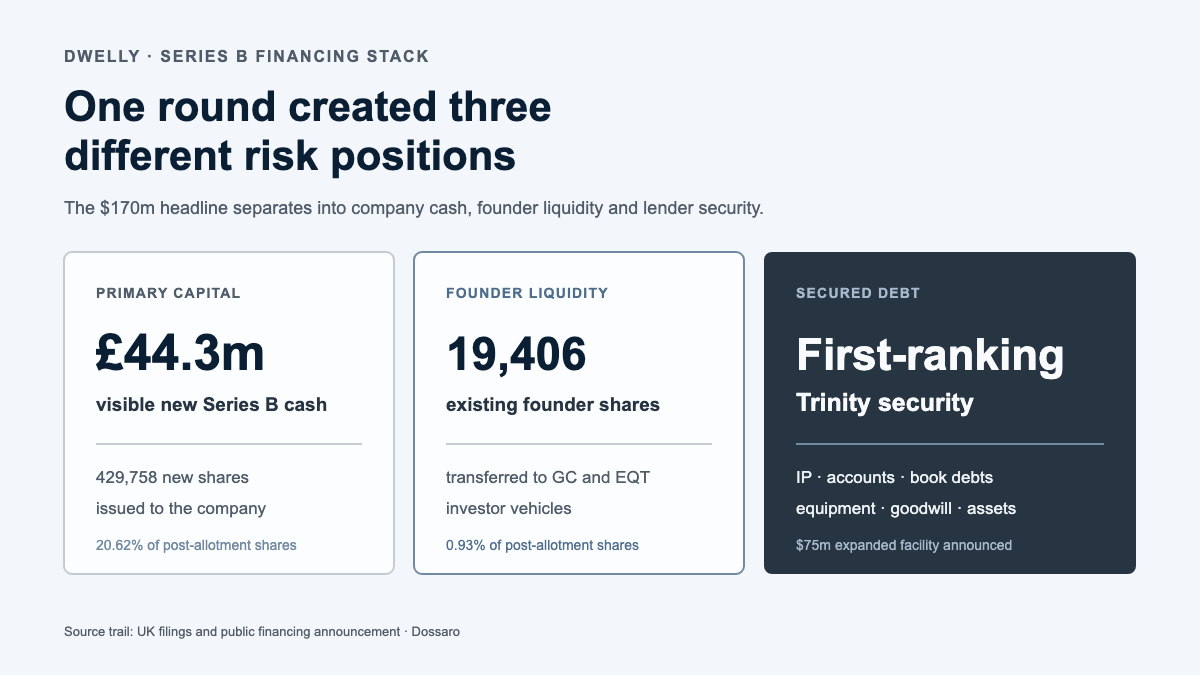
Dwelly's $170 million Series B combined three different economic outcomes. The property-management roll-up announced $95 million of equity and a $75 million Trinity Capital debt facility. UK filings show that the equity leg included £44.3 million of newly issued shares for the company, while 19,406 existing founder shares moved to vehicles linked to General Catalyst and EQT.
Trinity occupies a third position. An outstanding charge gives the lender first-ranking security over intellectual property, accounts, investments, book debts, equipment, goodwill and most of the remaining undertaking.
The financing therefore does more than fund acquisitions. It puts new cash into the company, gives founders a bounded amount of liquidity and protects the lender with claims over the operating asset base. Those three uses of capital carry different beneficiaries and different downside positions.
| Financing component | Public or filed amount | Immediate economic effect |
|---|---|---|
| Equity headline | $95m | Publicly described equity round led by EQT Growth and General Catalyst |
| New Series B shares visible in the filing | £44.29m | Cash issued to the company for 429,758 new shares |
| Existing founder shares transferred | 19,406 shares | Liquidity for selling founders; no new cash for the company |
| Trinity debt facility | $75m | Debt capital supported by broad security over operating assets |
The table separates the headline into its economic functions. The £44.29 million filing figure is not a conversion of the $95 million headline. It is the cash amount directly implied by the latest visible share allotment, and it does not reconcile the whole announced equity total by itself.
The Filed Equity Includes A Small Founder Sale
Prospire Technologies Ltd is the UK company behind Dwelly's group. On 31 March, its shareholders authorised transfers of 19,406 founder ordinary shares to General Catalyst Group XII Creation, L.P. and EQT's EG2 SPV Sarl. Those shares were then redesignated one for one as Series B preference shares.
The transfer matters because money paid for an existing share goes to the seller, not to the company. It created founder liquidity alongside the primary financing, but the scale is bounded.
Between 10 and 15 April, Prospire issued 429,758 new Series B shares for cash at £103.0495 each. That multiplication produces £44,286,347 of primary cash. The allotment took the company's issued share count to 2,084,056.
| Series B formation | Shares | Share of post-allotment total | Reading |
|---|---|---|---|
| Newly issued Series B | 429,758 | 20.62% | Primary capital for Prospire |
| Transferred founder shares | 19,406 | 0.93% | Secondary liquidity for founders |
| Resulting Series B block | 449,164 | 21.55% | New and transferred shares in the same class |
The founder sale represented 4.32% of the resulting Series B block and less than 1% of all post-allotment shares. Calling the transaction a founder cash-out round would exaggerate it. The more precise conclusion is that EQT and General Catalyst paired a large primary subscription with a small secondary component.
The filed articles also define a founder "Liquidity Portion" equal to 15% of founders' post-subscription holdings. That provision indicates that some founder liquidity was designed into the financing framework. It does not establish that the full 15% was sold in the transfers visible here or disclose how the 19,406 shares were divided among individual founders.
£44.3m Does Not Reconcile The Full Equity Headline
EQT's investment rationale presents the financing as a $170 million Series B, while independent coverage breaks it into $95 million of equity and a $75 million Trinity facility. The April allotment establishes £44.29 million of new cash at the UK parent, plus the 19,406-share secondary transfer. It does not explain the complete public equity figure.
A later closing, another security, a currency and timing convention, or an amount committed outside the visible allotment could bridge the difference. None is established by the current filing set. The headline should therefore not be called false, and the gap should not be labelled an undisclosed secondary sale.
This distinction matters for acquisition capacity. Dwelly buys independent letting agencies and moves their operations onto an artificial-intelligence platform. Primary equity can pay purchase prices, integration costs and hiring. Secondary proceeds do not expand the company's acquisition budget.
The governance record also points to continuity rather than an EQT takeover of the board seat. General Catalyst's Jeannette zu Fürstenberg ceased as a director on 17 July and Zeynep Yavuz was appointed the same day. Public biographical material identifies Yavuz with General Catalyst. Nils Petter Nygaard of EQT had joined the board in April.
Trinity Secured The Operating Asset Base
The debt leg changes the downside map. Prospire registered an outstanding charge in favour of Trinity Capital in January, months before the July financing announcement. The charge uses first fixed security across the assets that make the roll-up function, plus a first floating charge over the remaining undertaking.
| Charged asset group | Why it matters to Dwelly's model |
|---|---|
| Intellectual property and goodwill | Protects claims over the software, brand and integration platform |
| Accounts, investments and book debts | Reaches cash flows and receivables generated across the group |
| Equipment and authorisations | Covers operational infrastructure and regulated permissions |
| Remaining undertaking and assets | Floating security captures assets outside the fixed-charge list |
Companies House records the charge as outstanding and names Trinity Capital Inc. as the person entitled. The instrument also gives the secured party enforcement rights that include appointing an administrator.
The charge predates the announcement, so its existence alone does not prove that the January instrument was created for the entire newly reported $75 million. Public coverage describes the debt as an expanded Trinity facility. The durable point is that the lender's security was already attached to the operating company when the new financing was announced.
That makes the debt materially different from venture equity. If the roll-up underperforms, secured claims are addressed before shareholder value. The precise recovery would depend on asset value, other liabilities and the facility terms, but ordinary shareholders bear residual risk after debt and the preference economics attached to the Series B.
This is the same capital-stack distinction that shaped Dossaro's analysis of FINN's mix of venture equity, fleet debt and asset-backed funding. A large funding total says little about risk until each pool is matched to its repayment source and legal priority.
The Round Redistributed Risk As Well As Capital
The three legs solve different problems. New Series B cash finances the company's acquisition plan. The founder transfer converts a small part of existing ownership into liquidity. Trinity's facility adds purchasing power without issuing more shares, but places operating assets inside the lender's collateral perimeter.
| Stakeholder | Position created or strengthened | Principal exposure |
|---|---|---|
| Prospire Technologies | £44.29m of visible primary Series B cash | Must deploy capital into acquisitions and integration |
| Selling founders | Liquidity on 19,406 transferred shares | Retain exposure on unsold holdings; sale prices remain private |
| Series B investors | Preference, anti-dilution and transfer protections | Equity remains junior to creditors |
| Trinity Capital | Broad first-ranking security | Recovery depends on collateral value and enforceability |
| Earlier ordinary holders | Residual upside in the larger group | Dilution and lower priority in a weak outcome |
The commercial logic is straightforward. A buy-and-build company needs both equity that can absorb acquisition risk and debt that can scale purchasing capacity. Letting-agency revenue can be recurring, while software may improve margins after integration. Those characteristics can support leverage.
They also create an execution dependency. Dwelly must keep acquired agencies, landlords and tenants on the platform while integrating systems and centralising operations. If that process consumes more cash or produces less recurring income than planned, the all-asset security gives Trinity a structurally stronger claim than shareholders.
The Next Filing Must Reconcile The $95m Equity Figure
The next decision-changing evidence is a later allotment, confirmation statement or subscription schedule. It would show whether more primary shares were issued after April, how the Series B was divided between EQT and General Catalyst, and whether another instrument bridges the difference to the announced $95 million.
The investment agreement would answer a second question: how the Series B preference operates across different exit values. The current filings establish that preference and anti-dilution rights exist, but not a reliable quantified distribution for every scenario.
Researchers can preserve that evidence sequence through Dossaro's UK Companies House source page, connecting later capital filings to the existing charge rather than treating the round as one undifferentiated number.
Dwelly has raised capital on a scale that can change the UK lettings market. The sharper financing conclusion is narrower. At least £44.29 million of new Series B cash is visible at the company, founders sold 19,406 shares into the same class, and Trinity holds security over the assets meant to turn acquisitions into a platform. The next filing must show how the rest of the equity headline fits around those three proven positions.
Continue reading
Related Research
FINN's €140m Round Shows The Financing Stack Behind A Mobility Unicorn
FINN's 2025 shareholder lists show a 17.2% wider share base, Planet First's 18.8% block and a new Picus vehicle before the €140m Series D round.
Modo Energy Put Its Brands Behind $17m Of Venture Debt
Modo Energy called CIBC's $17m package growth funding. UK charges show fixed and floating security over its business and two core trademarks.
Greyparrot's Series B Shifts A Sub-£120m Sale Shortfall To Founders
Greyparrot's filed terms protect Series B as if a founder-led sale valued the company at £120m, with any shortfall deducted from founder proceeds.
Salesforce Raised Its SPREAD Stake Through A Founder Secondary
German shareholder lists show Salesforce acquired 612 existing SPREAD shares from two founder vehicles, raising its stake from 5.5% to 6.7% without new capital.