
Modo Energy Put Its Brands Behind $17m Of Venture Debt
Modo Energy called CIBC's $17m package growth funding. UK charges show fixed and floating security over its business and two core trademarks.
On this page
Conduct your own private market research
Add dossaro to Claude or ChatGPT and run source-backed register research from your own workspace.
 Add to Claude
 Add to ChatGPT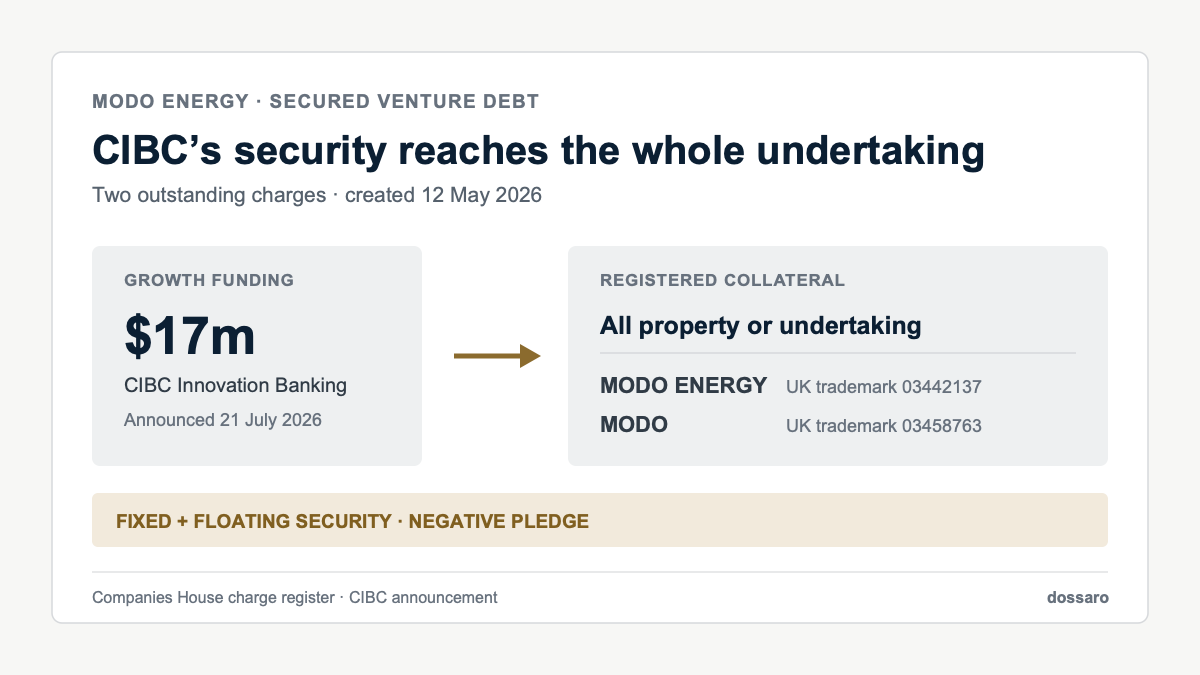
Modo Energy's $17 million growth-funding package is secured venture debt that puts Canadian Imperial Bank of Commerce ahead of equity against a broad pool of company assets. Two charges registered in May give the bank fixed security, a floating charge over Modo Energy's undertaking and negative pledges. One charge specifically names the company's two core trademarks.
That changes the commercial reading of the July announcement. Modo Energy gained capital for its platform, sales operation and expansion without publicly announcing another equity issue. CIBC gained a senior secured position over the operating company, including the MODO ENERGY and MODO brands.
The arrangement can preserve shareholders' percentage ownership today. It also moves more downside protection to the lender and can narrow the company's freedom to grant competing security later.
| Public financing message | Registered financing structure | Decision-relevant consequence |
|---|---|---|
| $17m growth-funding package | Two outstanding CIBC charges | The capital carries lender protections, not only a growth mandate |
| Investment in platform, sales and marketing | Fixed and floating security | CIBC has claims against charged assets if repayment fails |
| Largest single commitment secured by Modo Energy | Floating charge over all property or undertaking | The security reaches beyond one isolated asset |
| Total funding raised stated as $52m | Draw, pricing and maturity not public | The headline cannot be converted into current debt or cash without the credit agreement |
The table does not turn growth capital into a distress signal. Broad security is common in venture debt. It does show the financing trade that the announcement leaves mostly implicit: Modo Energy avoids immediate dilution from this instrument, while CIBC receives contractual protection that ordinary shareholders do not have.
CIBC Took Security Over The Business And Its Brands
Companies House lists two Modo Energy charges, both created on 12 May 2026, delivered two days later and still outstanding at the evidence cutoff. Canadian Imperial Bank of Commerce is the person entitled under each charge.
Charge 1199 8983 0001 contains the broadest public description. It includes fixed and floating charges, says the floating charge covers all the company's property or undertaking and contains a negative pledge. It also identifies the MODO ENERGY trademark under UK registration UK00003442137 and the MODO trademark under registration UK00003458763.
Charge 1199 8983 0002 also contains a fixed charge and negative pledge. Its public charge page gives no brief description of the charged asset. The existence of two registrations should not be read as two separate $17 million advances. The public record does not state what obligation the second charge secures or how the two instruments interact.
| Registered protection | Publicly visible scope | What it means commercially |
|---|---|---|
| Fixed charge | Present in both charges | CIBC has security tied to assets covered by the charging instruments |
| Floating charge | All property or undertaking under charge 0001 | Security can extend across the changing operating asset pool |
| Trademark security | MODO ENERGY and MODO named in charge 0001 | The lender's collateral package specifically reaches the company's brands |
| Negative pledge | Present in both charges | Modo Energy has agreed restrictions on granting competing security |
| Outstanding status | Both charges outstanding | No satisfaction or release was visible at the cutoff |
A fixed charge generally attaches to identified assets and limits how they can be dealt with outside the agreed terms. A floating charge follows a changing class of assets and can crystallise under specified circumstances. The negative pledge is another layer of protection because it restricts the borrower from weakening the lender's position with later security.
The exact rights still sit in the charging instruments and credit agreement. The register is enough to establish breadth, creditor identity and current status. It is not enough to calculate CIBC's eventual recovery or Modo Energy's covenant headroom.
The Security Predated The Public Announcement
CIBC announced the financing on 21 July, more than two months after the charges were created. CIBC's release calls the package the largest single commitment Modo Energy has secured and says it brings total funding raised to $52 million.
The earlier registration does not by itself prove when cash was drawn. It does show that the legal security was in place well before the funding story reached a wider audience.
| Date | Public event | What the evidence establishes |
|---|---|---|
| 12 May 2026 | Two CIBC charges created | Security instruments agreed at company level |
| 14 May 2026 | Both charges delivered to Companies House | Fixed, floating and negative-pledge features enter the public record |
| 21 July 2026 | CIBC announces $17m package | Lender, headline amount and stated growth use become public |
| 22 July 2026 | Independent funding coverage | Amount and expansion plan receive external confirmation |
| 29 July 2026 | Evidence cutoff | Both charges remain shown as outstanding |
The timing matters for due diligence. A funding announcement is a starting point, not a complete description of the instrument. In UK company research, the Companies House evidence workflow can expose registered creditor rights that sit behind the public capital narrative.
Venture Debt Preserved Equity And Reordered Downside
Modo Energy had completed a Series B six months before the CIBC package, according to the lender's announcement. CIBC describes Molten Ventures as the Series B lead and MMC as a follow-on investor. Choosing debt after that equity financing can extend the company's runway without issuing another publicly visible block of shares.
That is the founder and shareholder benefit. Existing holders keep their registered percentages unless other equity transactions occur. The cost is not visible dilution but a debt claim with priority against charged assets.
If the company performs and repays, shareholders retain the upside after interest, fees and principal. If the company cannot repay and the security is enforced, CIBC can look to the charged asset pool before equity receives residual value. Actual priority and recovery would still depend on the full documents, asset values, insolvency costs and any competing claims.
This is the same reason instrument labels matter in other private-company financings. Dossaro's analysis of Humanoid's founder loans beside its Series A separated capital that increased creditor claims from capital that changed ownership. Modo Energy presents the cleaner version of that trade: a bank facility that protects ownership percentages while establishing senior security.
The two trademark references make the structure unusually legible. Modo Energy describes itself as a benchmarking and valuation platform for energy storage and renewable assets. For a data and analytics company, the brands, software, contracts and wider undertaking can matter more than physical plant. The register specifically confirms that the collateral perimeter is not limited to equipment or receivables.
It does not disclose the value of those assets. A registered security interest is not a valuation, and a trademark name in a charge does not show how much a buyer would pay in an enforcement. The filing reveals which economic claims were protected, not what they would recover.
The Growth Case Still Has To Carry The Debt
Modo Energy and CIBC say the capital will be used to invest in the platform, expand sales and marketing, hire across a team of more than 75 people and enter new markets. CIBC says the company operates across 15 energy markets, serves more than 200 companies in 30 countries and has supported financing for more than $3.8 billion of assets.
Those operating figures are company and lender statements. They describe the growth case behind the facility, but they do not reveal revenue, cash generation or the debt-service burden.
EU-Startups independently reported the €14.9 million equivalent and $17 million amount on 22 July. It also repeated the planned platform investment and commercial expansion. Neither that report nor CIBC's release provides an interest rate, maturity, amortisation schedule or covenant thresholds.
That missing information decides whether the facility is flexible runway or a tight operating constraint. A company can benefit from non-dilutive capital and still face meaningful refinancing, liquidity and consent risk. The answer depends on how much is drawn, when repayment begins and what performance tests apply.
The negative pledges add another underwriting question. They can protect CIBC from later secured creditors, but the public pages do not show permitted-security baskets, ordinary-course exceptions or lender consent mechanics. It would be too strong to say Modo Energy cannot raise more debt. It is fair to say future secured financing now has to work around an existing package.
The Credit Agreement Must Price The Trade
The public record establishes the central financing consequence. CIBC supplied a $17 million growth package and registered broad security over Modo Energy, including its undertaking and core trademarks. Equity holders avoided a visible new share issue from this transaction, but they now sit behind a secured bank in the downside case.
The next documents need to convert that structural conclusion into a priced risk assessment.
| Next document | Decision-relevant answer |
|---|---|
| Credit agreement | Interest, fees, maturity, draw conditions and repayment schedule |
| Full charging instruments | Exact fixed-charge assets, enforcement triggers and interaction between the two charges |
| Covenant schedule | Performance tests, headroom and lender-consent requirements |
| Next annual accounts | Debt drawn, cash balance, finance cost and use of proceeds |
| Amendment or satisfaction filing | Whether the package was changed, reduced or repaid |
Until those documents appear, the safe conclusion is neither that Modo Energy raised $17 million of ordinary growth equity nor that its secured financing signals distress. It raised bank-backed growth capital against a broad collateral package.
For investors, that distinction changes the closing question. The headline asks how quickly Modo Energy can expand its platform. The financing structure asks whether that expansion will generate enough cash and enterprise value to keep CIBC's senior claim protective rather than decisive.
Continue reading
Related Research
Humanoid's $152m Round Recapitalises A Business With £50.5m Of Founder Loans
Humanoid raised $152m after ending 2025 with £43.5m of net liabilities and £50.5m in founder loans, while its founder appeared to retain 53% of ordinary shares.
QUICKBLOCK's £940k Funding Was Also A Recapitalisation
QUICKBLOCK raised £940,000 after reporting £534,213 of net liabilities. Filings map £638,571 to equity, leaving about £301,429 as implied grants.
Moa Technology's £22.2m Round Put £44.4m First In Line
Moa Technology's £22.2m Series C created 46.4% of its issued shares and a roughly £44.4m first claim after accounts warned the round was essential.
Risk Ledger's £24m Round Put Axiom Ahead Of Its Founder
UK filings show Axiom became Risk Ledger's largest individual shareholder as £18.5m of cash allotments trailed the announced £24m Series B headline.