
Inforcer Doubled Its Implied Valuation As Old Shares Entered Series C
Inforcer's filed Series C nearly doubled its implied value in nine months, while one-third of the preferred class came from existing ordinary shares.
On this page
Conduct your own private market research
Add dossaro to Claude or ChatGPT and run source-backed register research from your own workspace.
 Add to Claude
 Add to ChatGPT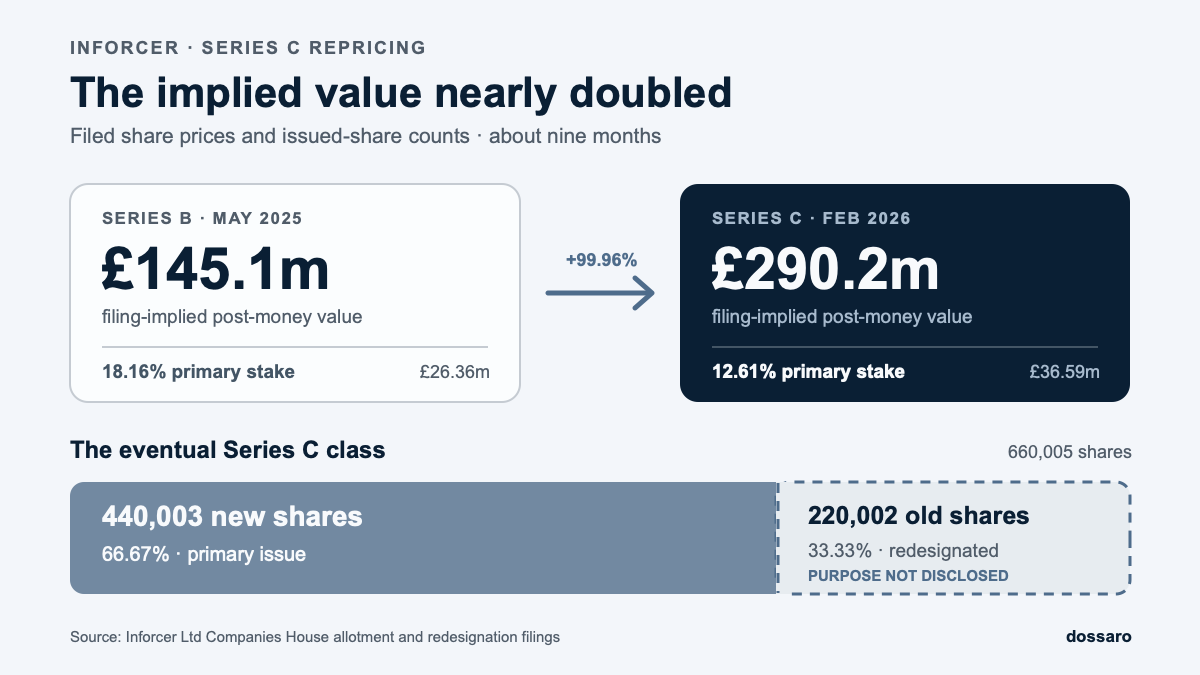
Source record available
INFORCER LTD · 14146319
Open the legal identity and 5 reviewed filings behind this analysis.
Inforcer's filed Series C nearly doubled the company's implied post-money value in about nine months, from £145.1 million to £290.2 million. The $50 million round bought 12.61% of the post-round issued shares on the primary terms disclosed at Companies House.
That was only part of the transaction's legal footprint. Two separate filings show 220,002 existing ordinary shares were redesignated into Series C. Those old shares became effectively one-third of the eventual 660,005-share preferred class, alongside 440,003 newly issued shares.
For private-market readers, the combination matters more than the funding headline alone. Existing holders received a sharp paper step-up, new money bought a smaller proportion of the company than in the prior round, and a material block of old shares moved into the new senior class. The filings do not identify whose shares changed class, whether money changed hands or why the redesignations occurred.
| Filed round economics | Series B, May 2025 | Series C, February 2026 |
|---|---|---|
| Newly allotted shares | 527,006 | 440,003 |
| Price per share | £50.0134 | £83.1696 |
| Calculated primary cash | £26.36m | £36.59m |
| Primary stake in post-round issued shares | 18.16% | 12.61% |
| Filing-implied post-money value | £145.11m | £290.17m |
The table translates the round into ownership terms. Inforcer raised about £10.2 million more primary cash than in its Series B while issuing fewer shares. The price per share rose 66.29%, and the implied post-money value increased 99.96%.
The $50m Headline Bought 12.61% On Filed Terms
Tech.eu reported on 30 July that Inforcer raised $50 million in a Series C led by Insight Partners, with existing investors Meritech Capital and Dawn Capital participating. The company said it would use the capital to expand its Microsoft security and artificial-intelligence management platform for managed service providers.
The Companies House filing history supplies the transaction arithmetic. A return of allotment records 440,003 Series C shares issued on 9 February 2026 at £83.1696 each. That produces £36,594,873.51 of calculated primary consideration, approximately the reported $50 million.
The same filing shows 3,488,858 shares in issue after the allotment. The new Series C shares therefore represented 12.6117% of the post-round issued total. Multiplying the share price by the post-round count gives an implied £290.17 million post-money value and a £253.57 million pre-money value.
These are filing-derived values, not a company-announced valuation. They assume the Series C subscription price can be applied across the issued-share denominator. Different share classes can carry different rights, and a fully diluted calculation would also need options, warrants or other instruments that are not captured by a simple issued-share count.
Even with that boundary, the comparison is useful because the same method can be applied to the prior round. In May 2025, Inforcer allotted 527,006 Series B shares at £50.0134. That issue raised £26.36 million and represented 18.16% of the 2,901,478 post-round shares, implying a £145.11 million post-money value.
The result is a clean repricing signal. In roughly nine months, the price paid for each new share rose by two-thirds, while the implied post-money value almost exactly doubled.
One-Third Of Series C Came From Old Shares
The primary issue created 440,003 Series C shares. It did not create the whole Series C class visible after the later filings.
An SH08 filed in March says 191,736 ordinary shares were redesignated as Series C effective 9 February, the same effective date as the primary allotment. A second SH08 filed in July records another 28,266 ordinary shares redesignated as Series C effective 2 July.
| Final Series C composition | Shares | Share of class | What the filing establishes |
|---|---|---|---|
| Newly allotted Series C | 440,003 | 66.67% | New primary shares issued at £83.1696 |
| Existing ordinary shares redesignated | 220,002 | 33.33% | Old shares moved into the Series C class |
| Eventual Series C class | 660,005 | 100.00% | Combined new and redesignated shares |
The class composition is effectively two-thirds new shares and one-third old shares. That makes the Series C broader than a clean block of newly issued growth capital.
It does not make the old shares a proven secondary transaction. A redesignation changes the legal class attached to an existing share. It does not by itself show a sale, a buyer, a seller or consideration. The old shares could reflect a rights conversion, internal reclassification or another implementation step agreed alongside the financing.
That distinction is central. Dossaro's analysis of Risk Ledger's Series B similarly separates newly issued capital from ownership changes that require their own documentary proof. In Inforcer's case, the filings prove the conversion but stop before its economic allocation.
The New Class Also Changed Downside Priority
The articles adopted after the February allotment give Series C more than a different label. They grant the Series C investor majority a director appointment right and place the class ahead of ordinary and B ordinary shares in the distribution waterfall.
On a liquidation or return of capital, Series C holders are entitled to the greater of their preference amount or the proceeds they would receive on an as-converted basis. That structure gives the class a contractual floor relative to junior ordinary capital while preserving participation if conversion produces the better outcome.
| Series C feature | Filed effect | Commercial consequence |
|---|---|---|
| Investor-director right | Series C investor majority can appoint a director | Governance influence is attached to the class |
| Liquidation preference | Greater of preference amount or as-converted proceeds | Downside priority before ordinary and B ordinary |
| Old-share redesignation | 220,002 ordinary shares moved into Series C | Some pre-existing shares obtained the new class rights |
The last row is why the missing holder allocation matters. A class conversion can change payout priority even without changing the total number of shares in issue. If old ordinary shares acquired Series C rights, the conversion shifted their contractual position relative to the junior classes.
The filings do not show which holders received that shift. Inforcer's January 2026 confirmation statement listed more than 100 holders. Dawn and Meritech already appeared across earlier share classes, while founders Jamie Daum and Richard Thompson retained material historical positions. None of that identifies the 220,002 redesignated shares. Assigning the conversion to a named party would exceed the evidence.
Existing Holders Won The Repricing, But Allocation Is Unknown
The primary economics are favourable to the pre-round capital as a group. The Series C price implies that existing issued shares entered the round at a £253.57 million pre-money value. That is about £108.46 million above the Series B post-money reference derived nine months earlier.
This is a paper revaluation, not cash proceeds. Existing holders benefit from a higher price assigned to the company's shares, but they receive liquidity only if some of their shares are sold or redeemed. The reviewed filings do not establish either event.
The $50 million headline also should not be treated as a precise exchange-rate reconciliation. The filed £36.59 million primary amount is close enough to confirm the scale and identity of the round. The company announcement and the Companies House return use different currencies and can reflect different timing conventions.
The fair counterposition is straightforward. Converting old shares into the new preferred class can be a routine way to align investor rights. Insight's new capital may support a larger and more valuable business, while the preference and governance rights compensate investors for funding the next stage. The register reveals the structure, not whether any party secured an unfair bargain.
The Next Holder Filing Will Explain The Conversion
The current evidence produces a defined set of answers and a narrower set of open questions.
| Question | Current answer | Decision-changing evidence |
|---|---|---|
| What did the primary issue buy? | 12.61% of post-round issued shares | Filed Series C allotment |
| How far did the price move? | 66.29% per share; implied post-money nearly doubled | Series B and Series C allotments |
| How was Series C composed? | Two-thirds new shares, one-third redesignated old shares | Two SH08 filings plus the SH01 |
| Who held the redesignated shares? | Not disclosed | Post-round confirmation statement or shareholder register |
| Did any holder receive cash? | Not established | Transaction schedule or investment agreement |
A post-Series-C confirmation statement is the most useful next public document. It could identify the holders of the 660,005 Series C shares and show whether the redesignated block sits with earlier institutions, founders, employees or another group. A transaction schedule would still be needed to prove consideration or a secondary sale.
Until then, the durable finding has two parts. Inforcer's filed primary Series C nearly doubled its implied post-money value to £290.2 million while selling 12.61% of post-round issued shares. Separately, 220,002 old ordinary shares entered the Series C class and became one-third of that preferred block.
That leaves the underwriting question the funding announcement cannot answer: was the old-share conversion only technical alignment, or did it redistribute valuable preference and governance rights among existing holders? Researchers can preserve the next evidence through Dossaro's company-register document workflow before using the private-company ownership workflow to compare the holder state.
Continue reading
Related Research
Risk Ledger's £24m Round Put Axiom Ahead Of Its Founder
UK filings show Axiom became Risk Ledger's largest individual shareholder as £18.5m of cash allotments trailed the announced £24m Series B headline.
Greyparrot's Series B Shifts A Sub-£120m Sale Shortfall To Founders
Greyparrot's filed terms protect Series B as if a founder-led sale valued the company at £120m, with any shortfall deducted from founder proceeds.
ZuriQ's $25.5m Seed Created A 28.6% Preferred Block
ZuriQ's $25.5m seed closed legally in May, creating a 28.6% preferred block and adding a Quantonation-linked director before its July reveal.
CuspAI's Founders Held 32.61% Before The $450m Series B
CuspAI's founders held 32.61% before its $450m Series B, while UK sovereign capital entered a company whose post-round ownership is not yet public.