
Kinematic Trees' £585k Round Coincided With A Board-Control Reset
Kinematic Trees issued 185,714 ordinary shares for £584,999.10, about 15.7% post-money, as a founder's registered majority-board right disappeared.
On this page
Conduct your own private market research
Add dossaro to Claude or ChatGPT and run source-backed register research from your own workspace.
 Add to Claude
 Add to ChatGPT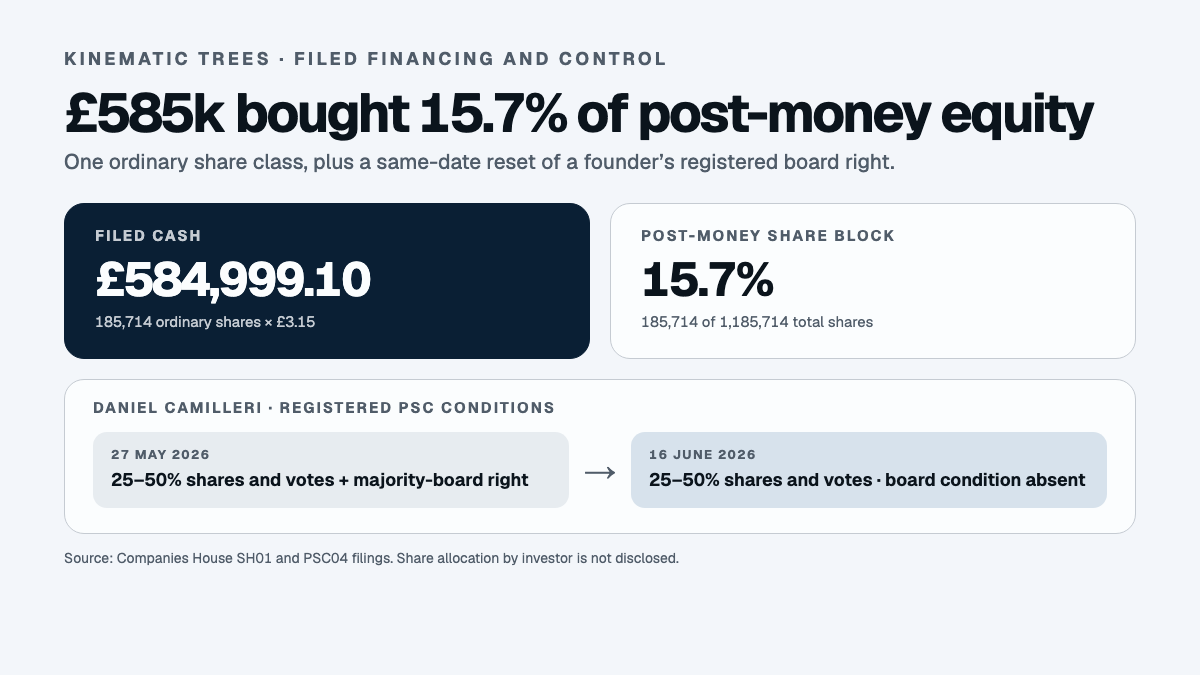
Kinematic Trees issued 185,714 ordinary shares at £3.15 each in June 2026, raising £584,999.10. That filing matches the robotics software company's announced £585,000 pre-seed round to within 90 pence and puts the new shares at about 15.7% of its post-money equity.
The same effective date brought a separate control change. Daniel Camilleri's earlier person-with-significant-control filing included the right to appoint or remove a majority of the board. The replacement filing effective 16 June retained his 25-50% share and voting bands but no longer listed that board right.
Together, the filings show a clean equity financing and a formal governance reset. They do not show that the investors acquired board control, that either founder lost practical influence, or how the new shares were divided among Haatch's SEIS Fund, the D2N2 Early-Stage Angel Investment Fund and the British Business Bank Syndicate Fund.
The Share Issue Explains The £585k Headline
Prolific North reported on 29 July that Kinematic Trees had raised £585,000. The company said it would use the money to build commercial, robotics and software-engineering teams across Sheffield, London and Nottinghamshire while preparing customer factory deployments.
The Companies House filing history provides the legal mechanics. An SH01 filed on 23 June records 185,714 ordinary shares allotted between 15 and 16 June. Each share had £3.15 paid and nothing unpaid.
Multiplying the count by the price gives £584,999.10. The 90-pence gap to the public £585,000 number is immaterial and strongly supports reading the filing and the announcement as the same financing.
| Financing and control measure | Before the round | Effective 16 June 2026 | Filed result |
|---|---|---|---|
| Ordinary shares | 1,000,000 | 185,714 new shares | 1,185,714 total |
| Cash paid for new shares | Not applicable | 185,714 × £3.15 | £584,999.10 |
| New-share percentage | 0% | 185,714 ÷ 1,185,714 | About 15.7% post-money |
| Daniel Camilleri PSC conditions | 25-50% shares and votes, plus majority-board appointment or removal right | 25-50% shares and votes | Board condition no longer listed |
The share percentage is also unusually clean for a public filing. Before the allotment, two subdivisions had turned the company's original capital into one million ordinary shares. The new 185,714-share block therefore represented 15.6631% of the enlarged total, rounded to 15.7%.
That is the collective new-money block, not any one investor's stake. The SH01 does not name subscribers. It would be wrong to assign a percentage to Haatch, D2N2 or the British Business Bank fund without the register of members or subscription schedule.
Investors Bought One Ordinary Class
The SH01 describes one ordinary share class. Its prescribed particulars say the shares carry full voting and dividend rights, pro-rata capital distribution rights and no preferential redemption, dividend or winding-up claim.
That makes the filed structure different from many venture rounds in which new capital enters through a senior preferred class. There is no visible liquidation preference in this statement of capital and no price ladder between several classes. On the face of the filing, new and existing shares participate through the same ordinary class.
The absence of a preference class should not be stretched too far. An investment agreement can still reserve board nominations, consent rights, information rights or transfer restrictions without creating a different share class. The public filing answers the share-rights question but not every contractual governance question.
For the founders, ordinary equity preserves participation in the same class while accepting dilution. For the incoming syndicate, it means the visible protection comes from ownership and votes rather than a senior economic waterfall. That can align holders in a strong outcome, while leaving more of the downside and decision-right bargain to private contracts.
The distinction matters because public-backed and tax-advantaged funding participated in the round. The British Business Bank describes its syndication work with Haatch as a way to increase early-stage capital available across the UK. But public programme involvement does not reveal the investment instrument or allocation inside one specific company. Here, the SH01 establishes ordinary equity and the aggregate price, nothing more.
One Founder's Registered Board Right Disappeared
The clearest governance change sits in two PSC04 filings for Daniel Camilleri.
The first filing, effective 27 May and filed on 3 June, recorded three conditions: more than 25% but no more than 50% of shares, the same band of voting rights, and the right to appoint or remove a majority of the board.
The replacement, filed on 11 August but effective from 16 June, kept only the 25-50% share and voting bands. The board-majority condition was no longer listed. A separate replacement for co-founder Stuart Wilson, also effective 16 June, recorded the same 25-50% share and voting bands without a board appointment condition.
That change is narrower than saying Camilleri lost control of the company. A PSC filing records whether specified statutory conditions apply. It does not publish the board roster, a shareholders' agreement or the practical influence of a founder who remains a director and substantial shareholder.
Nor does the filing show that the removed right moved to an investor. The company may have replaced a unilateral founder power with an ordinary board arrangement, negotiated investor consent, or another structure that does not itself create a registrable PSC condition. The public evidence establishes the deletion, not the recipient or motive.
This is the same interpretive discipline required in Cytix's financing-linked control reset. Falling out of a PSC condition, or losing one condition while retaining others, describes the public legal threshold. It does not by itself settle who wins a board vote.
The Timing Connects Financing And Governance, Not Causation
The date alignment is important. The new shares were allotted across 15 and 16 June. Both replacement PSC conditions were effective on 16 June. That supports treating the capital and governance changes as parts of the same closing sequence.
It does not prove why the governance condition changed. The financing could have required a broader board, the founders could have reorganised their existing arrangement, or the change could have corrected how an earlier right was reported. None of those explanations is available in the public forms.
The economically useful conclusion is therefore structural. Kinematic Trees raised almost exactly its announced amount through ordinary equity, giving the new-money block about 15.7% of post-money shares. At the same time, the register stopped showing one founder with a unilateral majority-board appointment or removal right.
That combination made the public control record less dependent on one unusually strong founder condition without exposing a preferred investor class. It is a meaningful shift from founder-centric formation towards institutionally financed governance, but it is not evidence of an investor takeover.
The Missing Documents Would Show Who Received Influence
Two documents would complete the story.
The register of members or subscription schedule would allocate the 185,714 shares among the named funding channels and show whether either founder transferred existing shares alongside the new issue. The executed shareholders' or investment agreement would identify board nomination rights, reserved matters and any consent thresholds negotiated at closing.
Those records could also explain whether the two founders remained economically balanced inside their 25-50% bands. PSC bands are too broad to establish exact holdings, and the SH01 contains no shareholder names.
Until that evidence appears, the filing supports a precise conclusion. Kinematic Trees' £585,000 pre-seed was almost perfectly visible as cash ordinary equity, and it represented about 15.7% of the enlarged company. The round coincided with the removal of a founder's registered board-majority right, but the public record stops before showing where that influence went.
Continue reading
Related Research
Cytix's $7m Series A Reset Its Registered Control
Cytix's $7m Series A ended both founders' significant-control status, added Northern Gritstone to the board and followed a £1m convertible bridge.
QUICKBLOCK's £940k Funding Was Also A Recapitalisation
QUICKBLOCK raised £940,000 after reporting £534,213 of net liabilities. Filings map £638,571 to equity, leaving about £301,429 as implied grants.
Edgify's New Class Can Turn 16% Of Equity Into 36.5% Of Votes
Edgify's authorised Seed Prime class can represent 16.1% of equity but 36.5% of votes, while Rank and Mangrove receive specific governance rights.
Callosum's $100m Seed Put 24.1% of the Holdco Into a New Preferred Class
Callosum's $100m seed maps to a filed £57.20m Series Seed 2 issue for 24.1% of its holdco, while Atomico and Plural-linked directors joined the board.