
Callosum's $100m Seed Put 24.1% of the Holdco Into a New Preferred Class
Callosum's $100m seed maps to a filed £57.20m Series Seed 2 issue for 24.1% of its holdco, while Atomico and Plural-linked directors joined the board.
On this page
Conduct your own private market research
Add dossaro to Claude or ChatGPT and run source-backed register research from your own workspace.
 Add to Claude
 Add to ChatGPT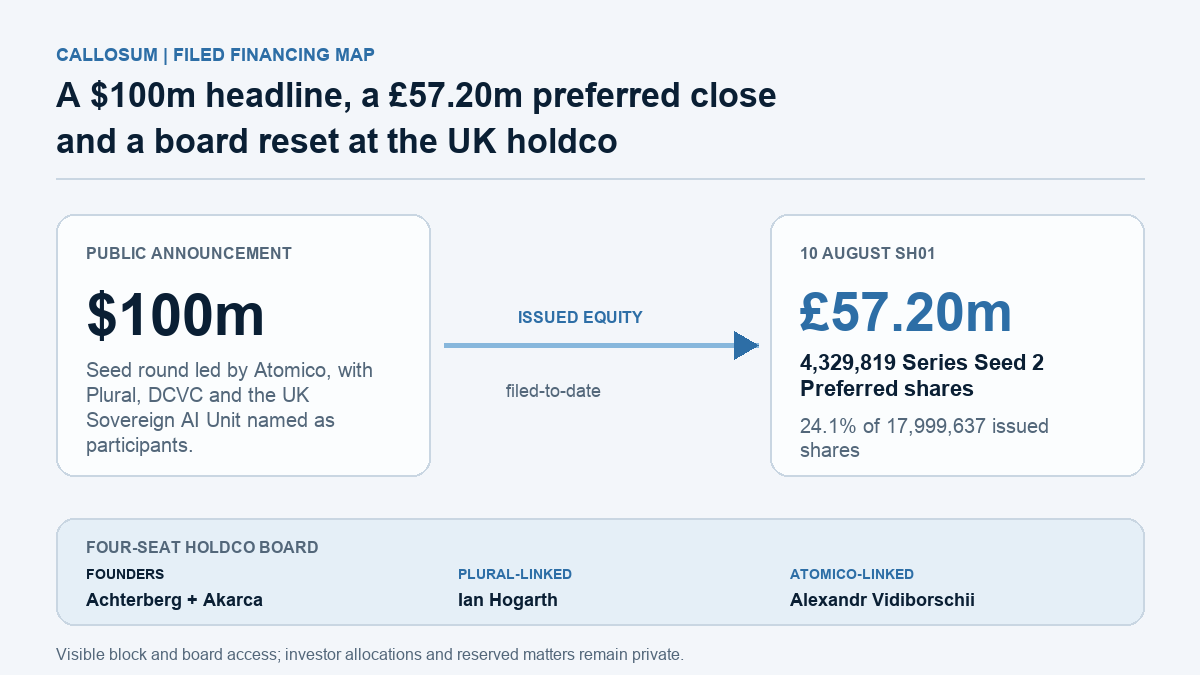
Callosum's $100 million seed round looks different when the financing company's filings are put beside the announcement. The latest share allotment at Callosum Technologies Ltd records £57.20 million of cash for a new preferred class equal to 24.1% of the resulting issued shares.
The same financing period changed the board. Two people publicly associated with Atomico and Plural joined the two founders on a four-seat board. That gives the new capital board-level access, but the filings do not establish investor control or disclose which institution owns which part of the new class.
The finding is not that Callosum's $100 million headline is wrong. A round can close in tranches, combine instruments or include commitments that are not yet allotted. The narrower point is more useful for investors: the public record shows a £57.20 million preferred-share close, a 24.1% issued-share block and a new board configuration at the UK holdco that sits above the operating company.
The filed close is smaller than the headline, but large enough to reset the denominator
Callosum announced the seed on 20 August 2026, describing a $100 million round led by Atomico with significant participation from Plural, DCVC and the UK Sovereign AI Unit. The company said the capital would support software that matches artificial-intelligence workloads to computing hardware. Bloomberg Law independently reported the round and its headline size.
Companies House records for Callosum Technologies Ltd tell a more specific capital story. On 10 August, the holdco reported 4,329,819 Series Seed 2 Preferred shares allotted between 24 June and 8 July at £13.21 cash per share. The arithmetic is straightforward:
| Filed position | Shares or cash | What it changes |
|---|---|---|
| Shares before Series Seed 2 | 13,669,818 | Existing ordinary and Series Seed holders' base |
| New Series Seed 2 Preferred | 4,329,819 | New class added in the June-July closing window |
| Shares after the allotment | 17,999,637 | Post-issue issued-share denominator |
| Registered cash for the new class | £57,196,908.99 | Filed-to-date cash, not a claimed full-round total |
| New class as a share of issued capital | 24.055% | Simple issued-share dilution for earlier holders |
Every earlier holder therefore owns a smaller percentage of the issued-share count after this allotment. The 24.1% figure is a share-count calculation, not a fully diluted ownership percentage. The preferred class has distribution-priority mechanics and one vote per share, while the amended articles contain the complete rights package.
That distinction keeps the comparison honest. The filed amount is in pounds and the announcement is in dollars. The public record does not say whether the difference reflects exchange rates, a later tranche, commitments, grants, another instrument or a different measurement date. It does show exactly what was allotted and paid for in the reported close.
Callosum built the financing in a new UK parent
The holdco was incorporated on 13 August 2025, shortly before the first major capital steps. A 26 August 2025 allotment issued 8,999,998 ordinary shares for non-cash consideration described as the legal and beneficial ownership of shares in SERNN, Inc. That structure placed the operating business under Callosum Technologies Ltd before the later cash financings.
The 9 September 2025 allotment then added 3,043,301 Series Seed shares for £1.36 each and 803,556 Series Seed shares for non-cash consideration described as SAFE conversion. Further cash allotments followed in February and March 2026. By the time the Series Seed 2 class arrived, the holdco had 13,669,818 issued shares.
Callosum's operating company record is therefore not the whole financing perimeter. The new preferred class sits in the parent that became the operating company's corporate person with significant control in August 2025. For diligence, the legal-entity choice matters: the round's dilution and governance entry are visible at the holdco, while the product and team are described at the Callosum operating-company level.
This is the same analytical problem that appears in Amber's concentrated Series A issuance. The funding announcement supplies the event and participants. The registered allotment shows which legal entity issued the equity and how far the denominator moved. Those are different pieces of the financing map.
Two investor-linked directors joined the founders
The capital reset was accompanied by a board change. Companies House filings dated 6 August record the appointments of Ian Hogarth and Alexandr Vidiborschii. Hogarth is publicly listed by Plural, while Vidiborschii appears on Atomico's investment team. Their appointments put two investor-affiliated individuals beside Callosum's two founders, Jascha Achterberg and Danyal Akarca.
The board is therefore evenly split by role on the public record: two founders and two people associated with the lead and participating venture firms. That creates board-level access for the new financing group. It does not, on its own, prove a majority of voting directors, reserved-matter rights, a casting vote or unilateral control. The filings identify the people and their appointment dates, not the shareholder agreement behind the appointments.
The timing is commercially relevant. The director appointments were filed shortly after the allotment window for the Series Seed 2 shares. The documents do not state whether the board rights were a condition of the round, part of a broader governance reset or an existing contractual right being exercised. They do show that capital and board composition changed in the same financing cycle.
For a venture investor, that is a more concrete diligence point than the headline round size. A quarter of issued shares with a preferred distribution position can influence future financings even when the investor allocations are private. A four-person board can make information flow and strategic consent more immediate, while still leaving control questions unresolved.
The ownership question is narrower than the headline question
The public announcement names Atomico, Plural, DCVC and the UK Sovereign AI Unit, but the Series Seed 2 SH01 does not allocate the 4,329,819 shares among them. It is therefore safe to describe the class as a 24.1% issued-share block and to connect the board appointments to named people with public ties to Atomico and Plural. It is not safe to assign a percentage to any one investor or to say the UK Sovereign AI Unit owns a particular part of the class.
The same boundary applies to the $100 million figure. The registered £57.20 million is a filed amount for one class and closing window. It is not evidence of a funding shortfall, and adding the earlier public $10.25 million announcement to it would manufacture a total without knowing the instruments and dates that each announcement covers.
The next decision-changing records are specific: a post-round shareholder list, the amended articles in readable form, and any shareholder or subscription agreement that sets allocation, preference and board rights. Those documents would answer what the 24.1% class means economically, whether further shares were committed but not allotted, and how the two investor-linked directors operate within the four-seat board.
Callosum's financing is already legible at one level. A new UK holdco issued a preferred class for £57.20 million, the class represents 24.1% of the resulting issued shares, and two investor-linked directors joined the founders. The unresolved question is no longer whether the seed changed the cap table. It is how the private rights package turns that visible block and board access into economic and governance power.
Continue reading
Related Research
Amber's €7m Series A Put 99.19% of New Shares With Two Institutions
Amber's €7m Series A created 11,113 shares: Ventech and NRW.BANK took 99.19%, lifting their combined holding to 36.09% and diluting three founder vehicles.
SoftBank's $200m Gravis Round Created A 12.63% Series A Class
Gravis's $200m SoftBank round created a Series A class equal to 12.63% of nominal shares and added two board members, not a takeover.
Kinematic Trees' £585k Round Coincided With A Board-Control Reset
Kinematic Trees issued 185,714 ordinary shares for £584,999.10, about 15.7% post-money, as a founder's registered majority-board right disappeared.
Nexeon's £100m Round Added Capital Around an Existing KDB Stake
Nexeon's £100m investment round added capital around an existing KDB preference stake, while staged allotments leave the latest recipients unnamed in filings.