
Amber's €7m Series A Put 99.19% of New Shares With Two Institutions
Amber's €7m Series A created 11,113 shares: Ventech and NRW.BANK took 99.19%, lifting their combined holding to 36.09% and diluting three founder vehicles.
On this page
Conduct your own private market research
Add dossaro to Claude or ChatGPT and run source-backed register research from your own workspace.
 Add to Claude
 Add to ChatGPT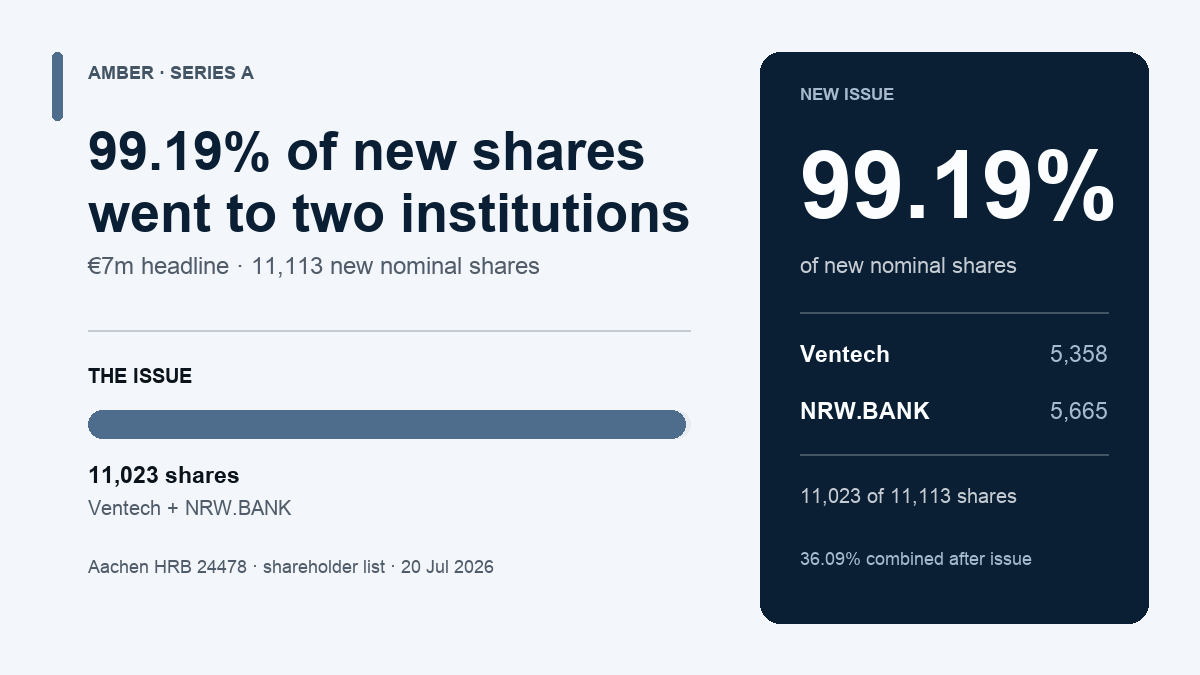
Amber’s €7 million Series A changed its ownership map before most readers could see it. A shareholder list filed for amber Tech GmbH records 11,113 new nominal shares. Ventech Capital VI S.L.P. subscribed 5,358 of them and NRW.BANK subscribed 5,665. Together, the two institutions took 11,023 shares, or 99.19% of the new issue.
That concentration gives the funding announcement a sharper commercial meaning. Ventech’s registered holding rose to 12,424 shares, or 24.79% of the company. NRW.BANK appears as a direct 5,665-share holder, equal to 11.30%. Their combined registered position is 36.09% after the issue. The three founder vehicles remained the largest bloc together, but their combined position fell from an implied 65.36% before the issue to 50.87% after it.
The filing points to primary issuance and dilution, not a founder secondary sale. It does not publish the subscription price, share premium, liquidation preferences or any shareholder agreement. Those missing terms determine the economic value of the percentages. The ownership direction is nevertheless clear: almost every newly created share went to the two institutional investors named alongside amber’s €7 million announcement.
A Series A With a Concentrated Share Issue
Amber’s announcement describes a €7 million Series A co-led by Ventech, an existing investor, and NRW.Venture, the venture arm of NRW.BANK. The company says the capital will fund expansion, hiring and its artificial-intelligence data layer. TechFundingNews independently reported the same round on 17 August 2026 and identified NRW.Venture as the NRW.BANK venture platform. The public narrative is a conventional institutional round. The filed share counts show how little of the new equity was spread beyond those two names.
| Holder or group | Before issue | New shares subscribed | After issue | Change in registered position |
|---|---|---|---|---|
| Ventech Capital VI S.L.P. | 7,066 shares, 18.11% implied | 5,358 | 12,424 shares, 24.79% | +6.68 percentage points |
| NRW.BANK | Not in the pre-issue list used here | 5,665 | 5,665 shares, 11.30% | New direct holder |
| Ventech plus NRW.BANK | 7,066 shares, 18.11% implied | 11,023 | 18,089 shares, 36.09% | +17.98 percentage points |
| Three founder vehicles | 65.36% implied | No registered sale identified | 50.87% implied | Dilution of 14.49 points |
| Total issued capital | €39,013 | 11,113 new shares | €50,126 | 28.48% nominal-capital increase |
The arithmetic is the central finding. The new issue represented 11,113 of 50,126 post-round shares. Ventech and NRW.BANK received 11,023 of those shares, leaving 90 for two existing holders: 36 shares for FROG VISION GmbH and 54 for Biosimab UG. Their share of the new issue was 0.81% combined. The round therefore added institutional capital and moved the founder bloc toward a threshold without requiring a disclosed sale by those founders.
This is the same distinction visible in Gravis Robotics’ registered Series A class: the funding headline names the financing event, while the holder list shows who received the equity and which class or position is actually visible. Amber’s list is unusually concentrated. It makes the allocation question answerable even though the broader rights package remains private.
The public-bank stake is direct and measurable
NRW.Venture’s role in the announcement could be read as a fund relationship. The shareholder list gives NRW.BANK itself a measurable position. At 5,665 of 50,126 issued shares, the bank holds 11.30% on the registered nominal-share basis used by the filing. That is not a statement about voting agreements, preferred economics or a separate feeder vehicle. It is a direct recorded holding in the company named in the list.
The distinction matters for diligence. A venture arm can provide a route into public-backed capital while leaving the investment vehicle one step removed from the operating company. Here the registered line points to the bank. The economic question is no longer whether public capital is part of the round. It is what rights and conditions sit behind an 11.30% position in a fast-growing German artificial-intelligence business.
The filing also shows that Ventech did not simply retain its earlier position. The investor held 7,066 shares before the issue and subscribed another 5,358. Its stake moved from an implied 18.11% to 24.79%. Combined with NRW.BANK, the two institutions became a 36.09% block. That does not establish control, but it changes the bargaining map for future financing, board appointments and any transaction that depends on investor consent.
Dilution moved the founders toward a threshold
The three founder vehicles named in the shareholder list are Manaj QuickPiq amberRoad UG, Reissinvest UG and Aras Beteiligungsgesellschaft UG. Their combined registered position fell from an implied 65.36% before the issue to 50.87% after it. The list identifies dilution through new shares, not a transfer of their existing holdings.
That direction is commercially different from a founder cash-out. A secondary sale would move shares from a founder vehicle to a buyer. Amber’s filing instead expands the denominator and gives nearly all of the new equity to the institutions. The founders still sit above 50% together on the nominal-share calculation, but the margin is materially thinner. Any future issue, option pool or consent right could therefore carry more weight than the €7 million headline suggests.
The public sources provide a straightforward business explanation for the financing. TechFundingNews says amber plans expansion into the Benelux and Nordic markets and reports that Ventech first backed the company with a €2.1 million seed round in March 2025. NRW.Venture’s entry brings a public-backed investor into the next growth phase. A concentrated primary issue can be an efficient way to fund that plan while preserving a founder majority on the registered share count.
That explanation does not answer the rights question. The 2025 YPOG deal note records Ventech’s earlier seed financing, but the current subscription agreement and amended shareholder arrangements are not public in the sources reviewed here. The cap table establishes who subscribed. It does not establish liquidation preference, veto rights, board seats, anti-dilution protection or the price paid above nominal value.
The next document will decide what 36.09% means
Amber’s Series A is therefore a financing and threshold story, not simply a €7 million announcement. The share capital rose from €39,013 to €50,126. Nearly all 11,113 new shares went to Ventech and NRW.BANK. Their combined nominal holding reached 36.09%, while the three founder vehicles were diluted to 50.87% without a registered sale.
The remaining evidence boundary is narrow but important. The shareholder list does not state the issue price or the rights attached to the new shares, so the nominal percentages cannot be read as a full economic ownership schedule. Nor do they prove that the founders can pass every future decision with 50.87% if a shareholder agreement sets higher consent thresholds.
The next decision-changing records are the subscription agreement, an amended shareholder agreement and the share-premium documentation. They should show whether NRW.Venture invests through the bank directly, which preferences sit behind the new shares and how the founders’ remaining majority works in practice. Until those terms appear, the hard finding is the allocation: amber’s public €7 million round put 99.19% of its new registered shares with two institutions and moved the founder bloc to the edge of a new ownership threshold.
Continue reading
Related Research
SoftBank's $200m Gravis Round Created A 12.63% Series A Class
Gravis's $200m SoftBank round created a Series A class equal to 12.63% of nominal shares and added two board members, not a takeover.
OLIX's $312m Round Diluted The Founder Stake Behind The £946m Headline
OLIX's $312m Series B diluted James Dacombe from 38.6% to about 34.1%, while 110,203 growth shares make part of the stake hurdle-dependent.
Mindgard’s $30m Round Followed A Founder Threshold Drop And A US Subsidiary Pledge
Mindgard raised a $30m Series A after its founder fell below the UK PSC threshold and First Citizens took security over its entire US subsidiary.
Flip's €22m Round Left A 10.8% Nominal Equity Signal
Flip's €22m financing followed a €6,115 legal-capital increase, revealing a 10.8% nominal equity signal without exposing investor-level economics.