
Flip's €22m Round Left A 10.8% Nominal Equity Signal
Flip's €22m financing followed a €6,115 legal-capital increase, revealing a 10.8% nominal equity signal without exposing investor-level economics.
On this page
Conduct your own private market research
Add dossaro to Claude or ChatGPT and run source-backed register research from your own workspace.
 Add to Claude
 Add to ChatGPT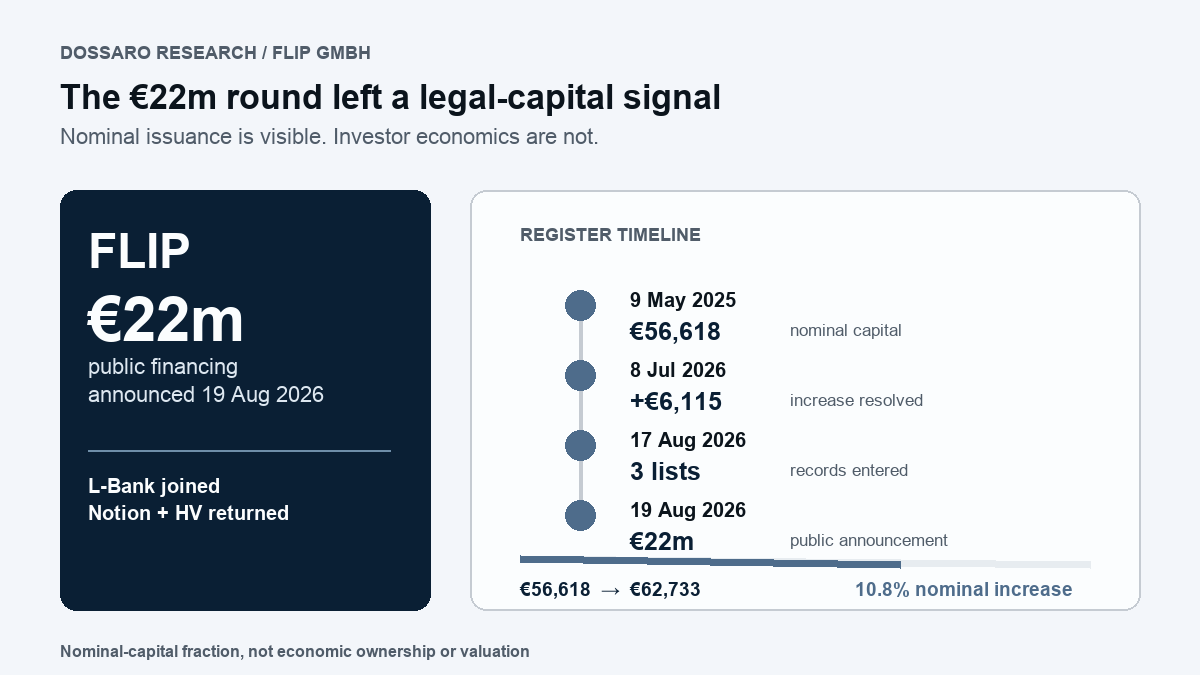
Flip's €22 million financing arrived in public on 19 August. The legal signal appeared earlier. A Stuttgart register extract records a €6,115 nominal-capital increase resolved on 8 July, lifting Flip GmbH's nominal capital from €56,618 to €62,733. That is a 10.8% increase on the pre-issue nominal base, before any share premium.
The chronology makes the round more than a press release, but it does not make the cap table public. EU-Startups says existing backers Notion Capital and HV Capital expanded their stakes and that L-Bank joined as a new investor. The register supports a visible primary-equity event around the same financing window. It does not say which investor subscribed, what price was paid above nominal value or whether the €22 million also included a convertible, secondary transfer or another instrument.
That distinction is the commercial finding. Flip has a hard legal-capital marker for the round, but the economic allocation remains behind the shareholder-list documents.
The public round and the legal close are different dates
EU-Startups reported that Stuttgart-based Flip raised €22 million to build AI infrastructure and knowledge tools for frontline workers. Notion Capital and HV Capital were described as returning investors, while L-Bank, the development bank of Baden-Württemberg, joined the syndicate. The report places the financing after a €25 million 2025 Series A extension and an earlier raise of more than €26.5 million in 2022.
Notion Capital's earlier investment note provides independent context on the company's deskless-worker thesis. It describes Notion and HV as co-leads of Flip's 2022 Series A, alongside Cavalry, LEA Partners and angels. The 2026 announcement therefore combines follow-on support with a new public-bank participant, rather than presenting a first institutional financing.
The register timeline adds a legal date that the announcement does not foreground. The increase was resolved on 8 July, while three shareholder-list records were entered on 17 August according to the sourcing brief's document-index chronology. The public reveal followed two days later.
| Date | Evidence | What it establishes |
|---|---|---|
| 9 May 2025 | Nominal capital reached €56,618 | Pre-issue legal-capital baseline |
| 8 July 2026 | €6,115 increase resolved | A visible equity issuance before the announcement |
| 17 August 2026 | Three shareholder-list records entered | Ownership paperwork was updated close to the public reveal |
| 19 August 2026 | €22m round announced | Amount, returning investors and L-Bank entered public coverage |
The sequence does not prove that all four entries describe one closing step. It does show that the legal-capital movement and the public financing belong to the same narrow window.
The arithmetic is real, but it is not the cap table
Flip's nominal capital has moved through several visible increases. The structured extract records €35,018 after a €34,517 increase in 2020, €47,431 after a €12,413 increase in December 2021, €56,618 after a €9,187 increase on 9 May 2025 and €62,733 after the €6,115 increase resolved on 8 July 2026.
The latest movement is straightforward to calculate:
| Measure | Calculation | Result |
|---|---|---|
| Increase against pre-issue capital | €6,115 ÷ €56,618 | 10.8% |
| New units as share of post-issue capital | €6,115 ÷ €62,733 | 9.7% |
Those percentages describe nominal capital only. A German GmbH can issue shares at a premium, so the cash paid for the new units can be much larger than their nominal value. The €6,115 does not reveal the valuation, the price per unit, the subscription premium, the option pool or the percentage held by any named investor.
It would therefore be wrong to write that L-Bank bought 10.8% of Flip, that founders suffered 10.8% economic dilution or that the round valued the company at a multiple of nominal capital. The legal issue is a signal that equity entered the structure. It is not a substitute for the shareholder list or the subscription documentation.
The same reading discipline applies to Flip's authorised capital. The extract records authorised capital of up to €891 through 28 February 2027. That is future issuance capacity, not a promise that the company will use it, nor evidence of a reserved investor allocation.
A new investor is visible, but the new holder is not
The investor story has two layers. The public layer names Notion Capital and HV Capital as existing backers that expanded their stakes and L-Bank as a new investor. The legal layer shows the nominal-capital increase and later shareholder-list activity. The missing layer is the mapping between those facts.
The current evidence cannot establish whether L-Bank subscribed directly, through a vehicle, or alongside other investors. It cannot show whether the returning funds took all of the new units or whether part of their investment bought existing shares. It also cannot show whether the €22 million included convertible instruments that will only become equity later.
For Flip's founders and employees, the distinction matters because economic dilution depends on the fully diluted cap table, not the nominal increase. For investors, it matters because the rights attached to the new units and any premium determine priority and value. For a counterparty assessing the company, the round amount signals fresh backing while the legal-capital change confirms that at least one equity step was formalised.
This is similar to the timing problem in Callosum's seed financing, where the filed issuance and public round required separate dates and calculations. It also resembles Amber's NRW.Bank round, where a public financing could be tied to a legal issuance without exposing every economic term.
The next document decides the allocation question
The sourcing run requested Flip GmbH's exact profile and document index through Dossaro Dev. The German register profile and document-index requests timed out during this run, so no shareholder-list artifact was fetched into the Dossaro cache and no document ID is presented as parsed evidence here. The article relies on the completed brief's structured extract and chronology and keeps the claim boundary explicit.
The next decisive record is a readable 17 August shareholder list or the 9 July “Liste der Übernehmer” notarial-deed record. That artifact could identify the holders behind the new nominal units. A subscription agreement or closing filing could additionally reveal the premium, instrument mix and whether the €22 million was entirely primary capital.
Until then, the strongest supported conclusion is narrow: Flip's public €22 million round was accompanied by a €6,115 nominal-capital increase that raised legal capital by 10.8% before premium, while the investor-level economics remain undisclosed. The register has confirmed an equity signal. It has not yet published the ownership answer.
Continue reading
Related Research
Callosum's $100m Seed Put 24.1% of the Holdco Into a New Preferred Class
Callosum's $100m seed maps to a filed £57.20m Series Seed 2 issue for 24.1% of its holdco, while Atomico and Plural-linked directors joined the board.
Amber's €7m Series A Put 99.19% of New Shares With Two Institutions
Amber's €7m Series A created 11,113 shares: Ventech and NRW.BANK took 99.19%, lifting their combined holding to 36.09% and diluting three founder vehicles.
Volta's $300m Raise Had A 30.5x Nominal Share-Price Ladder
Volta's $300m raise hid a 30.5x nominal price ladder from $58 Seed shares to $1,769.91 Series A stock, plus preferred rights and $2m of debt set-off.
ZuriQ's $25.5m Seed Created A 28.6% Preferred Block
ZuriQ's $25.5m seed closed legally in May, creating a 28.6% preferred block and adding a Quantonation-linked director before its July reveal.