
Mindgard’s $30m Round Followed A Founder Threshold Drop And A US Subsidiary Pledge
Mindgard raised a $30m Series A after its founder fell below the UK PSC threshold and First Citizens took security over its entire US subsidiary.
On this page
Conduct your own private market research
Add dossaro to Claude or ChatGPT and run source-backed register research from your own workspace.
 Add to Claude
 Add to ChatGPT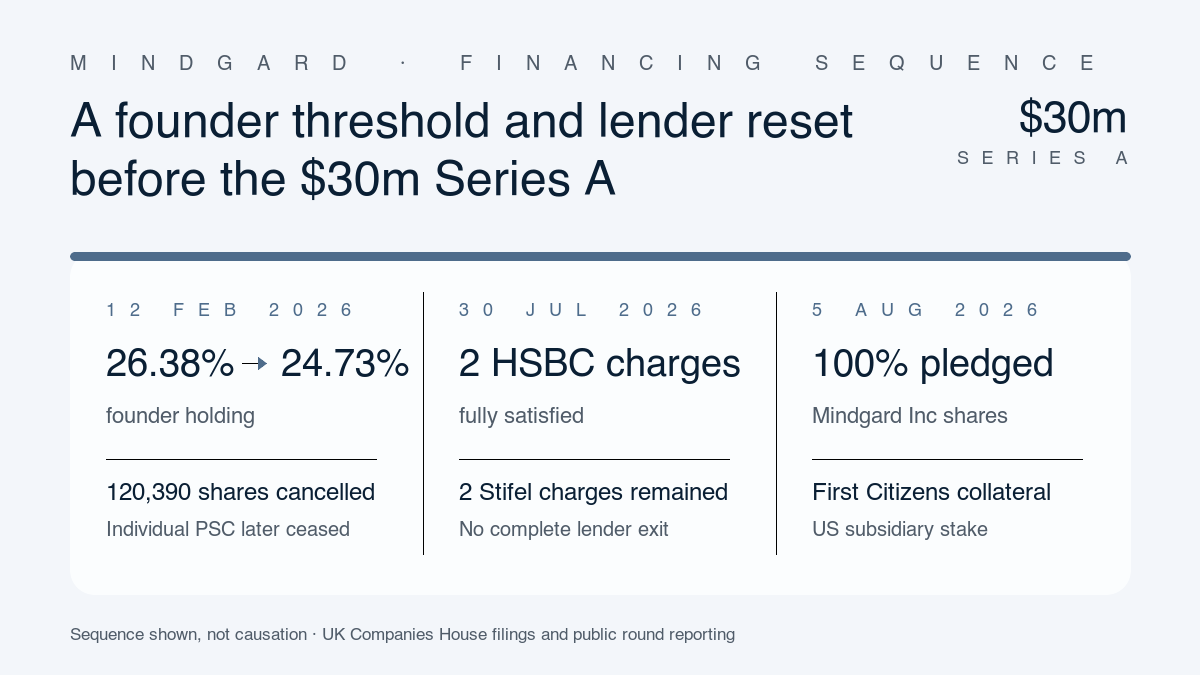
Mindgard raised a $30 million Series A after a six-month reset of its founder position and secured-creditor structure. Founder Peter Garraghan moved from 26.38% to 24.73% before ceasing to be a person with significant control. Two HSBC charges were later satisfied, two Stifel Bank charges remained outstanding, and First Citizens received a pledge over 100% of Mindgard's US subsidiary.
Those filings do not show that the ownership and lender changes caused or financed the round. They do show what the public funding announcement alone leaves out: the AI-security company entered its new financing phase with a different UK control disclosure and a fresh claim over its entire US corporate stake.
The reported Series A was led by Album VC. Karma Ventures, .406 Ventures, Atlantic Bridge, IQ Capital and Lakestar were also named. The first post-round allotment and confirmation statement were not public at the evidence cutoff, so the investors' exact new stakes and Garraghan's current percentage remain unknown.
A £0.01 Cancellation Took The Founder Below 25%
Mindgard's 2025 allotment filing recorded 3,468,035 shares in issue. Garraghan held 915,000 ordinary shares, equal to 26.3838%.
On 12 February 2026, the company bought back and cancelled 120,390 of Garraghan's ordinary shares for aggregate consideration of £0.01. It separately cancelled 134,950 deferred shares associated with Steve Street for another £0.01.
The two cancellations removed 255,340 shares, or 7.36% of the pre-cancellation total. Garraghan was left with 794,610 shares out of 3,212,695, equal to 24.7334%.
| Founder position | Before cancellation | After cancellation | Change |
|---|---|---|---|
| Peter Garraghan shares | 915,000 | 794,610 | -120,390 |
| Total shares in issue | 3,468,035 | 3,212,695 | -255,340 |
| Garraghan percentage | 26.38% | 24.73% | -1.65 percentage points |
| UK PSC position | Above 25% | Below 25% | Individual PSC ceased |
The nominal consideration should not be described as founder liquidity. A £0.01 aggregate payment is evidence of a capital reorganisation, not a meaningful cash exit. Nor was the threshold crossed through a conventional dilution event. Garraghan's own share count fell while the denominator also contracted.
The control consequence was still real. UK law uses more-than-25% ownership or voting thresholds among the conditions for identifying a person with significant control. Mindgard filed Garraghan's PSC cessation on 16 July and reported that the company no longer had a registrable person or relevant legal entity.
That does not mean nobody influences Mindgard. It means the public PSC test no longer identified a single registrable controller under the disclosed conditions. Shareholder agreements, board appointment rights and voting arrangements can distribute influence without producing a greater-than-25% holder.
The Public Register Shows A Lender Transition, Not A Clean Sweep
Mindgard's charge register contained five charges at the evidence cutoff. Three were outstanding and two had been satisfied.
The distinction prevents a tempting but inaccurate summary. HSBC Innovation Banking's two charges were cleared on 30 July. But two Stifel Bank charges created in October 2025 remained outstanding when First Citizens added a new charge in August 2026.
| Date | Secured creditor event | Public status | What it establishes |
|---|---|---|---|
| 10 Oct 2025 | Two Stifel Bank charges created | Outstanding | Earlier lender security remained on the register |
| 30 Jul 2026 | HSBC charges 0001 and 0002 satisfied | Satisfied | HSBC's registered security was released |
| 5 Aug 2026 | First Citizens stock pledge created | Outstanding | The bank received security over Mindgard Inc shares |
| 13 Aug 2026 | $30m Series A reported | Equity event | Timing is adjacent; funding linkage is not disclosed |
The charge sequence is therefore a creditor reset with overlapping layers, not proof that First Citizens replaced every previous lender. The public register does not disclose the outstanding balance under any facility or whether Stifel's security will later be released.
The separation between equity and lender documents also matters. A Series A issues or transfers equity interests. A bank charge gives a creditor collateral and enforcement rights. Dossaro found a similar distinction in Qureight's preferred-equity and HSBC security structure: two financing instruments can sit beside each other without one disclosing the economics of the other.
First Citizens Can Reach The Entire US Subsidiary Stake
The new instrument is a Stock Pledge Agreement dated 5 August 2026. Mindgard Ltd is the pledgor. First-Citizens Bank & Trust Company is the bank. Mindgard Ltd and Mindgard Inc are identified as borrowers under a separate loan and security agreement.
The filed exhibit states that Mindgard Ltd owns 100% of Mindgard Inc's issued and outstanding shares and voting rights. The UK parent pledged that entire position.
This is economically more specific than a broad all-assets label. The collateral is the parent's ownership of the US subsidiary. Following an event of default, the agreement gives the bank documented enforcement and sale rights over the pledged property, subject to the instrument's terms and applicable law.
For an AI-security company operating between London and Boston, the pledge puts the US corporate platform inside the lender's recovery perimeter. That can matter if customer contracts, employees, intellectual property or future revenue are concentrated in the subsidiary. The filing does not establish which assets sit there, so it cannot support a claim about how much of Mindgard's operating value is exposed.
It also does not disclose the First Citizens facility amount. The stock pledge references a separate credit agreement but does not state that the bank supplied any part of the $30 million round. Treating the debt and equity amounts as one financing package would invent a connection the public record does not provide.
The Round Arrived After Management Had Already Changed
The governance reset was not limited to the cap table. Mindgard appointed James Brear as chief executive in October 2025. Garraghan, a Lancaster University professor and the company's founding chief executive, moved to chief science officer.
The company's current profile presents Brear as CEO and Garraghan as founder and chief science officer. That division can be a normal scaling decision: an experienced commercial leader takes the executive role while the technical founder concentrates on product and research.
Placed beside the February share cancellations and July PSC change, however, it shows a broader transition before the Series A. The founder remained operationally central but no longer served as CEO, no longer held more than 25% on the last disclosed pre-round cap table and no longer appeared as an individual PSC.
None of those facts proves that new investors demanded the changes. The CEO appointment preceded the round by roughly ten months, and the cancelled shares were removed six months before the announcement. Corporate preparation often happens in stages, particularly when a company is expanding across jurisdictions and adding debt alongside institutional equity.
Existing Investors Returned, But The New Cap Table Is Missing
Mindgard's May 2026 confirmation statement named several existing holders that also appear in the Series A reporting, including .406 Ventures, IQ Capital and Lakestar. Karma Ventures and Atlantic Bridge were also named as round participants, while Album VC was described as the lead.
That continuity indicates that the round combined a new lead with support from prior backers. It does not reveal how much each investor subscribed, whether any existing shares changed hands or whether Garraghan's position fell further after the round.
An 835-share ordinary allotment filed in June is not the $30 million financing. Its small size and £0.001 nominal value establish only a limited pre-round issuance. No public SH01 at the evidence cutoff matched the scale or timing needed to reconstruct the Series A.
The absence matters because pre-round percentages cannot be carried forward. New preferred shares, option-pool changes, conversions or secondary transfers can all alter the post-money ownership. Applying the announced $30 million to the old share count would produce false precision.
The Strongest Benign Reading Is Preparation For Scale
The most straightforward counterposition is that Mindgard completed ordinary financing housekeeping. It simplified parts of the share structure, updated its PSC position, released HSBC security, retained existing Stifel arrangements and pledged the US subsidiary for a new bank facility. Then it announced a large institutional round to expand.
That reading may be correct. A lender taking collateral does not by itself indicate distress. A founder moving below 25% does not mean he lost all influence. And returning investors can view an experienced CEO, a technical founder and a bankable US structure as signs of maturity rather than conflict.
The commercial conclusion is narrower. Mindgard's $30 million announcement sits on top of a documented governance and security reset. Garraghan's last disclosed pre-round holding was 24.73%, HSBC's charges were gone, Stifel's were not, and First Citizens could look to the entire US subsidiary stake as collateral.
The next filings will determine how much that structure changed again. The first post-Series-A allotment or confirmation statement should reveal the new share classes and ownership distribution. An amended set of articles may expose investor rights. A First Citizens facility disclosure could put an amount on the debt. And any Stifel satisfaction filing would show whether the current lender overlap was temporary.
Until those documents arrive, the defensible finding is chronological rather than causal: Mindgard raised $30 million after its founder crossed below the public control threshold and after a new bank took security over 100% of its US subsidiary.
Continue reading
Related Research
Wordsmith's $114m Funding Sits Above A £1 UK Subsidiary
Wordsmith AI has announced $114 million of funding above a one-share UK subsidiary, while Ross McNairn's latest register state preserves founder control rights.
Qureight's $20m Round Sat Above Preferred Equity and HSBC Security
Qureight's $20m Series B followed a £2m senior C1 issue and four HSBC security filings, placing lenders and preferred capital ahead of older equity.
Cytix's $7m Series A Reset Its Registered Control
Cytix's $7m Series A ended both founders' significant-control status, added Northern Gritstone to the board and followed a £1m convertible bridge.
10x Banking's £40m Arrived After A Convertible Note Matured
10x Banking raised £40 million after a £25 million convertible note matured, leaving the old note, a 15% warrant and founder control terms unresolved.